

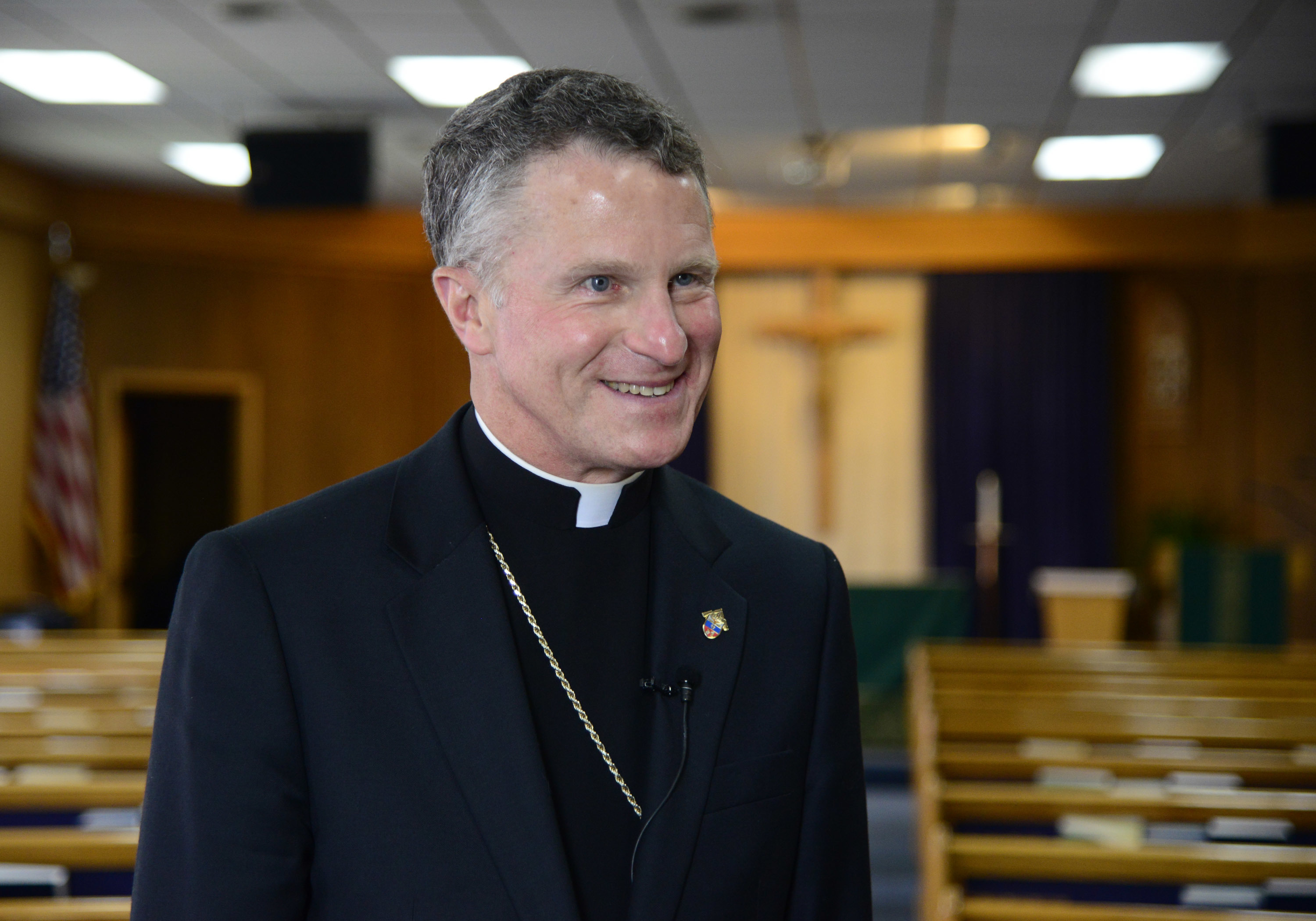
(ZENIT News / Washington, 04.07.2026).- As Washington deepens its military engagement with Iran, a different kind of front has opened within the United States: a moral and institutional reckoning inside the Catholic Church and the military structures that accompany American power abroad. At its center stands Timothy Broglio, the highest-ranking Catholic cleric serving U.S. armed forces, whose recent public intervention has sharpened the Church’s critique of the conflict.
In an interview aired on CBS’s “Face the Nation” on April 5, recorded three days earlier, Broglio offered an unusually direct assessment. Drawing on the classical framework of just war theory, he stated without hesitation that the current conflict does not meet the Church’s moral criteria. The reasoning advanced by the administration of Donald Trump—centered on the possibility of Iranian nuclear capability—was, in his view, insufficient. A hypothetical threat, he suggested, cannot justify the recourse to war under Catholic doctrine.
This judgment carries particular weight given Broglio’s institutional role. As head of the Archdiocese for the Military Services, he oversees more than 200 Catholic priests serving as chaplains across global deployments, ministering not in parishes but in bases, conflict zones, and increasingly fragmented communities. In his own description, the archdiocese is less a territory than a moving network—one currently strained by the realities of war. Families of service members have been relocated from volatile regions to Europe or back to the United States, leaving chaplains to adapt to a pastoral landscape defined by absence, displacement, and uncertainty.
The archbishop’s guidance to Catholic personnel reflects that tension. He does not question their duty outright, but reframes it: minimize harm, preserve innocent life, and remain attentive to conscience. It is a formulation that acknowledges the ethical burden carried by soldiers who must navigate the distance between orders and moral conviction.
At the same time, Broglio has drawn a clear boundary around the religious language used to justify the war. He described as “problematic” the invocation of Christ by Defense Secretary Pete Hegseth in support of military action, noting the difficulty of presenting a conflict of this nature as aligned with the Gospel’s message of peace.
His intervention does not stand in isolation. Other senior Catholic voices, including Robert McElroy, have expressed similar concerns, contributing to what observers describe as a notably unified episcopal stance—one that contrasts sharply with the divisions seen during the 2003 Iraq War, when some Catholic leaders supported the intervention despite the opposition of John Paul II. Today, at least on questions of war and migration, the U.S. Catholic hierarchy appears more cohesive, positioning itself as a counterweight to prevailing political currents.
Yet the moral debate is unfolding alongside a series of abrupt institutional changes within the military itself. In the midst of Holy Week, the Pentagon removed Major General William Green Jr. from his post as Chief of Chaplains, a position he had held since June 2023 and to which he had been formally appointed in December of that year. His dismissal on April 2—without public explanation—has been described by chaplaincy advocates as unprecedented, given that such roles typically carry fixed four-year terms.
The decision forms part of a broader pattern. Over the past 14 months, more than a dozen senior military leaders have been relieved of duty under Hegseth’s tenure. The removal of Green, alongside other high-ranking officers, has raised concerns about continuity and leadership stability at a time when U.S. forces are engaged across multiple theaters, including the Middle East and the Caribbean.
Criticism has also come from political quarters. Chris Coons publicly denounced the dismissal as unexplained and alarming, warning that the loss of experienced leadership undermines the armed forces precisely when strategic clarity is most needed.
The episode intersects with an ongoing debate over the identity and function of military chaplaincy. In mid-2025, Green had introduced a “Spiritual Fitness Guide” for the Army, which was later rejected by Hegseth on the grounds that it reflected “secular humanism” and insufficiently emphasized religious content. Broglio himself had supported the decision to withdraw the guide, arguing that chaplains should not be reduced to roles akin to social workers or morale officers, but should remain focused on explicitly religious ministry and counsel.
Behind these disputes lies a structural challenge that predates the current crisis. The Archdiocese for the Military Services faces a significant shortage of clergy: around 190 priests are currently in service, while internal estimates suggest that approximately 500 would be needed to meet demand. The gap is not merely numerical; it shapes the capacity of the Church to accompany soldiers in moments of moral crisis, when pastoral presence becomes most critical.
Even symbolic moments have reflected these strains. At the The Pentagon, no Catholic liturgy was held on Good Friday this year due to the absence of a priest, despite the regular availability of daily Mass. While officials cited logistical reasons, Catholic organizations noted the episode as indicative of the fragility of religious provision within the military environment.
Taken together, these developments reveal a layered reality. On one level, a war whose justification is being openly contested by the Church’s own military archbishop. On another, an institutional reshaping of the armed forces that is affecting not only command structures but also the spiritual care of those in uniform.
For Catholic thought, the moment is significant. The tradition of just war, developed over centuries from Augustine of Hippo to Thomas Aquinas, was intended precisely for such situations: to discipline the resort to force through moral criteria. What Broglio’s intervention suggests is that, in this case, those criteria are not being met.
For soldiers, however, the question is less theoretical. It is lived daily in decisions that carry immediate consequences. Between आदेश and conscience, between policy and principle, the Church’s voice—fragmented or unified, present or absent—remains one of the few frameworks available to interpret the cost of war beyond strategy.
In that sense, the current crisis is not only geopolitical. It is also ecclesial, testing whether a centuries-old moral tradition can still speak with clarity in the corridors of modern power—and whether those tasked with waging war are willing, or able, to listen.
Thank you for reading our content. If you would like to receive ZENIT’s daily e-mail news, you can subscribe for free through this link.

Publicaciones relacionadas:
 Leader of all U.S. bishops to migrants: “Count on our commitment to accompany you in these difficult times”
 California bishop waives Mass precept for immigrant Catholics in the face of Trump raids
 Bishop of El Paso to immigration agents: No one is obligated to follow an immoral law
 Trump exonerates major Catholic university from million-dollar fine imposed by Biden
