

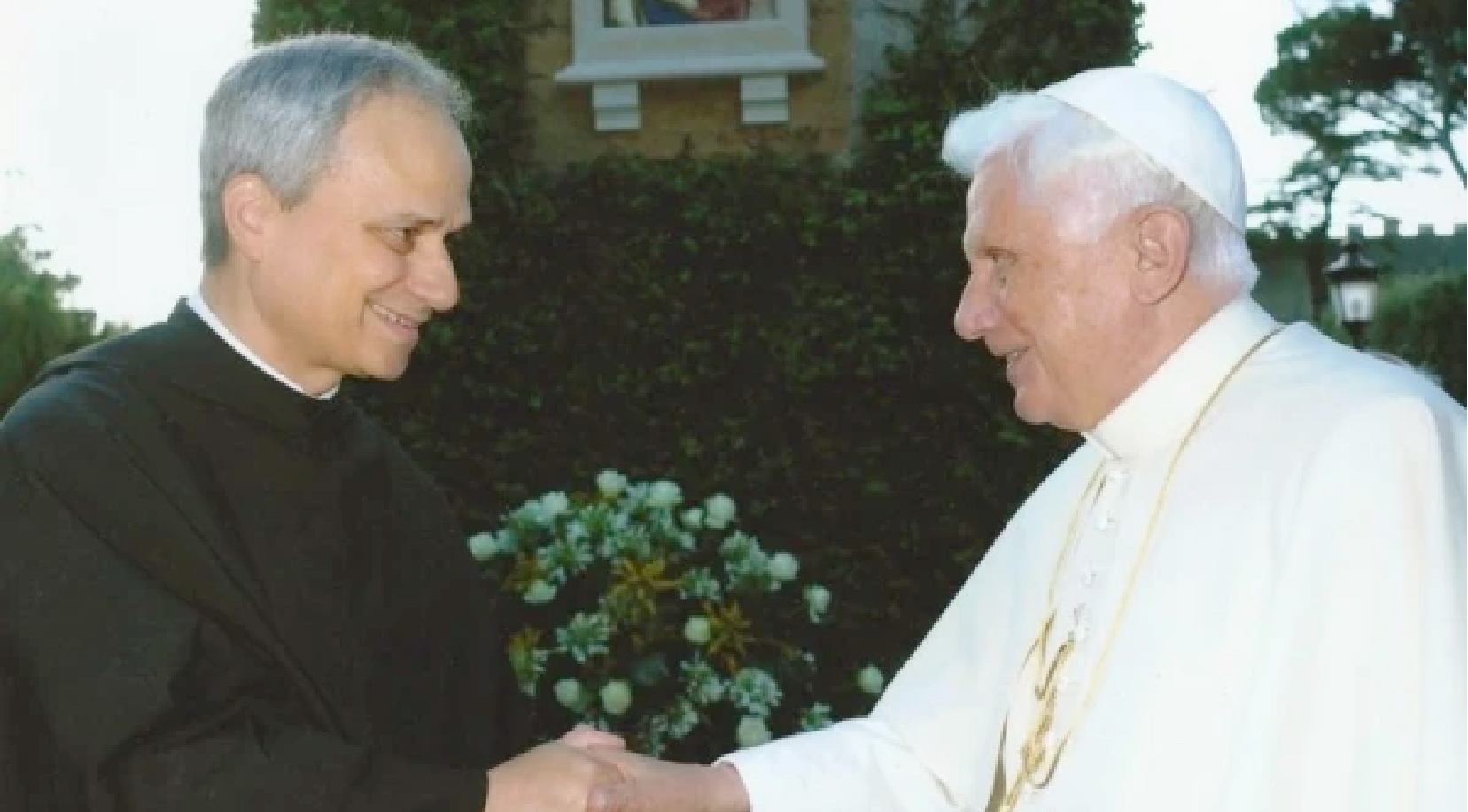
(ZENIT News / Rome, 04.17.2026).- A little-known letter from the man who would become Pope Leo has resurfaced. The text in question is a letter written in February 2013, in the immediate aftermath of Benedict XVI’s historic resignation, by then-Augustinian superior Robert Prevost. Its tone is nor routine. It is personal, precise, and deeply aligned with a particular vision of the Church—one that now appears strikingly relevant.
The rediscovery of this letter comes as commentators draw parallels between the pressures currently facing Leo XIV and the sustained criticism endured by Benedict XVI during his pontificate. The German pope was frequently the target of accusations that ranged from severe to demonstrably unfounded, including claims—revived even shortly before his death—that he had shielded abusive clergy in Germany. These allegations, widely contested, contrasted sharply with the historical record of a pontificate that many analysts now recognize as pivotal in confronting the global crisis of clerical sexual abuse.
It is precisely on this point that Prevost’s 2013 letter becomes most illuminating. Writing in the days following Benedict’s resignation, he expressed not only loyalty and admiration, but explicit gratitude for what he described as the pope’s “determination” in addressing abuse within the Church. He praised Benedict’s willingness to confront what he called a “tragic and painful” reality, highlighting both his pastoral sensitivity and his readiness to ask forgiveness from victims. Far from a generic acknowledgment, the language suggests a careful reading of Benedict’s actions and a clear endorsement of his approach.
This continuity is not merely rhetorical. Benedict XVI’s efforts against abuse were rooted in a theological diagnosis he had articulated even before his election. In the 2005 Via Crucis meditations, then-Cardinal Joseph Ratzinger spoke of the “filth” within the Church, framing the crisis not only as institutional failure but as a profound spiritual distortion. As pope, he translated that diagnosis into concrete measures: disciplinary actions, new norms, and a shift toward greater accountability. Prevost’s letter indicates that these efforts did not go unnoticed among those who would later inherit responsibility for the Church’s governance.
The document also reveals another layer of affinity between the two figures: a shared Augustinian sensibility. Though Benedict XVI was not a member of the Augustinian order, his theological work was deeply influenced by Augustine of Hippo, particularly in its emphasis on the restless search for truth and the primacy of grace. Prevost, as an Augustinian, recognized this connection explicitly, referring in his letter to Benedict’s frequent invocation of Augustine and his contribution to promoting that spiritual heritage within the wider Church.
This convergence is more than intellectual. It reflects a common understanding of the Church as a community constantly in need of purification, grounded not in institutional self-preservation but in fidelity to truth. Observers close to Benedict have noted that he saw Augustine as a kind of compass throughout his life—a thinker who, like himself, had not sought ecclesiastical office but accepted it as a form of service. That same dynamic can be discerned in Leo XIV’s trajectory, marked by a similar tension between scholarly inclination and pastoral responsibility.
Personal encounters between the two men further reinforce this sense of continuity. Accounts from those present at a 2007 visit to the tomb of Augustine in Pavia describe how Benedict was struck by Prevost’s address on that occasion, reportedly remarking on its depth and clarity. Such episodes, while anecdotal, contribute to a broader picture of mutual recognition grounded in shared theological language.
The significance of the 2013 letter, therefore, lies not only in its content but in its timing. Written at a moment of transition—when the Church was grappling with the unprecedented resignation of a pope—it captures a perspective that now informs the current pontificate. The esteem expressed for Benedict’s clarity of teaching, his commitment to unity, and his handling of abuse is not an isolated gesture. It anticipates key elements of Leo XIV’s own approach, particularly his insistence on moral credibility as a prerequisite for ecclesial authority.
In the present climate, where criticism of the papacy once again occupies headlines, this continuity offers a counterpoint to more superficial readings of Vatican dynamics. It suggests that beneath the shifting surface of controversies, there persists a coherent line of thought linking successive pontificates—one that places truth, accountability, and spiritual depth at the center of the Church’s mission.
The letter does not resolve the questions surrounding Leo XIV’s current challenges. But it does provide context. It reveals a pope who, long before his election, had already articulated a clear judgment on one of the most difficult chapters in recent Church history. And in doing so, it invites a reassessment not only of Benedict XVI’s legacy, but of the principles guiding the Church’s present course.
Thank you for reading our content. If you would like to receive ZENIT’s daily e-mail news, you can subscribe for free through this link.

Publicaciones relacionadas:
 New chapter in the protection of minors: Pope Leo XIV receives six victims of clerical abuse at the Vatican
 Children, Artificial Intelligence, and rights for their protection: this is what Pope Leo XIV thinks
 How to prevent all forms of abuse and how to be accountable: Pope Leo XIV puts dignity as the starting point
 Reform and Responsibility: Leo XIV Reshapes Vatican Governance from Finance to Safeguarding
