

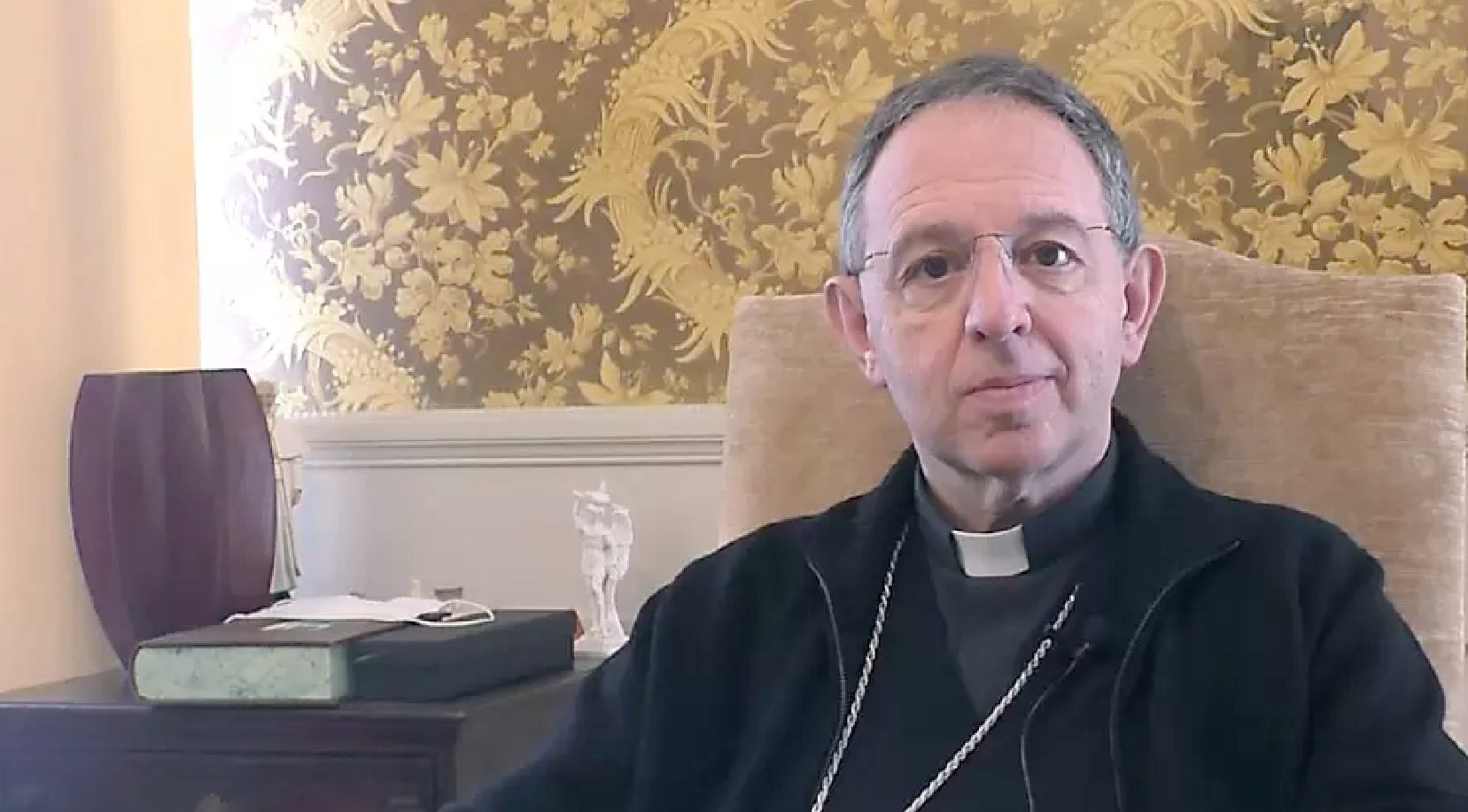
(ZENIT News / Rome, 05.28.2026).- At a time when much of Europe’s ecclesial discourse on migration focuses almost exclusively on humanitarian assistance and social integration, Bishop Antonio Suetta of the Diocese of Ventimiglia-San Remo has issued a strikingly direct challenge to Catholics: welcoming migrants without sharing the Gospel is ultimately an incomplete form of charity.
In a pastoral letter published on May 24 for Pentecost and titled No Greater Love, the Italian bishop argues that Christians betray their mission if they provide migrants with food, shelter and legal assistance while remaining silent about Jesus Christ. The document, unusual in tone within today’s European ecclesial climate, has rapidly attracted attention because of its explicit call to evangelize Muslims living in northern Italy.
Ventimiglia, on the French border, has for years been one of the principal transit points for migrants entering Europe. Many of those arriving are Muslims from North Africa and other regions. According to Bishop Suetta, the Catholic Church has long been deeply involved in emergency aid, reception programs and integration efforts there. Yet he says a growing unease emerged among volunteers themselves.
The origin of the initiative come from an ordinary Caritas meeting. A lay volunteer reportedly asked a simple but uncomfortable question: why does the Church dedicate so much energy to material support while failing to offer migrants “the most precious thing we possess — faith and the Gospel”?
That question became the seed of a broader pastoral initiative. Beginning in the 2026–2027 pastoral year, the diocese will launch a dedicated formation program coordinated by its catechetical office together with diocesan Caritas. The project will formally begin during October’s missionary month and will also include a major conference on interreligious dialogue delivered on October 9 in Sanremo by George Jacob Koovakad, prefect of the Vatican Dicastery for Interreligious Dialogue.
Suetta grounds his reflections not in polemics against Islam, but in what he describes as the Church’s obligation to charity and truth together. He repeatedly invokes the example of Francis of Assisi and his famous 1219 encounter with the Sultan during the Crusades. In the bishop’s reading, Francis did not travel merely to promote peaceful coexistence, but to bear witness to Christ, even at the risk of martyrdom.
The bishop also links his appeal to two anniversaries: the Year of Saint Francis proclaimed by Leo XIV from January 10, 2026 to January 10, 2027, and the 60th anniversary of the Second Vatican Council’s declaration Nostra Aetate. Suetta insists that Vatican II never abolished the missionary mandate toward non-Christians, despite what he calls decades of confusion surrounding the so-called “spirit of the Council.”
For the Italian prelate, interreligious dialogue has two legitimate goals. The first is social peace and mutual respect — particularly important in societies marked by religious tensions and mass migration. But dialogue, he argues, cannot stop at diplomacy or coexistence. Its deeper purpose must remain the search for truth.
In one of the letter’s most provocative observations, Suetta argues that many Muslims arriving in secularized Western societies mistakenly identify moral relativism and public immorality with Christianity itself. Only after encountering practicing Christians, he says, do some discover that secularization represents not the fruit of Christianity, but its erosion.
To explain his point, the bishop uses a vivid image: refusing to evangelize migrants is like watching a man being swept away by a river while declining to throw him a rope because he might somehow save himself. “The rope is liberation,” he writes.
Suetta rejects the idea that evangelization necessarily implies hostility or cultural aggression. On the contrary, he emphasizes that authentic Christian witness begins with personal example rather than confrontation. Echoing Franciscan spirituality, he notes that the Gospel should be proclaimed above all through life, though not without words when necessary.
His intervention touches a sensitive nerve within contemporary European Catholicism, where many church leaders strongly defend migrants’ dignity and rights but often avoid explicit language about conversion for fear of appearing triumphalist or insensitive. Suetta, however, contends that a dialogue “allergic to truth” ultimately fails both Christians and Muslims alike.
The bishop goes even further, suggesting that Christians themselves may one day be held accountable for withholding the Gospel from those they welcomed materially but never evangelized spiritually. For him, concern for eternal salvation remains the highest form of charity — a conviction deeply rooted in traditional Catholic teaching, yet increasingly rare in Europe’s public religious conversation.
Thank you for reading our content. If you would like to receive ZENIT’s daily e-mail news, you can subscribe for free through this link.

Publicaciones relacionadas:
 Prefect of the Dicastery for Education visits Argentine neighborhood and meets founder of the Pope’s Scholas project
 These are the 10 bishops who are candidates to lead the Catholic Church in the United States for the next three years
 Muslim radicals call for the execution of a cardinal in Iraq
 The German bishop who brought the local Catholic Church to the brink of schism announces that he will not seek re-election
