

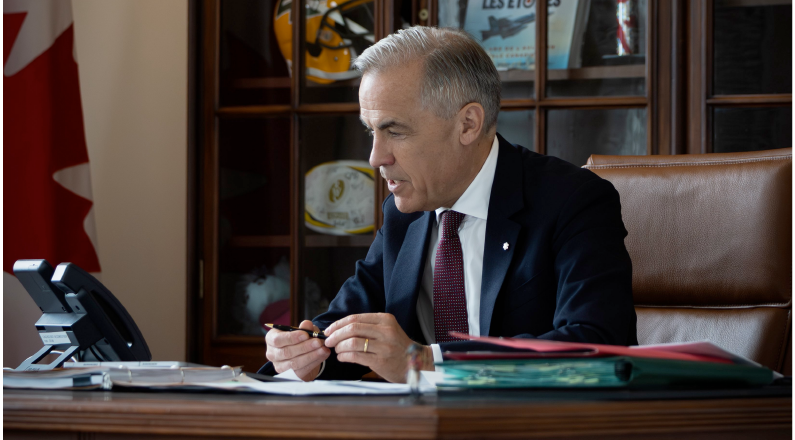
(ZENIT News / Rome, 06.01.2026).- A recent conversation between Pope Leo XIV and Canadian Prime Minister Mark Carney suggests that the debate over emerging technologies is no longer confined to laboratories, boardrooms, or government agencies. It has become a moral question as well.
On May 29, the Pope and the Canadian leader spoke by telephone following the publication of Leo XIV’s new encyclical, Magnifica Humanitas. According to the Holy See, the discussion focused on one of the document’s central concerns: ensuring that artificial intelligence develops according to ethical principles and remains firmly oriented toward the human person.
The exchange highlights a growing convergence between the Vatican’s reflections on technology and the concerns of political leaders facing the practical consequences of AI’s expansion. Rather than approaching artificial intelligence merely as an economic opportunity or a geopolitical competition, both sides emphasized the need for safeguards that protect human dignity, individual rights, and the common good.
The timing is significant. Only days before the conversation, Carney announced that his government would soon unveil a federal strategy on artificial intelligence aimed at protecting Canadians and democratic institutions while strengthening international cooperation in the field. The Canadian prime minister, a practicing Catholic who took office on March 14, 2025, has increasingly framed technological innovation as a challenge requiring both technical expertise and ethical responsibility.
In a public reflection after the call, Carney praised the Pope’s message of compassion and unity and stressed that AI must serve humanity rather than the other way around. He specifically highlighted the importance of protecting individuals as governments and businesses accelerate the deployment of new technologies.
His Holiness Pope Leo XIV’s message of unity and compassion continues to inspire hope and change across the globe.
During our conversation today, I thanked His Holiness for his efforts to return Indigenous artefacts from the Vatican Museums, and we discussed the urgent need for… pic.twitter.com/Fk8n4Fc4CX
— Mark Carney (@MarkJCarney) May 29, 2026
The conversation extended beyond digital ethics. According to the Vatican, Leo XIV and Carney also addressed several international issues, with particular attention to ongoing conflicts in Ukraine and the Middle East. The Holy See noted their shared concern for efforts to promote peace among peoples at a time when multiple regions continue to experience instability and violence.
Carney additionally expressed gratitude for Vatican initiatives aimed at returning Indigenous artifacts from the Vatican Museums, a gesture that has been welcomed in Canada as part of broader efforts toward reconciliation with Indigenous communities.
Although brief, the exchange offers an early indication of how Leo XIV intends to engage world leaders on one of the defining issues of the twenty-first century. The Church has often entered major social debates only after technological revolutions were already well underway. In the case of artificial intelligence, however, the Vatican appears determined to participate from the outset.
The discussion also reflects a theme increasingly visible throughout Leo XIV’s pontificate: technological progress cannot be evaluated solely by efficiency, productivity, or profit. The decisive question is whether innovation strengthens the human person and serves authentic human flourishing.
For Leo XIV, the future of artificial intelligence is not simply a technical matter. It is ultimately a question about what kind of civilization humanity wishes to build.
Thank you for reading our content. If you would like to receive ZENIT’s daily e-mail news, you can subscribe for free through this link.

Publicaciones relacionadas:
 Pope Leo’s visit to Argentina unofficially confirmed after audience with President Milei
 Pope Leo XIV Receives Nobel Prize Laureate Maria Corina Machado: This Is What the Venezuelan Leader Asked Him
 Pope Leo XIV Speaks Again About Trump and the War (and It Is Announced That the Pope Will Carry the Cross Throughout the Stations of the Cross on Good Friday)
 Trump Attacks the Pope for the Second Day, and Meloni Defends Him. The World Reacts While the Catholic Vice-President of the USA Supports Him
