

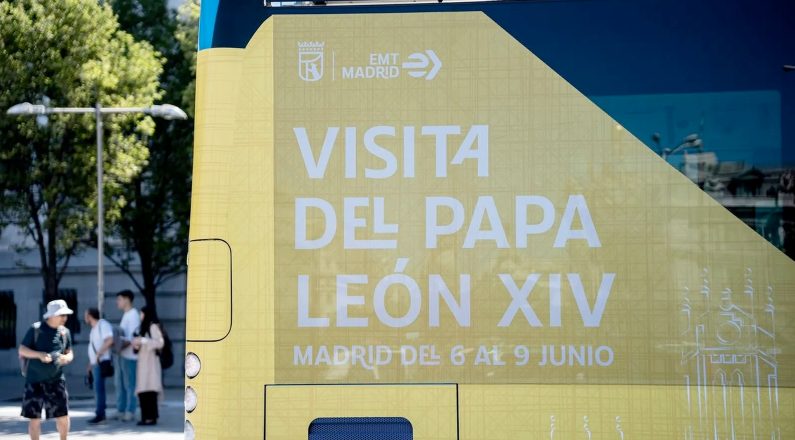
(ZENIT News / Barcelona-Madrid, 05.26.2026).- Long before Pope Leo XIV arrives in Spain, his anticipated visit is already reshaping public conversations. What might once have been treated primarily as a pastoral journey is increasingly becoming a mirror reflecting some of the deepest tensions in contemporary Spanish society: secularism and religious identity, faith and politics.
Two developments unfolding in Barcelona and Madrid illustrate how the same papal visit can be interpreted through very different lenses.
In Barcelona, a coalition of secularist organizations has launched a campaign under the slogan “I Do Not Wait for You,” calling for a boycott of the Pope’s visit. The initiative, promoted by the Francesc Ferrer i Guàrdia Foundation together with atheist and secular associations, argues that public institutions should avoid granting what organizers describe as special privileges to religious events.
The campaign criticizes public support for the papal journey and raises objections to the use of public resources and spaces connected with the visit. Organizers present their effort as a defense of a secular and plural society and contend that institutional neutrality requires maintaining distance from religious favoritism.
Among those associated with the initiative is Joan Francesc Pont Clemente, a professor of financial and tax law at the University of Barcelona and a prominent figure within liberal Spanish Freemasonry. His long involvement in Masonic organizations, intellectual initiatives, and secularist circles has made him one of the best-known public representatives of that current of thought in Catalonia.
For readers outside Spain, the relationship between the Catholic Church and Freemasonry has a long and often contentious history. Since the eighteenth century, several Popes expressed concerns that certain Masonic principles promoted philosophical positions incompatible with Catholic doctrine, particularly regarding religious relativism and the role of religion in public life.
The protest movement plans a public gathering on June 9, coinciding with a prayer vigil led by the Pope at Barcelona’s Olympic Stadium.
Yet while some sectors are organizing demonstrations against the visit, another debate is unfolding hundreds of kilometers away in the Spanish capital.
Madrid’s city council has found itself in disagreement over how to formally welcome Leo XIV. Political parties broadly support receiving the Pope, but divisions have emerged over language, emphasis, and symbolism.
The debate is not over whether the pontiff should be welcomed but over what exactly the welcome represents.
One proposal emphasizes Madrid as an open and diverse city committed to dialogue, human rights, social concerns, and solidarity with the vulnerable. Another highlights the Pope’s role as both a head of state and the successor of Saint Peter, placing greater attention on the city’s Christian heritage and on themes of peace and understanding among peoples.
Interestingly, support and criticism do not follow entirely predictable ideological lines. Different political groups have endorsed different versions of the declaration, while some parties have indicated willingness to support both texts.
Additional proposals under discussion would classify the papal journey as an event of exceptional significance for Madrid, potentially allowing municipal facilities to be made available and enabling administrative measures related to security, mobility, logistics, and taxation due to the large crowds expected.
Supporters of institutional participation argue that welcoming a Pope is not simply a religious matter but also recognition of a major international figure whose moral influence reaches far beyond Catholic communities. Critics respond that genuine neutrality requires public institutions to avoid privileging any religious tradition.
Yet the very intensity of the discussion may reveal something unexpected. A visit that supposedly concerns only believers has become a subject of national conversation among believers and non-believers alike.
Paradoxically, even opposition may demonstrate that religion still possesses a remarkable capacity to shape public life. Societies rarely organize protests, parliamentary debates, and municipal negotiations around matters they consider irrelevant.
Pope Leo XIV has not yet arrived in Spain. But his visit is already asking a question that modern Europe continues to wrestle with: whether faith belongs only inside churches, or whether it still has a place in the public square.
Thank you for reading our content. If you would like to receive ZENIT’s daily e-mail news, you can subscribe for free through this link.

Publicaciones relacionadas:
 Lion XIV could go to Australia in 2028: Prime Minister has already made the invitation and here’s why
 Where does a young man get the strength to resist corruption? Leo XIV’s answer with the life of a new Blessed
 First Italian poll shows Pope Leo XIV surpasses Francis and Benedict in popularity
 Childhood Home of Pope Leo XIV at the Center of Preservation Battle in Dolton, Illinois
