

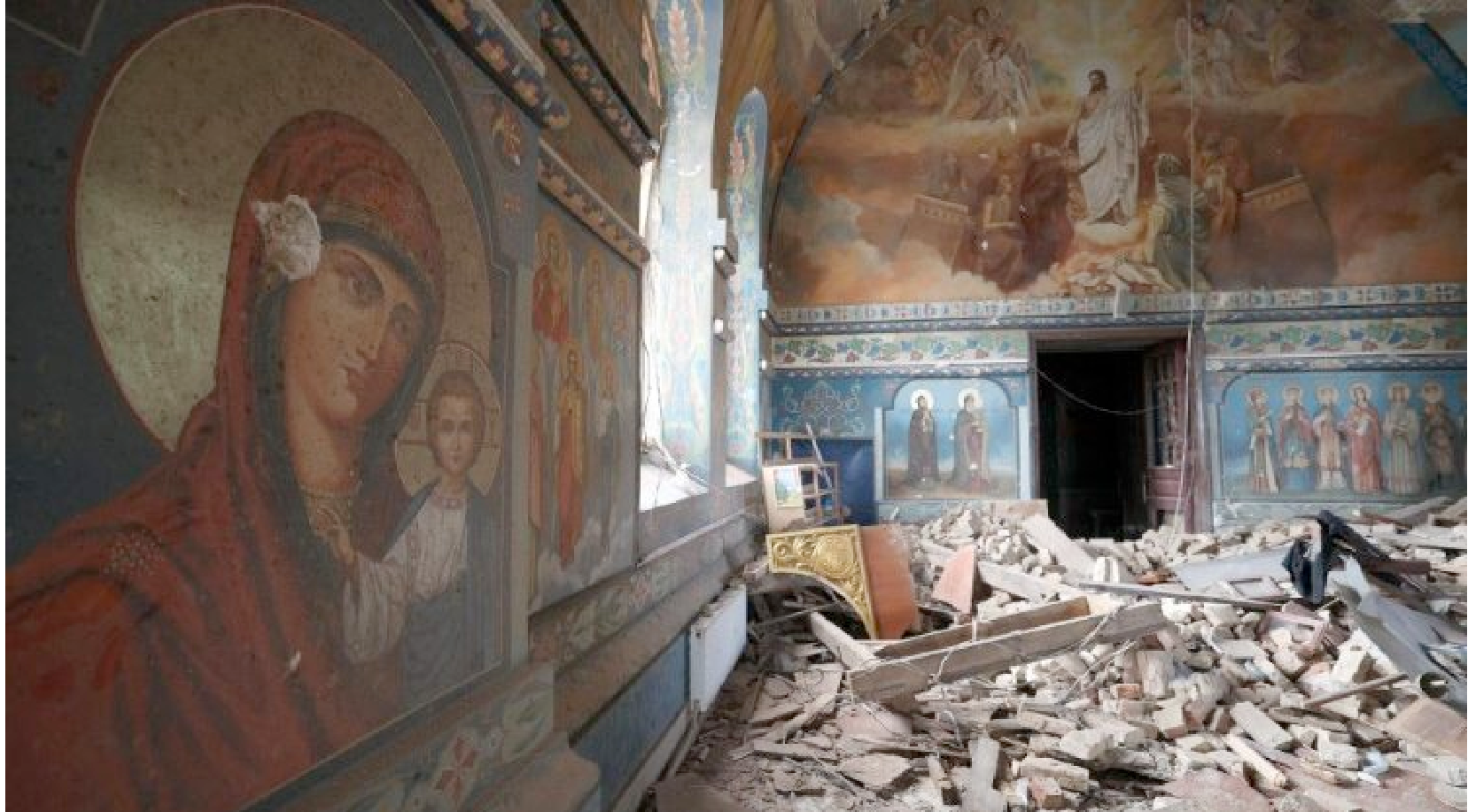
(ZENIT News / Paris, 04.28. 2026) The Holy See’s Permanent Observer highlighted the need to protect threatened cultural heritage in war zones, «where all international norms and conventions appear to be systematically violated. The numerous conflict situations, such as in Ukraine and the Middle East, lead to the destruction of material and cultural assets, often with the risk of loss of identity and the erasure of the collective memory.»
The Secretary-General of the Iranian Commission for UNESCO, Hassan Fartousi, stated that 160 cultural sites have been hit by aerial attacks in Iran over the past month, with irreparable damage in some cases.
Monsignor Roberto Campisi emphasized the need to protect religious cultural sites, as they represent living places of faith, culture, and community life, invoking International Humanitarian Law and «the obligation to respect and protect cultural property, including places of worship, which are expressions of the identity of peoples.»
Respect for the standards of care for religious cultural sites is a legal and moral responsibility in contexts of armed conflict. He said: «Safeguarding heritage is not a luxury, it is a priority: it contributes to the resilience of populations and constitutes an indispensable foundation for any process of reconciliation and reconstruction.» The preservation of these cultural riches requires the formation of consciences in respect, openness to intercultural encounter, and the assumption of shared responsibility that leads to peace.
Monsignor Campisi also spoke of education as the principal instrument of peace, leading to the recognition of culture as the soul of every people, as well as communication based on truth and not as a voice of propaganda and power.
The Permanent Observer of the Holy See acknowledged the support provided by countries, even those with financial limitations, to teachers and students in emergency situations who, as the Pope pointed out in his Message for the 6th World Day of Social Communications, need to «acquire critical thinking skills» and «grow in freedom of spirit» in the face of the horror and fear instilled by war.
The Prelate recalled the Global Compact on Education, promoted by Pope Francis and Pope Leo XIV, in the context of technological advances, emphasizing the role of the family as the primary place of communication and openness to transcendence in order to promote the «inalienable human dignity given by God.»
He explained that «educating for inclusion, oriented towards the common good, solidarity, and the safeguarding of Creation, fosters the humane and ethical use of digital technology and artificial intelligence, and values the inner and spiritual dimension of young people. It is through quality, authentic, and holistic education that more just societies, are built, capable of dialogue and peace.» He also warned that the challenge is not only technological but also anthropological. «The issue is not limited to what machines are capable of doing, but also refers to what happens to human beings when they live in technological environments that shape their attention, emotions, thoughts, and imagination.»

Publicaciones relacionadas:
 Interview with the Secretary of State on the interview with Pope Francis and the diplomatic crisis resulting from it.
 These Are the Ten Countries that Give Most Money to the Pope’s Charitable Works
 Patriarch of Constantinople: Conversations Are Underway for Catholics and Orthodox to Celebrate Easter on the Same Date
 Papal Audience for the Catholic President of Hungary
