

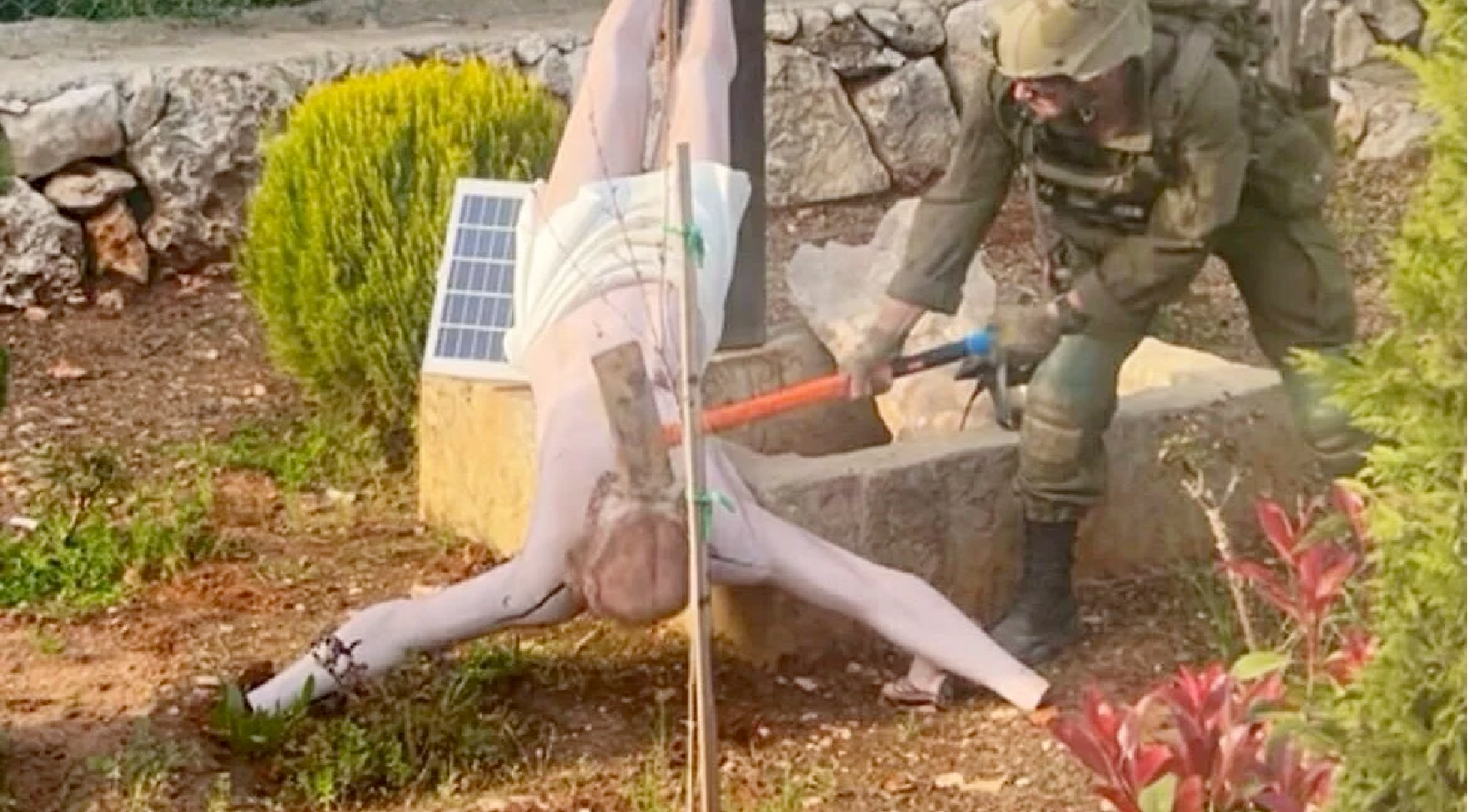
(ZENIT News / Jerusalem, 04.22.2026).- A recent act of vandalism against a Christian symbol in southern Lebanon has triggered not only outrage but also an unexpected and significant response: a public apology from more than 150 Jewish leaders.
The incident, which took place in the Christian village of Debel, involved an Israeli soldier destroying a statue of Jesus with a sledgehammer. The image, captured and circulated widely on April 20, quickly became emblematic of the broader tensions surrounding the ongoing conflict in the area. Yet the reaction it provoked among prominent Jewish voices suggests that the event may also become a reference point for accountability.
The letter, signed by rabbis and educators from Orthodox, Conservative and Reform communities, does not attempt to minimize the gravity of the act. On the contrary, it defines it in theological as well as moral terms: a “profanation of the name of God.” In Jewish tradition, the concept of desecrating God’s name—known as chillul Hashem—refers to actions that publicly contradict the ethical demands of faith, especially when committed by those who are seen as representatives of a religious people.
By invoking this category, the signatories place the घटना beyond the realm of a mere disciplinary breach. They frame it as a moral failure that wounds not only the Christian community directly affected, but also the integrity of Jewish ethical witness. The apology addressed to Christians worldwide is therefore not a diplomatic gesture, but an acknowledgment rooted in religious conscience.
Among the signatories are figures with longstanding involvement in interreligious dialogue, including leaders associated with organizations dedicated to Jewish-Christian relations. Their intervention reflects a broader awareness: that in a region marked by historical grievances and present-day violence, symbolic acts carry disproportionate weight. A statue is not simply an object; it represents identity, memory and the visible presence of a community.
This is particularly true for Christians in the Middle East, many of whom belong to ancient communities whose numbers have declined dramatically over recent decades due to war, emigration and instability. For these communities, already living with a sense of vulnerability, the desecration of a religious image can be experienced as part of a wider pattern of marginalization.
The letter’s authors explicitly recognize this dimension. They describe the act as an affront not only to local believers, but to “ancient Christian communities of the Middle East”. At the same time, they warn of the damage inflicted on Jewish-Christian relations, a relationship that has undergone significant transformation in recent decades and is widely regarded as one of the most important developments in contemporary interreligious dialogue.
What gives the statement particular weight is its refusal to separate moral responsibility from the context of conflict. The signatories acknowledge that Israel faces real security threats and enemies committed to its destruction. The appeal is clear: war does not nullify moral law; it tests its credibility.
This insistence resonates with a broader principle found across the Abrahamic traditions: that the dignity of the human person and respect for what is sacred are not contingent on political conditions. In Catholic social teaching, as in Jewish ethics, the defense of life and the rejection of desecration are not optional ideals, but foundational commitments that must endure even in the most difficult contexts.
The reaction of Israeli authorities, who condemned the act and described it as incompatible with military values, aligns in part with this perspective. However, the intervention of religious leaders introduces an additional layer, one that speaks not only to institutional discipline but to the formation of conscience. It suggests that legal or military responses, while necessary, are insufficient without a deeper cultural and spiritual renewal.
The letter also touches on a less frequently discussed issue: the asymmetry of knowledge between communities. While millions of Christians around the world express strong support for Israel, the signatories note that many Israelis have limited understanding of contemporary Christianity. This gap, they argue, risks weakening a relationship that could otherwise serve as a bridge in a fractured region.
In this sense, the apology issued by these Jewish leaders does more than respond to a single incident. It reaffirms a principle that is essential for any hope of lasting peace: that the sacred must never become collateral damage, and that the path toward reconciliation begins with the courage to name wrongdoing and to seek forgiveness.
The full letter can be read in English here.
Thank you for reading our content. If you would like to receive ZENIT’s daily e-mail news, you can subscribe for free through this link.

Publicaciones relacionadas:
 “We return from Gaza with broken hearts”: Cardinal Pizzaballa at press conference in Jerusalem
 Patriarch of Jerusalem on the flotilla intercepted by Israel: “They do not bring anything concrete to the people of Gaza”
 Pope Francis’ popemobile converted into an ambulance receives permission to enter Gaza
 Vatican questions “preventive” war in Iran as Leo XIV intensifies diplomatic calls for peace
