

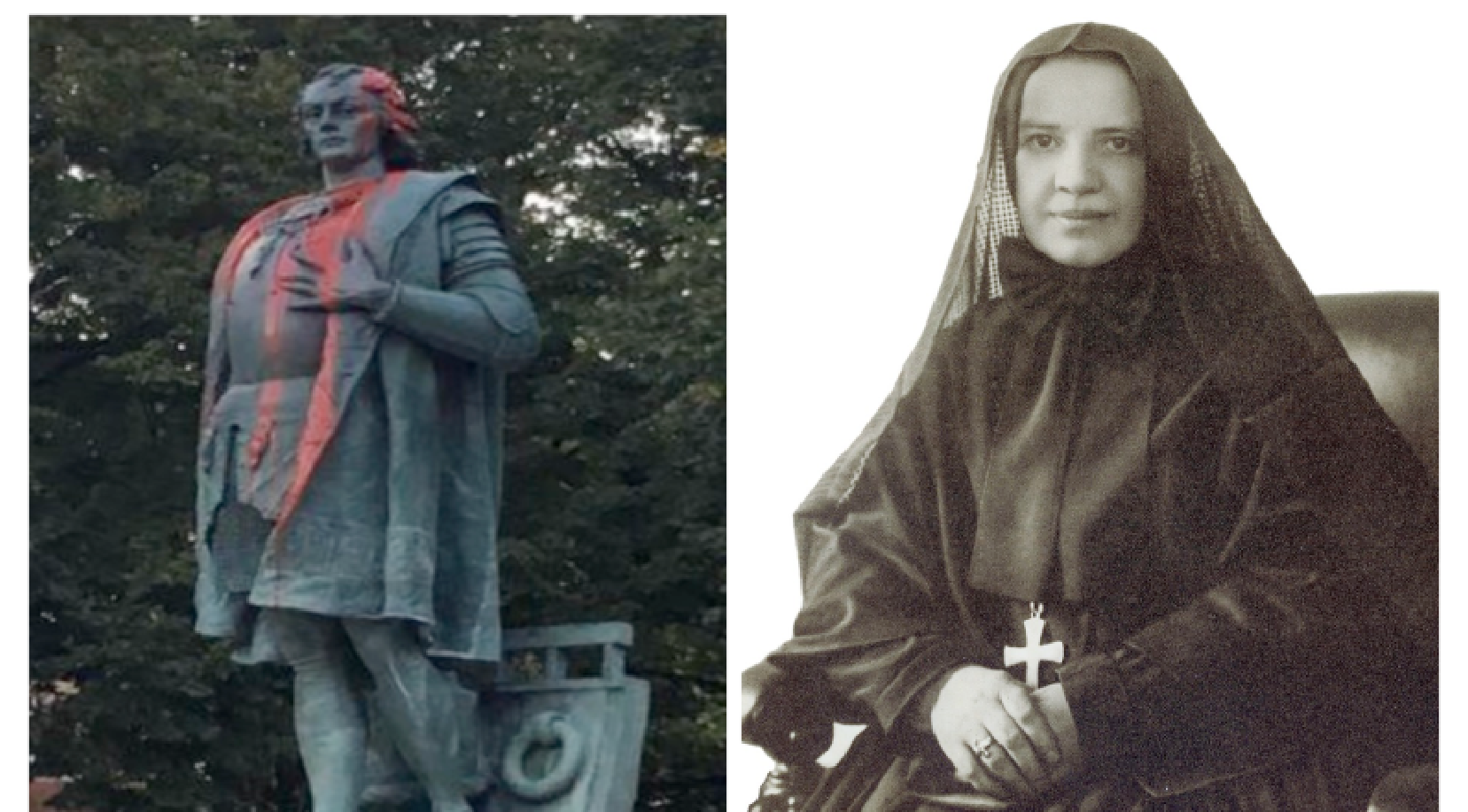
(ZENIT News / Chicago, 04.22.2026).- In a city shaped by successive waves of migration, the question of whom to honor in public space has become a window into deeper cultural debates. Chicago’s decision to commemorate Mother Cabrini with a new monument in Arrigo Park, in the heart of Little Italy, reveals a reconfiguration of collective memory, where the legacy of exploration gives way to the witness of service, and where the story of immigration is told through the lens of care for the most vulnerable.
The choice followed a public consultation process launched by the Chicago Park District after the removal of a statue of Christopher Columbus between 2019 and 2020, amid widespread protests linked to racial justice movements. The removal itself was not an isolated act, but part of a broader reassessment across the United States of figures associated with colonial expansion. In Chicago, tensions culminated in July 2020, when clashes between demonstrators and police around a Columbus statue left dozens injured. Within days, three statues dedicated to the explorer were dismantled across the city.
To resolve the dispute, city authorities committed to replacing the monument in Arrigo Park with a figure representative of the Italian-American experience. What followed was a structured selection process: more than 150 candidates were initially considered, ten finalists were announced, and residents were invited to vote. The outcome was decisive. Cabrini received around 15,000 votes, nearly 40 percent of the total, far surpassing figures of global stature such as physicist Enrico Fermi, who obtained 648 votes, and Supreme Court Justice Antonin Scalia, who received 597.
That a religious sister prevailed over Nobel laureates and jurists is telling. It suggests that, at least in this context, the public is drawn not only to intellectual or political achievement, but also to moral witness. Cabrini’s life offers a narrative that resonates with the foundational experiences of immigrant communities. Born in northern Italy, she arrived in the United States in the late nineteenth century and devoted herself to the pastoral and material needs of poor Italian migrants. At a time when immigrants often faced hostility, exploitation, and marginalization, she built structures of support that combined charity with institutional foresight.
Over the course of her life, she founded 67 institutions across the Americas, including schools, hospitals, and orphanages. In Chicago, she established key social and educational initiatives, including the city’s first Italian parish school and two hospitals, both named after Columbus—a historical irony not lost in the current debate. She died in Chicago in 1917, and in 1946 she was canonized, becoming the first United States citizen to be declared a saint. The Catholic Church later recognized her as the patroness of immigrants.
The new monument, the first public statue dedicated to Cabrini in a Chicago park, carries multiple layers of meaning. On one level, it is a gesture toward the Italian-American community, acknowledging its historical contributions and the role of faith in sustaining its identity. On another, it reframes the narrative of immigration itself. Instead of focusing on discovery and conquest, it highlights accompaniment, solidarity, and the defense of human dignity—values that remain central to contemporary debates on migration.
The decision also brings into focus the often-overlooked contribution of women religious in the shaping of modern societies. Cabrini’s work was not limited to charitable acts in the narrow sense; it involved the creation of durable institutions capable of addressing structural needs. In this regard, her legacy aligns with a broader Catholic social vision that sees care for the poor not as episodic generosity, but as a commitment to building systems that uphold life and dignity.
At the same time, the relocation of the Columbus statue to a future museum dedicated to Italian immigration suggests an attempt at balance rather than erasure. Public space, increasingly contested, is being reimagined not as a static repository of memory but as a dynamic arena where different narratives compete and coexist. By moving Columbus from a central square to a more contextualized setting, the city appears to be distinguishing between commemoration and critical reflection.
The timeline for the new statue remains open, though artists have been invited to submit proposals since March 1. What is already clear, however, is that the figure who will stand in Arrigo Park embodies a particular vision of society.
Thank you for reading our content. If you would like to receive ZENIT’s daily e-mail news, you can subscribe for free through this link.

Publicaciones relacionadas:
 Barcelona: Antonio Gaudí’s Beatification Process Advances
 Vincent, the boy alive thanks to a miracle attributed to Cardinal George Pell
 Impressive Via Crucis and the Crucifixion of Jesus Returns to the Center of London and Is Seen by 20,000 People
 Bartolo Longo, A Former Satanic Priest Who Became A Saint, Is Canonized by Leo XIV
