(ZENIT News / Rome, 06.14.2026).- Answered by Legionary of Christ Father Edward McNamara, professor of liturgy and sacramental theology at the Pontifical Regina Apostolorum university.
Q: I have the following five questions [below]. — A.P., Patna, Bihar, India
A: I do not usually respond to a miscellany of questions. However, since the questions submitted are frequently asked, I address them briefly as they will probably help many inquirers.
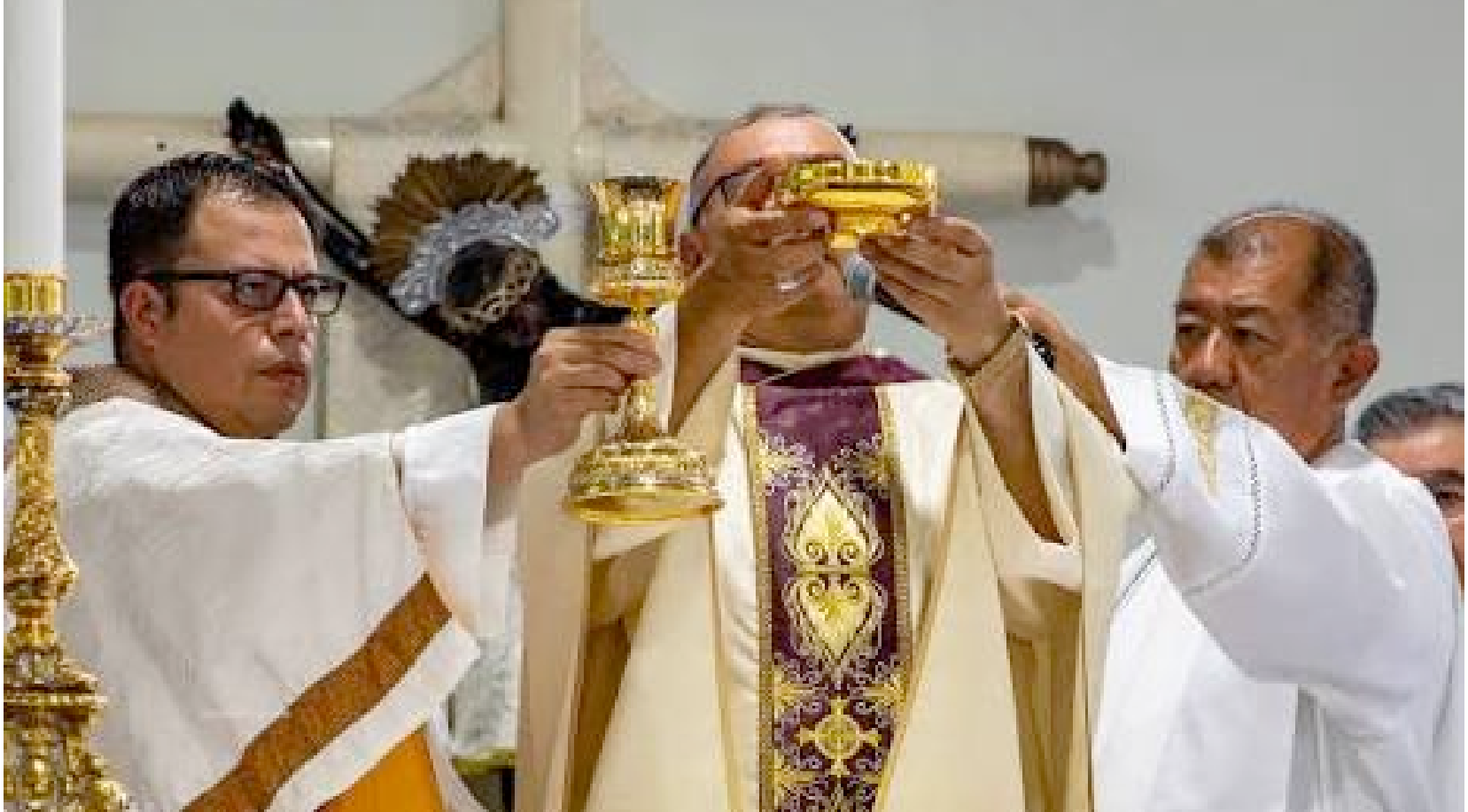
1) Can a concelebrating priest hold the chalice at the doxology in the absence of a deacon?
The brief answer is yes. The General Instruction of the Roman Missal says:
«208. If a Deacon is not present, the functions proper to him are to be carried out by some of the concelebrants. If other ministers are also absent, their proper parts may be entrusted to other suitable faithful laypeople; otherwise, they are carried out by some of the concelebrants.»
Therefore, this particular function of elevating the chalice, along with others such as proclaiming the Gospel, are assigned to one or more concelebrants in the absence of a deacon.
2) Why is the penitential rite omitted for the ritual Mass of Marriage?
This follows a general principle of the liturgy that is applicable to several rites, and not just marriage, which foresees the omission of the penitential rite whenever the Mass is joined to another rite.
This can be done on other occasions such as when Mass is united to morning or evening prayer and for certain blessings carried out at the beginning of Mass. The rubrics will indicate how to proceed in accordance with each particular ritual.
Since the penitential rite serves as a spiritual preparation for all the rites that follow, it follows logically that if another rite has been incorporated into Mass that also serves as a spiritual preparation for a celebration, then this rite would suffice.
These are also usually very particular rites reserved for special occasions. It would not be correct to habitually omit the penitential rite.
3) When there is no cross in the sanctuary, we use an altar cross. In such a case, does the cross face toward the people or toward the celebrant? Why?
The figure on the cross faces the altar.
4) Why is the prayer of embolism omitted after the nuptial blessings given after Our Father?
The location of the nuptial blessing has varied over the centuries. One ancient text places it before the exchange of peace. A 12th-century pontifical anticipates it to the conclusion of the Roman Canon before the expression: «Through whom you continue to make all these things, O Lord; you sanctify them, fill them with life, bless them, and bestow them upon us.» Some scholars believe that this might reflect its most ancient collocation.
However, at a slightly later date we find it more or less at its present place. It immediately followed the Our Father but was before the embolism, which was not omitted.
Why, therefore, does the present rite omit the embolisms when the nuptial blessing is used?
I think that this is because of the changed function of the Our Father within the Mass as a prayer of the whole assembly with its embolism taking its cue from the last words of the Lord’s Prayer.
In the former rite, although the rubrics allowed for the possibility of a communal recitation of the Pater Noster on some occasions, the most common practice was that the priest would recite the prayer in a low voice and raise his voice only at the end for the words: «And deliver us from evil.» This was followed by the embolism «Deliver us Lord from every evil …,» also in a low voice. Therefore, the inclusion of the nuptial blessing was an extra element of the nuptial Mass added to the usual rites.
With the Conciliar reform, the Our Father has become a communal prayer recited or sung by all and is naturally followed by the embolism, which is now also proclaimed in a clear voice.
When the Rite of Marriage was reformed in 1969 it was decided to conserve the blessing in its by-now traditional place after the Our Father. However, the proclamation of the embolism «Deliver us Lord from every evil …» would now be dissociated from the last words of the Lord’s Prayer.
I believe that to avoid this somewhat dissonant situation, and in order to give the nuptial blessing its own particular role, those formulating the new rite decided that the best option was to omit entirely the embolism directly following the Pater Noster.
5) Why the does the priest join his hands at the greeting before the proclamation of the Gospel? At other times the priest extends his hands while greeting.
The Ceremonial of Bishops, No. 74, explains this gesture, to wit:
«At the ambo the deacon stands facing the people and, with hands joined, says the greeting; then with his right thumb he makes the sign of the cross, first on the book at the beginning of the gospel passage that he is about to read, then on his forehead, lips, and breast, saying, A reading from the holy gospel. The bishop signs himself in the same way on forehead, lips, and breast, and all present do the same. Then, at least at a stational Mass, the deacon incenses the Book of the Gospels three times, that is, in the center, to the left, and to the right. Then he proclaims the gospel reading to its conclusion.»
As seen above in the quote from the Ceremonial of Bishop, the rubric is clear that the minister should not open and close his hands at this moment. The historical and liturgical reasons are not so clear.
My personal reasoning is the following.
First, in the Latin rite the opening and closing of the hands is strictly a presidential gesture. Consequently, at no time during Mass should the deacon ever open and close his hands — not at the Gospel, not at the sign of peace and not at the dismissal.
A deacon may use this gesture, in accordance with the rubrics, whenever he presides at a celebration in the absence of a priest.
Second, again in line with the Roman liturgical tradition, the reading of the Gospel has never been reserved to the presiding celebrant. If there is a deacon present, he should proclaim it. In a concelebration it is preferably read by another concelebrant even if the principal celebrant is to preach the homily. Only in the absence of any other ordained minister should the priest read the Gospel.
Therefore, since proclaiming the Gospel is not a presidential act, the greeting «The Lord be with you» at the Gospel is not a presidential greeting, and the gesture of opening and closing the hands is thus omitted.
This is true even in those cases where, by default, the Gospel is proclaimed by a concelebrating priest or the principal celebrant.
* * *
Readers may send questions to zenit.liturgy@gmail.com. Please put the word «Liturgy» in the subject field. The text should include your initials, your city and your state, province or country. Father McNamara can only answer a small selection of the great number of questions that arrive.
Thank you for reading our content. If you would like to receive ZENIT’s daily e-mail news, you can subscribe for free through this link.