

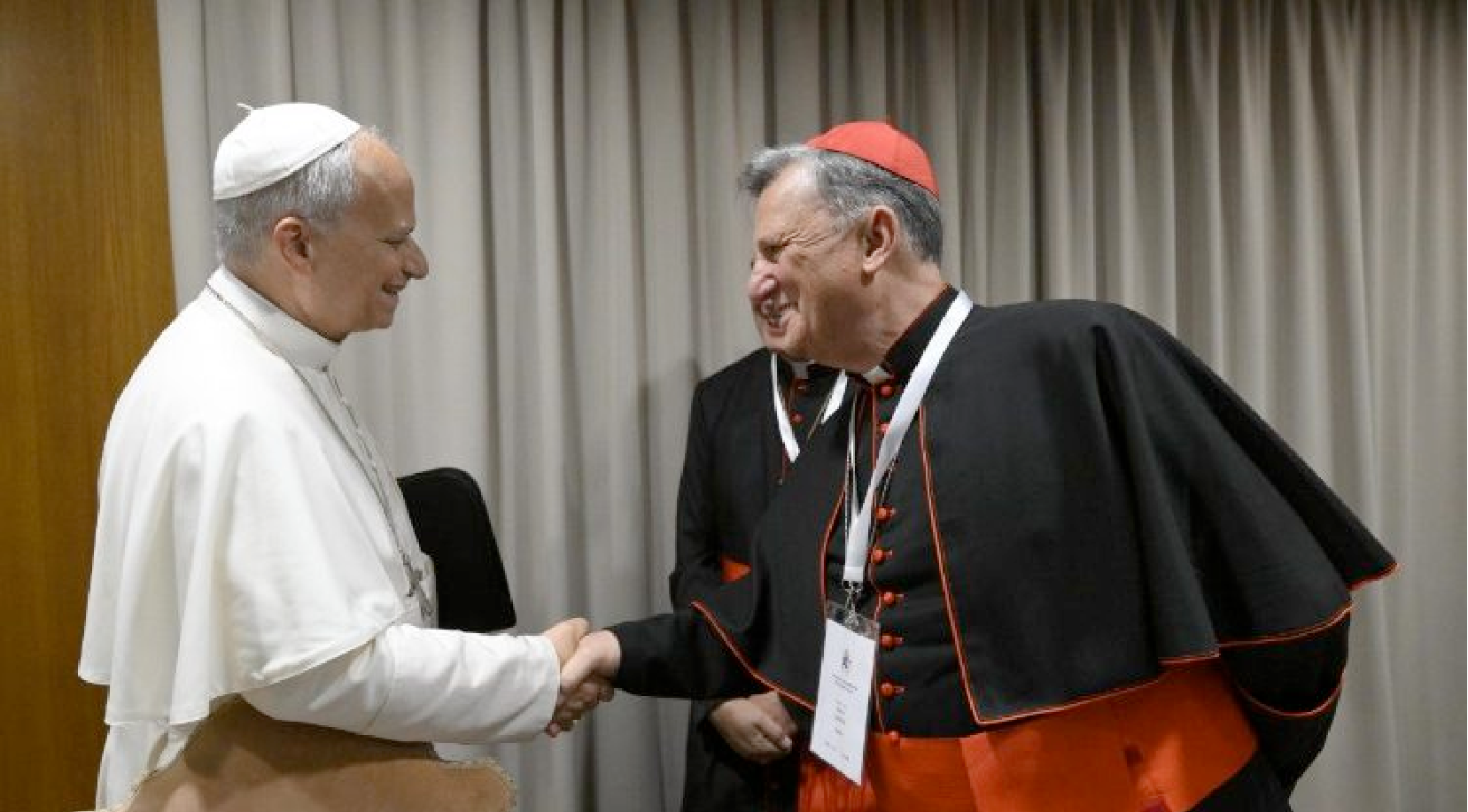
Cardenal Mario Grech
(ZENIT News / Vatican City, 06.26.2026).- Among the speeches delivered by the cardinals who were invited to speak at the request of Pope Leo XIV during the Extraordinary Consistory in late June 2026, the longest was that of Cardinal Mario Grech, Secretary General of the Synod of Bishops. He is the church leader whose immediate mission is the promotion, implementation, and development of the process that Pope Francis has termed “synodality.” Below is the full text of the extensive speech he delivered on the afternoon of Saturday, June 27, at the opening of the fourth session of the Consistory.
***
The Synod’s implementation journey
Towards the Assemblies 2027-2028
Holy Father,
Brother Cardinals,
- The Experience of the Spirit in a Church journeying in Synod
I gladly and gratefully take the floor to share some reflections on what has begun to unfold throughout the Church during these years of the synodal journey. I do so mindful of how this process has enabled all of us to experience in an intense way the listening of Bishops and of the ecclesial communities inseparably united to them; how the practice of conversation in the Spirit has spread and continues to be widely embraced; and how the desire for participation has grown across every dimension of the Church’s life. It is in this light that I wish to indicate the steps that now lie before us in what our recent document describes as the implementation phase of the Synod.
This is not, however, an intervention intended to persuade anyone of the necessity or fruitfulness of the Synod. Rather, it is a modest and humble act of faith and discernment, one that looks upon the Synod through the gift of the fear of God, bestowed by the Holy Spirit.
When, some years ago, the Synod on Synodality was launched, few could have imagined the breadth of participation it would inspire. Millions of people, in the most diverse regions of the world, took part in the journey: bishops, priests, deacons, consecrated women and men, laymen and laywomen, young people, families, and persons living in situations of suffering or marginalization. Many participated for the first time in moments of ecclesial listening and discernment. Many communities discovered new ways of meeting, dialogue, and co-responsibility.
Naturally, the process was not uniform. Ecclesial contexts differ greatly from one another. In some places, the journey was embraced enthusiastically; in others, it encountered resistance, difficulties, and questions. Yet beyond these differences, one fact deserves recognition: the Synod has awakened throughout the Church a widespread desire for participation, mutual listening, and communal discernment. It has brought to light a longing for a Church capable of journeying together, valuing the gifts and responsibilities of all.
Many of the faithful have discovered that Mother Church, to whom they belong, is also a community for which they are called to exercise co-responsibility according to their vocation. Many pastors have rediscovered that listening to the People of God does not weaken their ministry but, rather, supports and enriches it.
The Synod has been an authentic spiritual experience – indeed, it would be more accurate to describe it as an experience “in the Spirit”. The category of an experience in the Spirit now invites us to adopt it as a key for interpreting the ecclesial processes presently underway. The Spirit of God, the Spirit who is God together with the Father and the Son, is at work among us, within our conversations and debates, our consultations and discernments. There He makes present the living reality of the Risen Lord and of His being the Father’s eternal Word.
One of the most significant features accompanying the synodal experience of these years has been the choice of conversation in the Spirit as its method. The effort required of everyone – indeed, of everyone – to arrive at a new awareness capable of grasping the substantial difference between spiritual conversation (as a thematic exercise) and conversation in the Spirit (that is, entering into the self-giving and self-communication of the Risen Lord among us through the work of the Spirit) has itself become a testimony to the cry of faith dwelling in Ecclesiae in Synodo perficiendo: we desire to encounter the Risen Lord; we desire to experience and live concretely our identity as disciples.
Beyond the method itself, what struck so many participants was the discovery that ecclesial discernment consists not primarily in the exchange of opinions, but in a shared search for what the Spirit is saying to the Churches today.
- The Synod’s implementation phase: communication and communion
Brother Cardinals, gathered here with Peter and around him, if we reflect on the present moment, we can recognize that this is truly a favourable time for the whole Church to experience – while respecting the diversity of ministries – synodal participation as a dynamic force of communion, directed toward the mystery of the Church’s unity and universality. We are His Body; we are one body.
The implementation phase is an act of ecclesial communication and communion that enables participation in the exchange of gifts among the Churches, offering one’s own experience while remaining open to that of others. The synodal journey has awakened throughout the Church a spiritual desire for fraternity and sharing among the various local Churches; it has broadened the sense of belonging to the one People of God.
In other words, we are called to accompany a process of ecclesial reception. As has happened throughout the Church’s history with every significant development, the Synod now requires a period of assimilation, discernment, and maturation. The most fruitful insights do not immediately produce all their effects. They need to be received within cultures, institutions, pastoral practices, and ecclesial relationships. They need to be tested and verified in the concrete life of communities.
One of the most beautiful aspects of the synodal process is precisely the diversity of those whom it has involved and continues to involve. It is a journey that engages the entire People of God, each according to his or her vocation, charism, and responsibility.
This synodal participation in the unity and universality of the Church must therefore be carefully conceived and planned in its gradual unfolding and concrete implementation. The synodal process now requires an implementation framework, a living and participatory experience of the bond between the Spirit and the Church.
To accompany this phase, the General Secretariat of the Synod has proposed a path leading to the ecclesial Assembly foreseen for October 2028. The stages outlined in the document Towards the Assemblies 2027-2028 do not constitute a new worldwide consultation. We are not being asked to repeat the work already completed.
At times, the word “implementation” can be misunderstood. One might think of it as the simple application of decisions already taken, or as a set of tasks to be carried out. This is not the meaning we intend to give it. Rather, we are invited to gather the fruits of the experience that has been lived. We are called to help the Churches revisit what they have experienced, recognize the fruits that have matured, identify the conversions that are still needed, and gradually translate into the ordinary life of communities the insights that have emerged along the way.
Subsequently, the Churches are invited to share these experiences in the great exchange of gifts that characterizes the life of the Church. This aspect deserves particular attention. During the Synod, many Churches discovered more deeply the value of mutual listening within their own communities. The implementation phase now invites us to take a further step: to learn how to listen to other Churches. National, regional, and continental Assemblies will be not primarily meetings of Episcopal Conferences, coordinating bodies, or ecclesial structures. Rather, as far as possible, they are intended to be places of encounter among the Churches themselves, represented in the diversity of their vocations, ministries, and charisms.
The proposed path is intended precisely to foster an authentic dialogue among the Churches. Through the letters that will be prepared during the various Assemblies, each Church will be invited to share its own experience, the fruits that have matured, the insights received, and the questions that remain open. In this way, an exchange of gifts becomes possible – an exchange that goes beyond the mere transmission of information and becomes a concrete experience of ecclesial communion.
Within this process, the ministry of the Bishop plays an irreplaceable role. The Bishop is the primary steward of the synodal journey in the Church entrusted to his care. It is his responsibility to foster discernment, safeguard communion, encourage participation, and guide the process of reception. Alongside him work many others and numerous ecclesial realities: synodal teams, participatory bodies, ordained ministers, consecrated men and women, associations, movements, formation institutions, families, young people, and local communities.
- The Synod’s implementation phase: the ecclesiological significance of the various stages
The proposed path is therefore structured around stages, criteria, and tools for preparation. I will not attempt here to provide a summary of the path itself; that is the purpose of the Document. Rather, I would like to convey the spirit that underlies the choice of the four verbs that mark its stages: recollecting, interpreting, orienting, celebrating.
Recollecting: that is, choosing to accompany all the local Churches in experiencing a dynamic exchange among the Churches, one that nourishes communion and sustains mission. It means helping the Churches transform their lived experience into shared wisdom. This does not entail repeating the initial phase of listening that characterized the first stage of the Synod. Rather, it means giving hospitality to what has been heard, especially from those who experience forms of ecclesial marginalization, so as to arrive at a shared wisdom, a common narrative that chooses words of hospitality in the light of those very words of the Gospel that exclude no one.
Interpreting: is the moment when local experiences are received within a broader horizon – that of groupings of Churches capable of identifying common dynamics, convergences and tensions, and perspectives concerning the life of the Church in a given territory as a whole. In this phase, the contribution of theologians, ecclesiastical faculties, and formation institutes becomes especially valuable.
This is the theological moment, called to bring together the listening of faith and the listening of humanity, of history and of human stories, reaching both their hidden depths and their wounds. It is theology faithful to the mystery of the Incarnation. “We have the mind of Christ”, Saint Paul affirms with humility. We are therefore called to enter into those hospitable and shared narratives in order to discern the questions and expectations that dwell within them, the hopes that generate them, and the wounds that weaken them. At this deeper level, one perceives the saving bond between the life of the Church and the history of all men and women.
Orienting: within the Synod’s implementation process, the continental stage takes on a distinctive role of orientation, capable of opening new horizons. Ecclesia in Synodo perficiendo experiences her prophetic vocation. The horizons of discernment are widened. The discernment of the signs of the times, ecumenical and interreligious dialogue, and the commitment to justice and peace become measures of the Church’s diakonia. This is the synodal path of transmitting the faith. We are called to identify priorities, support the most promising processes, address questions that remain open, and offer guidance capable of directing the future journey.
Celebrating: the journey accomplished is ultimately gathered into unity, opened to further developments, and entrusted to the discernment of the Church as a whole under the guidance of the Holy Father. Celebration does not represent a merely formal conclusion to the process. Rather, it is the moment in which the Church gives thanks for the path travelled, renews her commitment to the mission, and entrusts to the Lord the steps that still remain to be taken.
Thus, Eucharistic action and synodality become profoundly intertwined. Synodality finds both its source and its summit in the liturgical celebration and, in a particular way, in the full, conscious, and active participation of the faithful in the Eucharistic Synaxis. Through the action of the Spirit, we become what we celebrate. The mystery of the epiclesis brings about a profound reciprocity between Synaxis and Synod. The Synaxis is Synod.
The Ecclesial Assembly foreseen for 2028 will need to be further specified in light of the journey that the Churches will undertake in the coming years. Even now, however, it is important to clarify that it is not conceived as a new synodal Assembly.
- What bond does the Spirit forge between our consistory and the synod?
The Holy Spirit is the true bond between the experience of the Consistory and the synodal experience that all of us, together with the entire People of God, have lived thus far. Our gathering in Consistory does not stand apart from the mature ecclesial spirituality of synodality that has become so widely established throughout the Church. We belong to the one Body of the Lord, which is the Church, and within her we share, through the synodal exercise of communion, a particular closeness to Peter and to his precious universal ministry.
Today we experience the presence of the Spirit among us as the living bond between Collegiality and Synodality – two operative dimensions of the same Communion. The Consistory is called to be a living memory of that collegial communion which the Master entrusted to his first disciples as a relational style of governance and which he entrusted to the responsibility, primacy, and faith of Peter, sign and guardian of the unity of the whole Church.
Alongside the synodal assemblies – which are themselves a living memory of that fraternal and theological communion that gives life to every local Church and sacramentally enables it to participate in the gift of salvation – the Consistory is now called to exercise a ministry of discernment and witness. Thus, we are all heirs and faithful interpreters of the ecclesiology of the Second Vatican Council: that ecclesiology of the People of God and of communion which finds in the hierarchica communio both its structure and its vital force.
Today the Consistory takes place within that synodal process that permeates the whole Church – a Church journeying in Synod. Our collegiality, no less than synodality, is a hospitable space capable of welcoming anew the presence of the Lord in the Spirit.
Synodality without the ministry of the Pastors would risk losing its ecclesial grounding. Collegiality without listening to the People of God would risk failing to benefit fully from the richness of the gifts that the Spirit distributes throughout the Church.
- Our confidence is that the Holy Spirit continues to guide the Church
Brother Cardinals, in this context of fraternity and collegiality, in the presence of Peter, I wish to address you directly. The journey we have described concerns not only the General Secretariat of the Synod, the synodal teams, or those more directly involved in organizing the process. It concerns the whole Church and, in a particular way, the ministry that each of us exercises.
Many of you shepherd local Churches that are called to live this implementation phase. Others serve the universal Church through the Dicasteries of the Roman Curia. All of us share responsibility for safeguarding ecclesial communion and advancing the Church’s mission. For this reason, the contribution of the College of Cardinals will be especially important in the years ahead.
The synodal journey requires our support, our discernment, and our closeness to the Churches. We are called to encourage processes of reception, to help overcome misunderstandings and fears, and to foster a climate of trust and communion. The implementation phase requires a wisdom that is shared. For the ultimate horizon remains mission.
Synodality is not an end in itself. It exists so that the Church may proclaim the Gospel more effectively and serve the men and women of our time more faithfully. We live in a world marked by profound transformations. Wars and violence continue to wound entire peoples. Social inequalities are increasing. Migration is reshaping the face of our societies. New technologies are changing the way we communicate, learn, and even understand ourselves. Many people are searching for meaning, hope, and authentic relationships. Many look to the Church for a credible witness to the Gospel.
Faced with these challenges, synodality appears ever more clearly as a missionary resource. It helps the Church to listen more attentively to the questions of humanity, to recognize the signs of the times, to value the gifts of all, and to discern together the steps to be taken. In this way, the implementation phase becomes a new stage in the reception of the Second Vatican Council and in the missionary renewal of the Church within the concrete realities of ecclesial life.
This is the responsibility that the Holy Father, Pope Leo XIV, encourages us to embrace together: not merely to preserve an inheritance we have received, but to make it bear fruit in the life of the Churches and in the mission entrusted to the Church in our time.
Allow me a final thought. At a global moment marked by the tragedy of a geopolitics that has become accustomed – almost resigned – to war and economic domination, Ecclesia in Synodo perficiendo can become, for the history of the human family, a sign of the times: a witness to a style of governance and participation shaped by the evangelical virtue of meekness. As Pope Leo states in Magnifica Humanitas, in society’s endeavor of rebuilding the New Jerusalem, “Christians discover their unique role of guiding actions toward God so that, in his light, pluralism does not dissipate into disorder, but instead, through the practice of synodality, it becomes the space in which humanity rediscovers its solid foundations and its final end.” (10).
The beatitude of meekness is the spiritual soul of the synodal journey.
Thank you for reading our content. If you would like to receive ZENIT’s daily e-mail news, you can subscribe for free through this link.

Publicaciones relacionadas:
 Cardinal Ambongo: statements on the new colonialisms and Fiducia Supplicans
 What Is the Difference Between the Holy See, Vatican City, and the Roman Curia? Cardinal Ghirlanda Explains
 Vatican to Release Marian Document Clarifying Supernatural Phenomena Guidelines
 “We return from Gaza with broken hearts”: Cardinal Pizzaballa at press conference in Jerusalem
