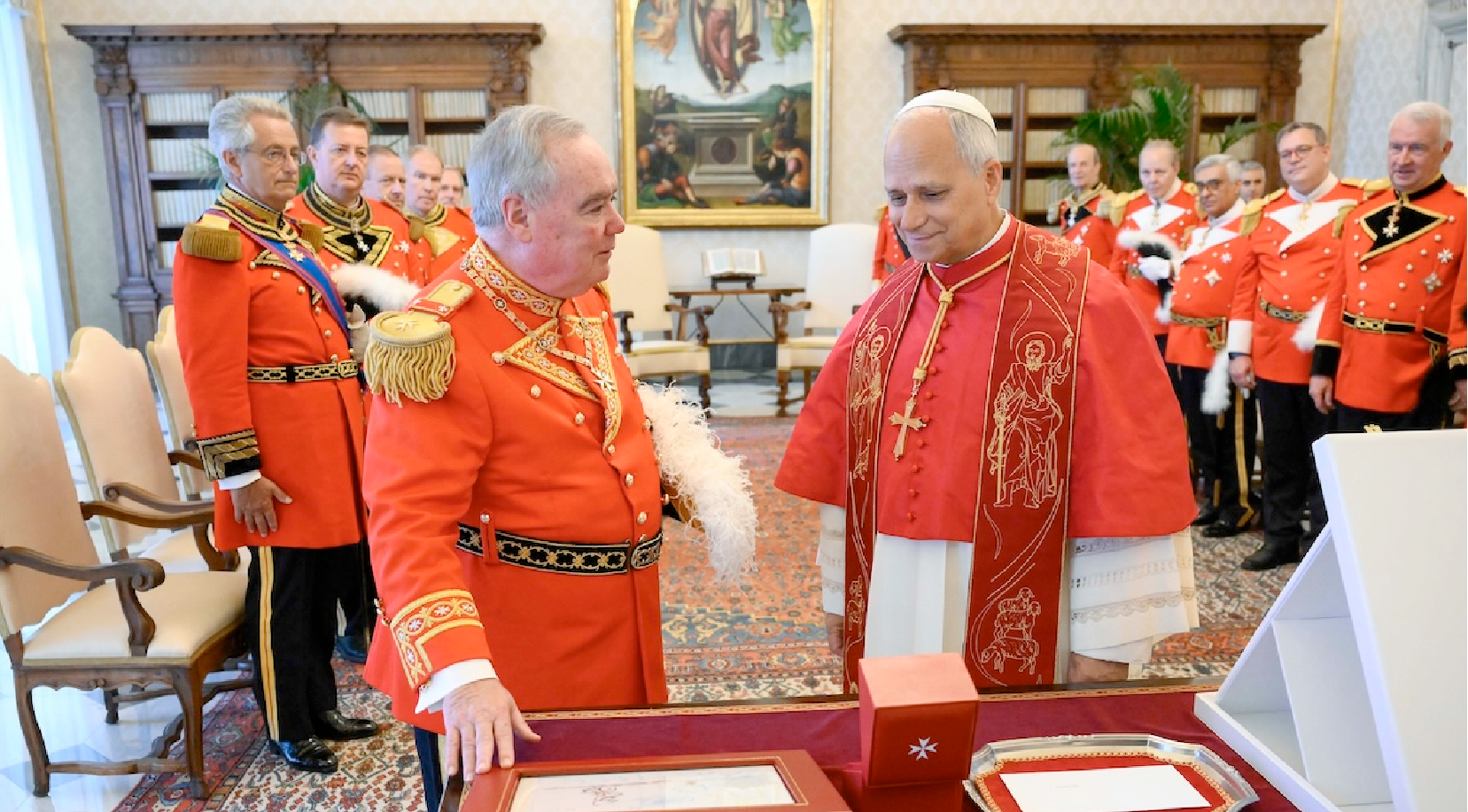
(ZENIT News / Vatican City, 06.29.2026).- Pope Leo XIV has made his first significant legal intervention in the governance of the Sovereign Military Order of Malta, approving a series of targeted amendments to the Order’s Constitutional Charter and Melitense Code. While the changes are relatively limited in scope, they provide an early indication of how the new pontiff intends to relate to one of the Catholic Church’s oldest and most distinctive institutions.
The Rescriptum ex Audientia Sanctissimi, approved by the Pope on April 10 and signed by Cardinal Gianfranco Ghirlanda, revises fourteen provisions—five articles of the Constitutional Charter and nine articles of the Melitense Code. Rather than rewriting the constitutional framework established in 2022, the document fine-tunes specific aspects of governance, internal oversight, and religious formation.
The amendments introduce fixed term limits for the Order’s highest offices, one of the most notable innovations. Senior officials will now serve six-year terms and may hold office for no more than two consecutive mandates. Similar limits are extended to representatives of the Second and Third Classes serving on governing councils, reinforcing a broader principle of periodic renewal within the institution.
Another significant development concerns the balance of authority inside the Order itself. Decisions regarding the establishment of Priories, Sub-Priories and Associations, together with the approval of their statutes, will no longer depend solely on the Grand Master’s initiative. Instead, they will require the joint consent of both the Council of the Professed and the Sovereign Council. If those two bodies fail to reach agreement, the Grand Master cannot proceed.
The reforms also adjust the admission process for candidates entering the Aspirancy, assigning the final decision to the Grand Master acting with the consent of the Council of the Professed. At the same time, the regulations governing spiritual exercises have been updated, with retreat requirements becoming more differentiated according to members’ vocation and responsibilities. Depending on the class of membership, retreats will now last between three and eight days.
Although these revisions may appear technical, they are best understood against the backdrop of one of the most turbulent periods in the Order’s modern history.
The constitutional crisis began in late 2016 with the dismissal of Grand Chancellor Albrecht von Boeselager, a dispute that soon escalated into a direct confrontation between the Order’s leadership and Pope Francis. In January 2017, Grand Master Fra’ Matthew Festing resigned at the Pope’s request after resisting a Vatican investigation, arguing that the Order’s sovereignty should protect it from outside intervention.
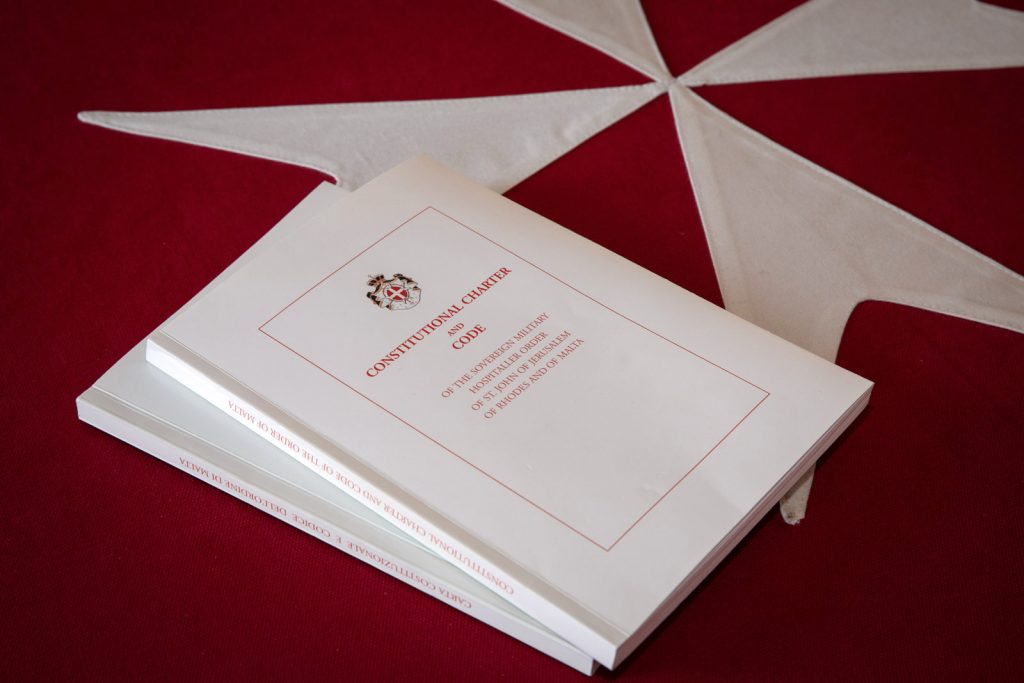
The Holy See responded by appointing a Special Delegate with extraordinary powers, first Cardinal Angelo Becciu and later Cardinal Silvano Maria Tomasi, assisted by Jesuit canon lawyer Gianfranco Ghirlanda. During the following years, the Vatican exercised unprecedented oversight of the Order’s constitutional reform, culminating in September 2022 when Pope Francis personally promulgated a new Constitutional Charter and Melitense Code, dissolved the Sovereign Council, revoked the principal offices, and appointed an interim governing body pending fresh elections.
That reform reaffirmed a principle long recognized in canon law but frequently debated in public discussion: although the Order enjoys international legal personality and maintains diplomatic relations with more than one hundred states, it remains first and foremost a religious order subject to the spiritual authority of the Holy See. The Vatican cited the conclusions of the 1953 Cardinals’ Tribunal established under Pope Pius XII, which held that the Order’s sovereign prerogatives are functional rather than equivalent to those exercised by fully sovereign states.
The election of Fra’ John Dunlap as Grand Master in May 2023 marked the beginning of a more stable phase after years of institutional uncertainty. With the conclusion of the Special Delegate’s mandate and Cardinal Ghirlanda’s subsequent appointment as Cardinal Patron, governance returned to more ordinary channels.
It is within that context that Leo XIV’s rescript acquires its broader significance.
Legally, the new Pope has fully embraced the constitutional framework inherited from his predecessor. The amendments were approved «in forma specifica,» confirming that the Order’s fundamental law continues to require papal approval for any modification. In that sense, there is no reversal of the central role assumed by the Holy See during the previous reform.
Yet the substance of the new measures tells a somewhat different story. None of the fourteen amendments expands the authority of the Vatican, the Cardinal Patron, or the Pope over the internal administration of the Order. Instead, the revisions strengthen institutional checks and balances within the Order itself, redistributing responsibilities among its own governing bodies rather than transferring additional authority to Rome.
Equally noteworthy is the process that produced the reforms. Unlike the extraordinary interventions that characterized the previous decade, the amendments originated from a request submitted by the Grand Master, examined through the ordinary office of the Cardinal Patron, and ultimately ratified by the Pope. The sequence suggests a return to regular constitutional governance rather than exceptional papal administration.
Founded in Jerusalem around 900 years ago, the Sovereign Military Order of Malta today combines its religious vocation with one of the world’s largest humanitarian networks, operating hospitals, emergency medical services and relief missions in more than 120 countries. Its unique dual identity—as both a religious order of the Catholic Church and a sovereign entity under international law—has long required a delicate balance between autonomy and ecclesiastical oversight.
Leo XIV’s first legislative act concerning the Order does not alter that balance dramatically. Instead, it appears to signal a quieter approach: preserving the constitutional architecture established after years of crisis while allowing the institution greater responsibility for managing its own internal life within the framework of the Church’s authority.
Thank you for reading our content. If you would like to receive ZENIT’s daily e-mail news, you can subscribe for free through this link.