

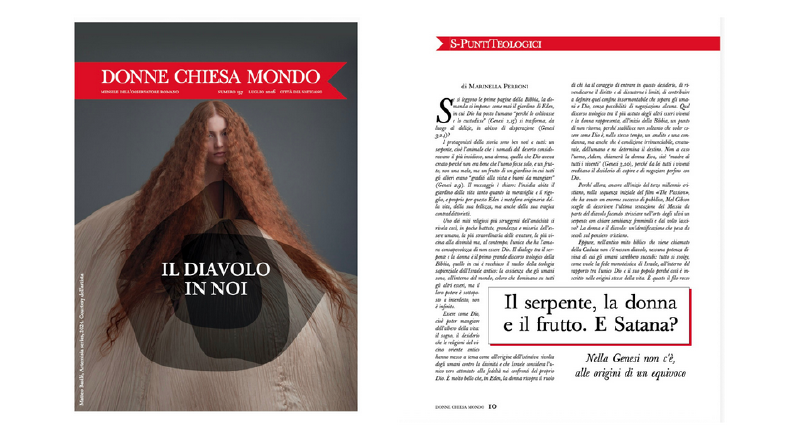
(ZENIT News / Rome, 07.07.2026).- A theological debate has erupted following the publication of the latest issue of Donne Chiesa Mondo, the monthly supplement of L’Osservatore Romano, after several contributors examined the nature of evil in ways that critics say blur the Catholic Church’s longstanding teaching on the personal existence of Satan.
The controversy centers on Issue No. 157, released on July 1 under the theme “The Devil Within Us.” While the edition explores evil through biblical, psychological, cultural and social perspectives, its overall approach has prompted questions about whether it adequately reflects Catholic doctrine on one of Christianity’s most fundamental spiritual realities.
Much of the discussion has focused on an essay by Italian New Testament Marinella Perroni, titled “The Serpent, the Woman and the Fruit. And Satan?” In it, Perroni argues that the account of humanity’s fall in Genesis does not explicitly identify the serpent with the devil. She notes that the association between the serpent of Genesis 3 and Satan emerged progressively within later Jewish tradition before being fully developed in Christian interpretation.
From a historical and exegetical perspective, this observation is widely recognized by biblical scholars. The Book of Genesis itself never names the serpent as Satan; the explicit identification appears later in biblical revelation, most notably in the Book of Revelation, where the “ancient serpent” is identified with the devil. Perroni also traces the development of Jewish demonology to later historical periods influenced by the religious cultures of the ancient Near East and the Hellenistic world.
Her essay further argues that subsequent interpretations of Genesis contributed to linking women, sin and the devil within patriarchal frameworks that shaped Christian thought over the centuries.
Other articles in the issue continue the same general exploration from psychological and cultural perspectives. Italian author Dacia Maraini reflects on evil as rooted in the human heart, while additional contributors examine experiences commonly described as “the devil” through the lenses of guilt, emotional wounds, personal trauma and social pressures.
For many readers, however, the principal concern lies less in what the contributors affirm than in what they leave unsaid. Critics argue that the edition gives considerable attention to symbolic and psychological interpretations while offering little reference to the Church’s authoritative teaching on Satan as a real personal being.
Catholic doctrine on this point has remained remarkably consistent. The Fourth Lateran Council in 1215 taught that the devil and the other demons were created good by God but became evil through their own free choice. The Catechism of the Catholic Church, particularly paragraphs 391 through 395, presents Satan as a fallen angel rather than a metaphor for evil. More recently, St. Paul VI warned in a 1972 general audience that denying the existence of the devil departs from biblical and ecclesial teaching, while Pope Francis repeatedly emphasized throughout his pontificate that Christians face not merely abstract evil but the action of a personal spiritual adversary.
The publication’s treatment has drawn particular attention because Donne Chiesa Mondo appears under the banner of L’Osservatore Romano, the Holy See’s newspaper. Although the supplement maintains editorial independence and does not exercise magisterial authority, its association with the Vatican inevitably leads many readers to assume that its contents broadly reflect contemporary Catholic thought.
The discussion also illustrates a broader challenge facing Catholic biblical scholarship. Modern exegesis frequently distinguishes between the historical development of biblical texts and later doctrinal formulations, while the Church insists that Sacred Scripture must ultimately be interpreted within the living Tradition and the Magisterium. For Catholic theology, historical-critical analysis and doctrinal teaching are not meant to contradict one another but to illuminate different dimensions of divine revelation.
As a result, the debate surrounding the latest issue extends well beyond one author’s interpretation of Genesis. It touches on a larger question confronting contemporary theology: how biblical scholarship, historical research and pastoral reflection can engage modern readers without obscuring doctrines that the Church has consistently regarded as essential to the Christian faith.
Thank you for reading our content. If you would like to receive ZENIT’s daily e-mail news, you can subscribe for free through this link.

Publicaciones relacionadas:
 A diplomatic storm denied: Vatican and Washington push back against claims of Pentagon pressure on the Holy See
 Trump and Vance prolong the conflict with Leon XIV as Russia and Brazil join the controversy
 On the Controversy with Trump, Leo XIV Denounces a «Not Entirely Accurate Narrative»
 Trump takes another swipe at the Pope following the audience granted by Leo XIV to the mayor of Chicago
