

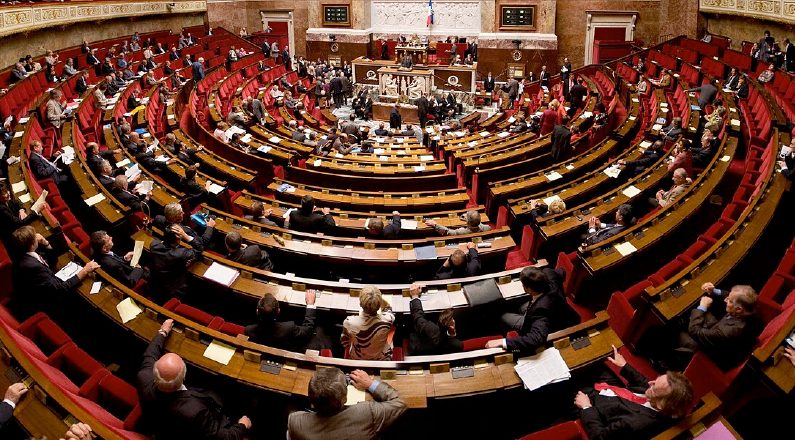
(ZENIT News / Paris, 07.17.2026).- France has taken a decisive step toward legalizing euthanasia and assisted suicide, but the country’s most consequential debate over the end of life is not yet over.
On July 15, the National Assembly approved the legislation by 291 votes to 241, with 29 abstentions, after more than two years of parliamentary conflict and four separate votes in the lower house. The Senate rejected the measure three times, but a constitutional mechanism allowed the National Assembly to give the bill final approval without securing the Senate’s agreement.
Prime Minister Sébastien Lecornu has now referred the legislation to the Constitutional Council, which will examine several of its most controversial provisions before the law can be promulgated.
The vote fulfilled a major political commitment made by President Emmanuel Macron, who had promised during his 2022 presidential campaign to open the way to assisted dying. Macron said after the vote that he had kept that promise through a democratic process conducted with seriousness and respect.
Yet the narrowing parliamentary majorities tell another part of the story. The bill received 305 votes in favour and 199 against in May 2025, 299 to 226 in February 2026, and 295 to 232 in June. Its final passage, at 291 to 241, came after years of opposition from senators, doctors, healthcare professionals, civil society groups and religious leaders.
The legislation represents a major departure from France’s previous legal framework.
Under the 2005 Leonetti law, patients could refuse treatment considered unreasonable and doctors could allow a terminally ill person to die without artificially prolonging the dying process. Since 2016, French law has also permitted continuous deep sedation in certain circumstances for terminally ill patients.
The new legislation goes further. It creates a legal framework under which an adult may request assistance to die if he or she is a French citizen or a stable legal resident, suffers from a serious and incurable illness that is advanced and life-threatening, experiences physical or psychological suffering that is unbearable or resistant to treatment, and is capable of making a free and informed decision.
Psychological suffering alone is excluded.
The normal procedure requires the patient to administer the lethal substance personally. If the person is physically unable to do so, a doctor or nurse may administer it. The requesting doctor must reach a decision within 15 days, and the patient must confirm the request after a minimum two-day reflection period.
The legislation deliberately avoids the words «euthanasia» and «assisted suicide», opting instead for the more politically acceptable expression «assistance to die». Supporters argue that the terminology reflects a carefully regulated medical procedure rather than an unrestricted authorization to kill.
Critics answer that the legal reality matters more than the vocabulary. When a healthcare professional may directly administer a lethal substance to a patient, they argue, the law has entered the territory of euthanasia regardless of the terminology chosen.
The French bishops have been equally clear in their opposition.
The French Bishops’ Conference described the vote as a grave turning point, arguing that the law breaks with a long tradition of care whose purpose has been to relieve suffering and accompany people until their natural death.
The bishops’ concern is not limited to the immediate operation of the law. They fear that its cultural consequences could gradually alter how society views old age, disability, illness and dependence.
The most vulnerable, they warn, may ultimately be the least free. An elderly person living in poverty could feel pressure to die rather than become a burden to children or grandchildren. The Church also points to the possibility that eligibility criteria may expand over time, while investment in palliative care loses political urgency.
The Pontifical Academy for Life has expressed a similar concern, while placing particular emphasis on the human response to suffering.
Father Andrea Ciucci, the Academy’s secretary, argued that everyone should be helped to die in the sense that no one should be abandoned at the moment of death. But, he insisted, this must mean helping people to live fully through the final stage of life, not deliberately causing death.
That distinction goes to the heart of the Catholic position. The Church does not deny the reality of unbearable suffering, nor does it regard a request to die as something that can simply be dismissed. Such a request, Ciucci argued, must be taken seriously. But the response, he maintained, should begin with the person’s loneliness, fear, pain and social circumstances rather than treating death as the solution.
The French bishops have therefore placed renewed emphasis on palliative care and personal accompaniment. Their argument is that medicine should relieve pain without transforming the deliberate ending of a patient’s life into a medical service.
The legislation’s treatment of conscience has become another major point of controversy.
Individual healthcare professionals may refuse to participate. However, critics argue that the protection is incomplete. Pharmacists may still face obligations connected with assisted dying, while institutions whose religious identity rejects euthanasia may not be allowed to refuse participation as institutions.
That issue is particularly significant for Catholic healthcare organizations and religious foundations whose mission is built around caring for the sick and dying while explicitly rejecting the deliberate taking of life.
Bishop Mathieu Rougé of Nanterre, a spokesman for the French bishops on end-of-life issues, has argued that an institution must be able to preserve its ethical identity. A personal conscience clause, he maintains, does not adequately protect a hospital or care institution whose entire mission is founded on a contrary moral commitment.
The Constitutional Council will now examine several of these issues, including the two-day reflection period, the treatment of adults under legal protection and the obligation imposed on healthcare and social-care institutions. The Council may uphold the law, strike down particular provisions or impose interpretive conditions.
For the Church in France, however, the legal battle is only one part of the response.
The bishops have called for a renewed commitment to people who are isolated, poor, disabled, elderly or seriously ill. Their argument is that a law cannot by itself determine the moral culture of a nation. If people request death because they feel abandoned, the answer must include a society willing to stand beside them.
That is why the bishops have urged Catholics to respond not merely with condemnation, but with concrete fraternity involving families, healthcare workers, volunteers, relatives, associations and chaplains.
The debate has also raised questions about the role of Catholic politicians. Some French bishops have warned Catholic legislators that voting for a law authorizing the intentional ending of a patient’s life creates a serious contradiction with fundamental Catholic teaching. The question has generated tensions even in local communities, where priests and politicians have publicly disagreed over the legislation.
The controversy will acquire an additional dimension later this year, when Pope Leo XIV is expected to visit France. French Catholics opposed to the law are likely to look to the Pope for a clear defence of the right to life and for encouragement to accompany vulnerable people.
The new French law, if it survives constitutional review, will place the country among a growing number of nations that permit some form of assisted dying, including Belgium, the Netherlands, Spain, Switzerland, Canada and Uruguay.
But France’s decision also reveals the unresolved question beneath the legislation: whether the answer to suffering is best expressed by offering death as a legally recognized option, or by building a society in which no one concludes that death is preferable because care, medicine, family or community have failed.
The bishops have chosen their answer. They insist that fraternity must serve life, not death.
The final decision now belongs to the Constitutional Council. The deeper cultural question, however, will remain long after the judges have ruled: when a society legalizes the power to end a life in response to suffering, can it ensure that the choice will always be entirely free—or will the weakest eventually discover that what the law presents as a right can begin to feel like an expectation?
Thank you for reading our content. If you would like to receive ZENIT’s daily e-mail news, you can subscribe for free through this link.

Publicaciones relacionadas:
 USA: Survey Shows That Those with “No Religion” Aren’t Increasing
 New Gallup Poll Shows Approval and Disapproval Levels of Pope Francis in the U.S.
 Religion and Elections in the USA: Pew Research Reveals How Each Candidate Is Supported
 The Middle East, the spread of war, and the position of the Pope and the Catholic Church
