

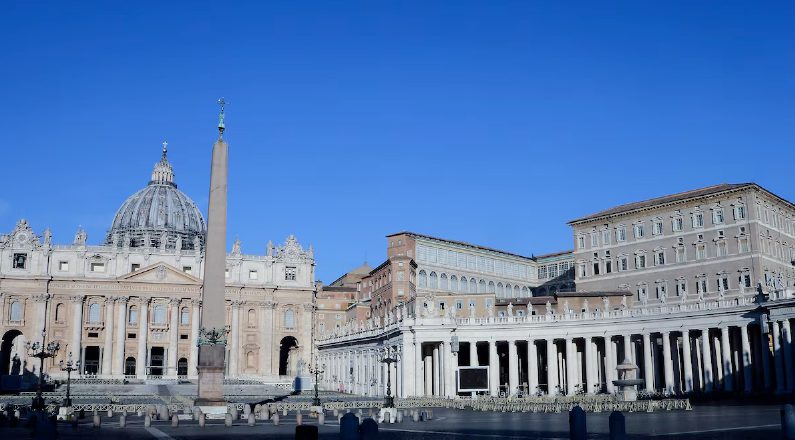
(ZENIT News / Vatican City, 09.15.2026).- Leo XIV has reformulated some of the practical decisions inherited from Pope Francis through two measures.
On Monday, September 14, the Vatican announced that Leo XIV had abolished the salary reductions imposed during the coronavirus pandemic, while also overturning a plan to expand the Vatican Apostolic Archive and Vatican Apostolic Library into the premises of the Pontifical Roman Major Seminary at the Lateran. In both cases, the pope did not simply restore the past. He replaced earlier arrangements with a different approach to the problems they were intended to solve.
The salary decision marks the end of an exceptional measure introduced by Francis in March 2021, when the pandemic had compounded a financial deficit that had already affected the Holy See for years. Cardinals working in the Roman Curia had their salaries reduced by 10 percent, heads and secretaries of Vatican departments by 8 percent, and clergy and religious by 3 percent. Biennial seniority increases were also suspended for employees from salary grade four upward.
Francis had presented the cuts as a way of containing expenditure and avoiding more painful consequences, including staff dismissals. The measure therefore belonged to a broader effort to protect employment while Vatican revenues were under severe pressure.
Leo XIV’s new decree, issued after consultation with the Council for the Economy, takes effect retroactively from September 1. The 10 percent reduction for cardinals and the 8 percent reduction affecting senior Vatican officials are consequently removed. The 3 percent reduction for clergy and religious had already been abolished in June 2025.
The decision does not, however, amount to a financial return to the status quo before the pandemic. The Vatican will not reimburse sums previously withheld, pay arrears or restore the seniority increases that were frozen between 2021 and 2023. Those restrictions therefore remain part of the financial legacy of the crisis.
The timing is significant because the Holy See’s accounts have improved considerably, although they are far from resolving its longer-term structural difficulties. In 2024, the Vatican reported a surplus of €1.6 million, compared with a €51.2 million deficit in 2023. The structural deficit, excluding financial-market results, fell almost by half, from €83.5 million to €44.4 million.
The improvement was attributed principally to higher donations and stronger financial results. The Vatican’s own economic assessment cautioned that full financial sustainability remains a long-term objective, particularly because the improvement has depended substantially on donations.
Leo’s decree acknowledges precisely that tension. The salary restrictions can now be lifted because circumstances have changed, but the institutions of the Holy See and Vatican City State are expected to continue pursuing economic sustainability through other means.
That same concern with institutional sustainability appears in the pope’s second decision of September 14, concerning a problem of a very different kind: where the Vatican will put its growing documentary and intellectual heritage.
The Apostolic Archive and Apostolic Library have accumulated material for decades, to the point that existing storage facilities are no longer sufficient. The Vatican has repeatedly had to find new space. In 1927, Pius XI converted former stables in the Belvedere Courtyard into storage for printed books. Paul VI later commissioned an underground archive beneath the Pinecone Courtyard, inaugurated by John Paul II in 1980, with approximately 85 kilometers of shelving. Additional storage for manuscripts was created beneath the Library’s internal courtyard between 1982 and 1984.
Francis had chosen another solution. In a June 2024 decision, he designated part of the Pontifical Roman Major Seminary and its surrounding premises at the Lateran for an expansion of the two institutions. The plan had already moved beyond the conceptual stage: the Library was using storage space at the seminary, and a commission had been established to determine what materials might eventually be transferred there.
Leo XIV has now redirected the project back inside Vatican City State. His September 14 chirograph orders the construction of new repositories in the area known as the Automobile Pool Fountain and its adjoining spaces. The Vatican’s vehicle facility will have to be relocated and a new parking area created. The new building is to use modern architectural and technological standards, with its principal purpose being to house the Archive and Library, while allocating space fairly between them and reserving part of the building for other Vatican services.
The financial arrangements are unusually explicit. The Governorate will pay only for the portions of the building devoted to its own services. The Archive and Library will finance the remaining costs, including the relocation of the vehicle facility and construction of its replacement parking area.
To raise those funds, Leo has ordered the two institutions to establish a Vatican foundation to support the project. Such foundations remain public entities of the Holy See and operate under economic oversight and auditing mechanisms. The pope used a similar institutional structure in June for the “Brother Sun” foundation created by the Governorate and the Administration of the Patrimony of the Apostolic See to develop the agrivoltaic project at Santa Maria di Galeria.
The contrast between the two decisions is revealing. In the first, Leo XIV is removing an emergency measure because the financial circumstances that prompted it have improved, while preserving safeguards against a return to unchecked expenditure. In the second, he is abandoning a solution already selected under Francis and substituting a project that keeps the Vatican’s principal cultural institutions within the state’s territory.
Neither move necessarily represents a repudiation of Francis’s objectives. The pandemic salary cuts were designed to protect the Vatican’s finances and jobs; Leo maintains the commitment to sustainability while judging that the exceptional restrictions are no longer necessary. Francis’s Lateran plan was likewise an attempt to solve a genuine shortage of archival and library space. Leo accepts the problem but has chosen a different answer.
Taken together, the decisions suggest an early feature of Leo XIV’s administration: inherited problems are being revisited not simply by reversing his predecessor, but by asking whether the structures created to address them remain the most appropriate ones.
Thank you for reading our content. If you would like to receive ZENIT’s daily e-mail news, you can subscribe for free through this link.

Publicaciones relacionadas:
 Pope Francis Institutes Vatican’s Investments Committee Headed by Cardinal Kevin Farrell
 Pope Announces that Two Women Will Assist Him in the Dicastery that Chooses the Bishops from Around the World
 Cardinal Ouellet Says “The Interpretation and Diffusion of Accusations as Sexual Aggressions Is Defamatory”
 Pope Francis Authorizes the Renovation of the Swiss Guards’ Barracks
