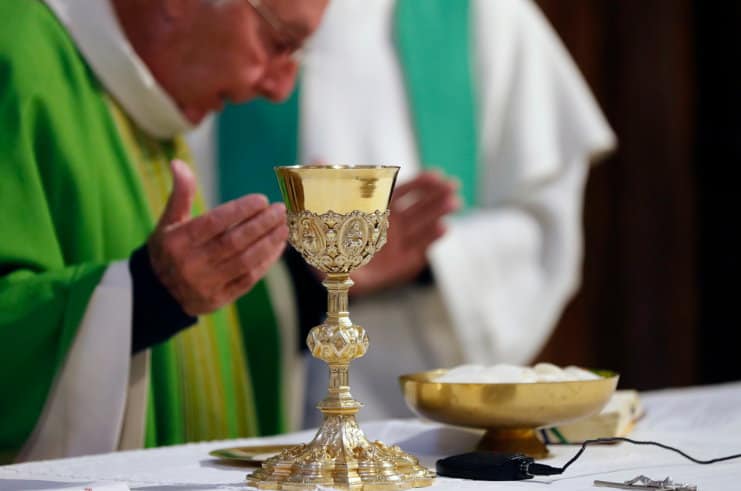
(ZENIT News / Rome, 10.04.2026).- Answered by Legionary of Christ Father Edward McNamara, professor of liturgy and sacramental theology at the Pontifical Regina Apostolorum university.
Q: During a Sunday Mass at church the priest forgot to do the consecration of the bread and wine. He was in his 50s and looked healthy. A priest assistant tried to tell the priest, but he was not aware. So, the communion was distributed without the consecration having been done. This case has been reported to the archbishop. If this happens at a Mass I attend, what should I do? Should I attend another Mass? What if I cannot attend the next Mass? — M.Y., Jakarta, Indonesia
A: While this might seem to be an exceptional situation, it does occasionally happen. Priests are human beings and can be distracted by stray thoughts or even a medical condition.
However, rather than the entire consecration, it is more common that one of the two parts of the consecration is skipped, most often that of the chalice, by the priest jumping from the consecration of the host to the Mystery of Faith.
Even with respect to the pre-Vatican II liturgy, with the priest reciting the Canon in a low voice, the manuals of sacramental moral and pastoral theology, such as that published by Jesuit Father Henry Davis in 1935, dealt with the possibility of a priest doubting if he had consecrated one or both species.
He was advised to ask the altar server who would be beside him if he remembered the priest elevating the host and/or chalice during the Canon. If the response was affirmative, the priest could continue the Mass in good faith. If there was insufficient certainty, the priest would conditionally repeat the words of consecration before continuing with the rest of the Mass.
In the present form of Mass, such an error would usually be immediately evident to any attentive parishioner, as was the case of our reader.
In such a grave case the deacon, an acolyte or anybody at all should immediately cast aside any human respect and approach the priest to tell him that he has omitted the consecration.
I was surprised that, given the essential nature of the situation presented by our reader, the priest assistant was not more forceful in reminding the priest that he had omitted the consecration.
Once informed, the priest should then interrupt the Eucharistic Prayer and proceed to consecrate the bread and wine before continuing. He should preferably repeat the second part of the Eucharistic Prayer as these orations only make sense in the presence of the complete sacrifice. If he finds out later, say, just before communion, he will only need to say the words of consecration.
If the priest was in a confused state of mind due to some illness, the assistant priest mentioned by our reader could even have substituted him as presider and continued the Mass from the consecration onward.
The consecration of both species is an absolute necessity for a valid Mass. And the priest’s communion is necessary for its completeness as a sign of sacrifice. It is true that Christ is really present in the hosts immediately after the consecration of the bread, but the sacrifice of the Mass requires the consecration of both species.
If the priest found after Mass that he had omitted the whole consecration, He should repeat the entire celebration as Mass would not have taken place.
If a priest is told that he omitted the consecration of the chalice after the Mass is over, he should privately complete the sacrifice by pouring wine and water into the chalice, consecrate and consume the Sanguis (see General Instruction of the Roman Missal, 324).
The same basic principle would apply in the less likely situation of a priest skipping directly to the consecration of the chalice and omitting the consecration of the hosts. The change in order of the two consecrations would not invalidate the Mass.
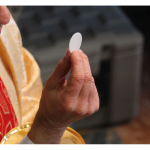
In the case presented by our reader of the omission of the entire consecration, the hosts are not consecrated and hence under no circumstances should they be distributed to the faithful. Likewise, any member of the faithful who realizes what has happened should not approach the sanctuary.
To do so would be technically a material act of idolatry, by offering divine worship to an unconsecrated host.
In the case of hosts consecrated before the omission of the consecration of just the chalice, as a general principle, they should not be distributed for communion until the wine is consecrated. This is because hosts should only be distributed as the fruit of a completed sacrifice of the Mass.
The above-mentioned manual, albeit treating of the more dramatic case of a priest taken ill or dying after consecrating the hosts, states the following:
«Only in very rare and extreme situations may the consecrated species of an interrupted Mass be consumed. Such occasions would be, for example, an imminent danger of profanation of the sacred species or the objective impossibility of safely keeping them, such as during wartime conditions or a climate where the species of wine would certainly become corrupt before a priest can come to complete the Mass.”
If a priest forgets to consecrate the chalice and then administers the hosts to the faithful, they will receive the Body of Christ but, strictly speaking, would not have participated at the sacrifice of the Mass. It would not even be the same as the distribution of Communion outside of Mass as hosts thus received are the fruit of a complete sacrifice.
Needless to say, such distractions ought never to occur, but frail humanity — and priestly humanity is no exception — is fraught with imperfections and limitations. Thus, such things do happen.
I would say that the faithful, if they are able to attend another Mass with no great inconvenience, would do well to do so, but would not be obliged as they have done all they can to fulfill the precept.
* * *
Follow-up: Words of Absolution
The version of the formula of absolution that I offered last week was imprecise in one detail. The official formula should read:
«God, the Father of mercies,
through the Death and Resurrection of his Son
has reconciled the world to himself
and poured out the Holy Spirit for the forgiveness of sins;
through the ministry of the Church
may God grant you pardon and peace.
AND I ABSOLVE YOU FROM YOUR SINS,
IN THE NAME OF THE FATHER, AND OF THE SON, + AND OF THE HOLY SPIRIT.
R. Amen.”
In the version I included, from a normally reliable source, the author correctly noted the change of «sent the Holy Spirit among us» to the new, and more precise translation: «poured out the Holy Spirit» but he included the expression «among us» which in fact has logically been removed as “poured out among us” would not make much sense.
The other change was from «give» to «grant,» referring to pardon and peace.
* * *
Readers may send questions to zenit.liturgy@gmail.com. Please put the word «Liturgy» in the subject field. The text should include your initials, your city and your state, province or country. Father McNamara can only answer a small selection of the great number of questions that arrive.
Thank you for reading our content. If you would like to receive ZENIT’s daily e-mail news, you can subscribe for free through this link.