

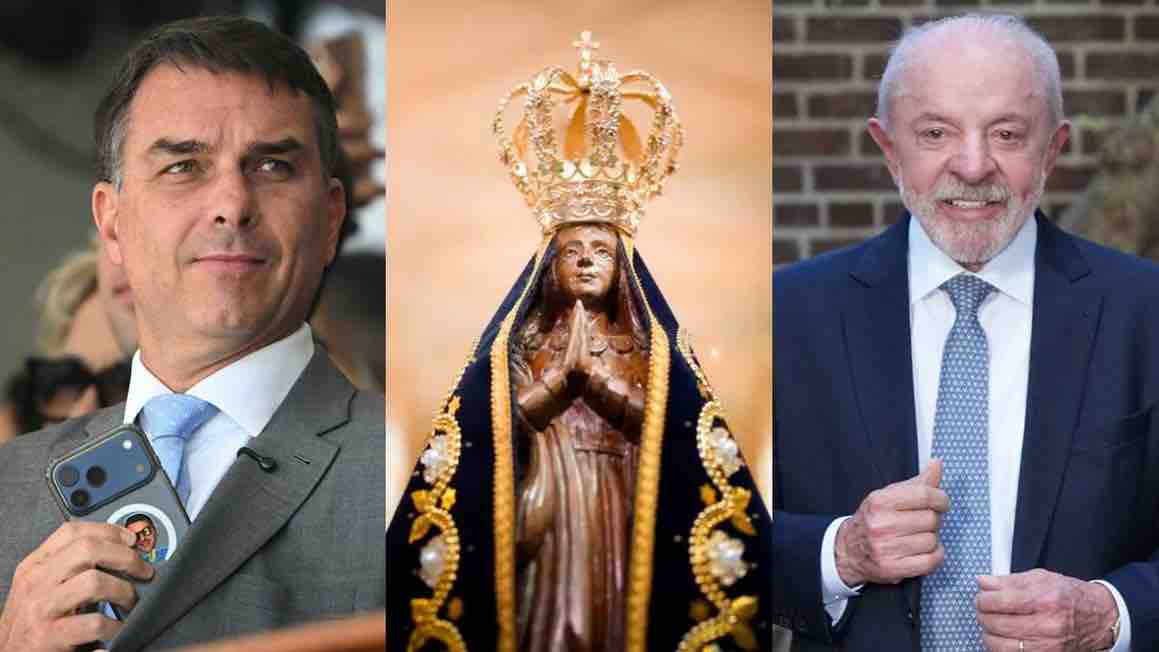
(ZENIT News / Brazilia, 10.05.2026).- Brazil’s presidential election has produced an unexpected religious fault line: a false claim about Our Lady of Aparecida, the country’s patroness, became the subject of a judicial battle over misinformation, freedom of expression and the place of religion in an increasingly polarized campaign.
The controversy did not prevent Senator Flávio Bolsonaro from finishing first in Sunday’s presidential election. With 99.99 percent of the vote counted, Bolsonaro received 47.03 percent, or more than 56.1 million votes, while President Luiz Inácio Lula da Silva obtained 45.16 percent, or almost 53.9 million. Neither reached the majority required for an outright victory, sending the two candidates into a runoff on October 25.
But in the days immediately preceding the vote, the political battle had acquired a distinctly religious dimension.
A widely circulated claim alleged that Bolsonaro, if elected, would seek to strip Our Lady of Aparecida of her status as patroness of Brazil. The candidate emphatically denied it and took the matter to the Superior Electoral Court. The supposed legislative basis for the story was not a Bolsonaro initiative at all: it was a bill introduced in 2007 by a former congressman concerning the name used for the Marian devotion in legislation surrounding the October 12 holiday. The proposal was archived by the Chamber of Deputies in 2022.
The episode nevertheless became sufficiently influential to reach Brazil’s highest courts.
On September 25, Justice André Mendonça of the Superior Electoral Court ordered social-media platforms to remove material presenting the allegation as fact. His intervention triggered a broader dispute because one particular post, published by comedian Antonio Tabet, did not actually mention Bolsonaro by name.
Tabet had posted an image of the dark-skinned statue of Our Lady of Aparecida alongside a statement accusing “the militia family” of attacking the Marian image. Bolsonaro argued that the publication formed part of the false narrative linking him to the supposed campaign against the patroness.
On September 27, however, Supreme Court Justice Flávio Dino overturned Mendonça’s decision concerning Tabet’s post and ordered that it be restored, reasoning that it was protected by freedom of expression and religious freedom. Dino stressed that the publication did not identify Bolsonaro or any member of his family.
The dispute then became institutional as well as political. Kassio Nunes Marques, president of the Superior Electoral Court, complained to the head of the Supreme Court about what he regarded as repeated overlaps between the jurisdictions of the two courts. He warned that unilateral decisions could weaken the coherent administration of the electoral process.
The Superior Electoral Court subsequently took up the issue collectively. On September 30, it maintained the removal of publications that explicitly attributed to Bolsonaro a plan to remove Aparecida’s title, while allowing Tabet’s ambiguous post to remain online. Mendonça revised his position on that particular publication, invoking the principles of minimal judicial intervention and stronger protection for freedom of expression.
The distinction is important. The court did not conclude that criticism of Bolsonaro involving a religious symbol was forbidden. Rather, it maintained that claims presented as factual — namely, that Bolsonaro had authored, proposed, supported or organized an initiative to deprive Our Lady of Aparecida of her national status — were objectively false.
Mendonça also rejected the suggestion that removing such claims amounted to an attack on Catholic devotion. In his view, the judicial dispute concerned electoral misinformation, not the right of Catholics to venerate the Virgin Mary. Nunes Marques similarly argued that preventing an unsupported allegation from being used to provoke voters protected religious freedom in its collective and democratic dimension.
Yet the controversy exposed how difficult that boundary can become during an election. A false political claim can be wrapped around a genuinely sacred symbol, while a court attempting to stop misinformation can itself face accusations of suppressing legitimate political expression. The fact that the Tabet post remained online after Mendonça reconsidered his initial position illustrates the court’s attempt to distinguish an explicit false factual attribution from a political or satirical statement whose meaning was genuinely ambiguous.
The religious dimension of the campaign is not accidental. Brazil remains a country in which Catholic and evangelical identities carry substantial political weight, although the two candidates draw support from different religious constituencies. The election has therefore encouraged both campaigns to speak to voters whose political choices are intertwined, in different ways, with their religious convictions.
Bolsonaro has particularly sought support among evangelicals, while Lula has retained stronger backing among Catholic voters. Figures cited during the campaign showed Lula’s support among Catholics rising from 43 percent to 48 percent, while Bolsonaro’s increased from 27 percent to 29 percent. Among evangelicals, Lula moved from 23 percent to 27 percent, while Bolsonaro stood at 46 percent, down from 49 percent.
The candidate’s own rhetoric helped fuel the religious discussion. In August, Bolsonaro said that one of his first acts in government would be to declare that Brazil “belongs to the Lord Jesus Christ.” That statement was subsequently connected on social media to the entirely different allegation concerning Our Lady of Aparecida. Bolsonaro accused sectors of Lula’s Workers’ Party and members of the Brazilian bishops’ conference of helping to spread the story. The bishops’ conference denied producing, authorizing or participating in the creation or dissemination of election-related false information and said unsupported accusations unfairly damaged the institution.
Bolsonaro also sought to demonstrate publicly where he stood on the Marian devotion. On September 28, during a march in central São Paulo, he raised an image of Our Lady of Aparecida.
The judicial quarrel therefore became something larger than a dispute over one social-media post. It raised questions about who should police political speech during an election, how courts should distinguish false factual claims from satire and political criticism, and whether religious freedom is best protected by removing false claims about a faith tradition or by exercising maximum restraint in restricting public expression.
It also placed the courts themselves under scrutiny. The disagreement between the Superior Electoral Court and the Supreme Court occurred amid an already serious internal crisis at the Supreme Court, whose justices had publicly clashed over the handling of an investigation involving banker Daniel Vorcaro, who was imprisoned in connection with a major financial fraud case.
For the Church, the affair carries another lesson. Our Lady of Aparecida is not simply a campaign prop. Her shrine in Aparecida is one of the most important Catholic pilgrimage sites in Brazil, and the devotion has a powerful cultural presence far beyond the boundaries of party politics. Turning the image into an instrument of electoral misinformation risks reducing a deeply rooted religious identity to another weapon in a polarized political contest.
For Bolsonaro, however, the episode did not appear to translate into an electoral setback. He entered the October 4 vote with 47.03 percent, more than two million votes ahead of Lula, and will now face the incumbent in the decisive October 25 runoff.
The irony is difficult to miss. A rumor about removing Brazil’s patroness became one of the campaign’s most contentious religious stories, yet the immediate political consequence was not the collapse of Bolsonaro’s support but his emergence as the first-round leader.
Thank you for reading our content. If you would like to receive ZENIT’s daily e-mail news, you can subscribe for free through this link.

Publicaciones relacionadas:
 9 interesting and curious facts you may not have known about U.S. Catholics
 USA: Pope Francis Sends Cardinal Tagle as Special Envoy to the National Eucharistic Congress
 Official: Pope Francis to visit Belgium and Luxembourg in September 2024
 England’s Cathedrals See Post-Pandemic Revival in Visitors, but Worship Attendance Tells a More Complex Story
