

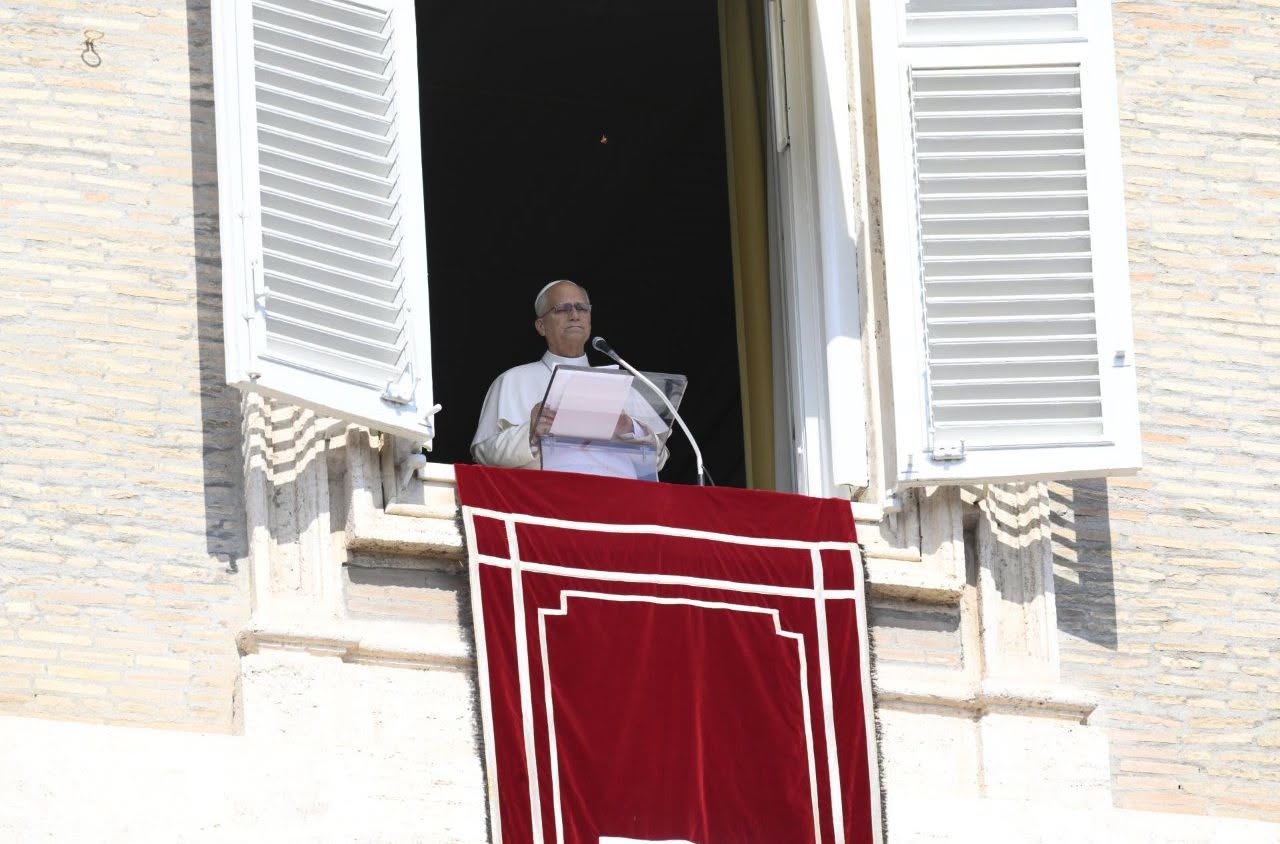
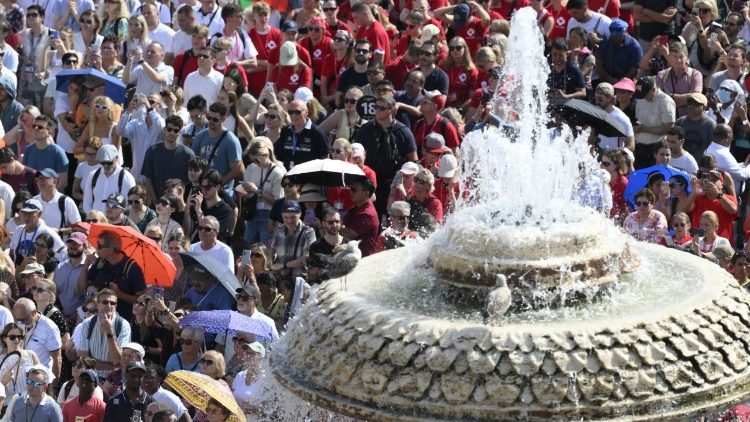
(ZENIT News / Vatican City, 10.04.2026).- At noon on Sunday, October 4—a national holiday in Italy marking the feast day of its patron saint, St. Francis of Assisi—Pope Leo XIV recited the Marian prayer of the Angelus with hundreds of pilgrims gathered in St. Peter’s Square. Below is the English translation of the Holy Father’s address, delivered before the recitation of the Angelus:
***
Dear brothers and sisters, happy Sunday!
The Gospel parable proclaimed in this Sunday’s Liturgy speaks of Jesus’ life and sheds light on the meaning of his mission (cf. Mt 21:33-43). He is the Son of God sent into the world, yet he is rejected by the very people who should have welcomed him with open arms. The One who came to bring salvation is condemned; the One who wishes to give life is put to death. While this leads us to reflect on the many cruelties that plague the world and the history of peoples, Christ’s teaching reveals the ever-greater mercy of his Father.
Indeed, the violent rejection does not thwart God’s will; in his infinite justice, he transforms evil into redemption: “The stone that the builders rejected has become the cornerstone” (Mt 21:42; cf. Ps 118:22). Jesus himself recalls these words from the Psalm, which celebrates the marvelous work done by the Lord: it is precisely what was cast aside that becomes the foundation that sustains everything. This is how the Almighty guides history, coming to our aid in all our falls: God never discards our lives!
According to the image used in the parable, the vineyard to be cultivated with justice is the Church, which we build up or damage through our choices. In this regard, today — on the eighth centenary of his death — I wish to recall a laborer who worked with great fruitfulness in the Lord’s vineyard: Saint Francis of Assisi, whom Jesus himself asked to repair his Church. Inspired by the Crucified One, Francis first and foremost built his own life upon the foundation of Christ, sharing in his poverty, joy and sufferings, even to the point of receiving the mystical sign of the stigmata. A man of fervent prayer, full of charity toward all, he was an example to the first friars who shared his asceticism as an authentic condition for the reform of the Church. Saint Francis repaired the Church by virtue of his faith in the Lord Jesus, healing the rifts of discord through the witness of fraternal love.
Dear friends, the charism of Saint Francis continues to bear fruit even today, after eight centuries. This is attested to, not only by the great and vibrant Franciscan family but also by the many gifts that his spiritual legacy bestows upon the People of God. As we celebrate the Franciscan Jubilee Year, therefore, let us perseveringly ask for the gift of peace and sincerely commit ourselves to building harmony among peoples.
May the intercession of Mary Most Holy, our Mother, always accompany us in this work. To her we now turn, spiritually united with the faithful gathered at the Shrine of Pompeii to offer the Supplication to the Virgin of the Holy Rosary.
Thank you for reading our content. If you would like to receive ZENIT’s daily e-mail news, you can subscribe for free through this link.

Publicaciones relacionadas:
 Which comes first: the commandments or love of God? Pope Leo XIV answers
 The Ascension of the Lord and Us: An Explanation by Pope Leo XIV
 What is the source of the apostolate’s strength? Pope Leo XIV answers
 Do you need to forgive, or have you been forgiven? This brief reflection by Pope Leo XIV is for you
