


(ZENIT News / Rome, 10.06.2026).- The Catholic Church has become accustomed to hearing that young people are abandoning religion because faith no longer fits the modern world. But new data on American men aged 18 to 29 suggest a more complicated possibility: perhaps the problem is not simply that religion has failed to adapt to contemporary life, but that contemporary life has left many young men with precisely the forms of belonging that religious communities once provided.
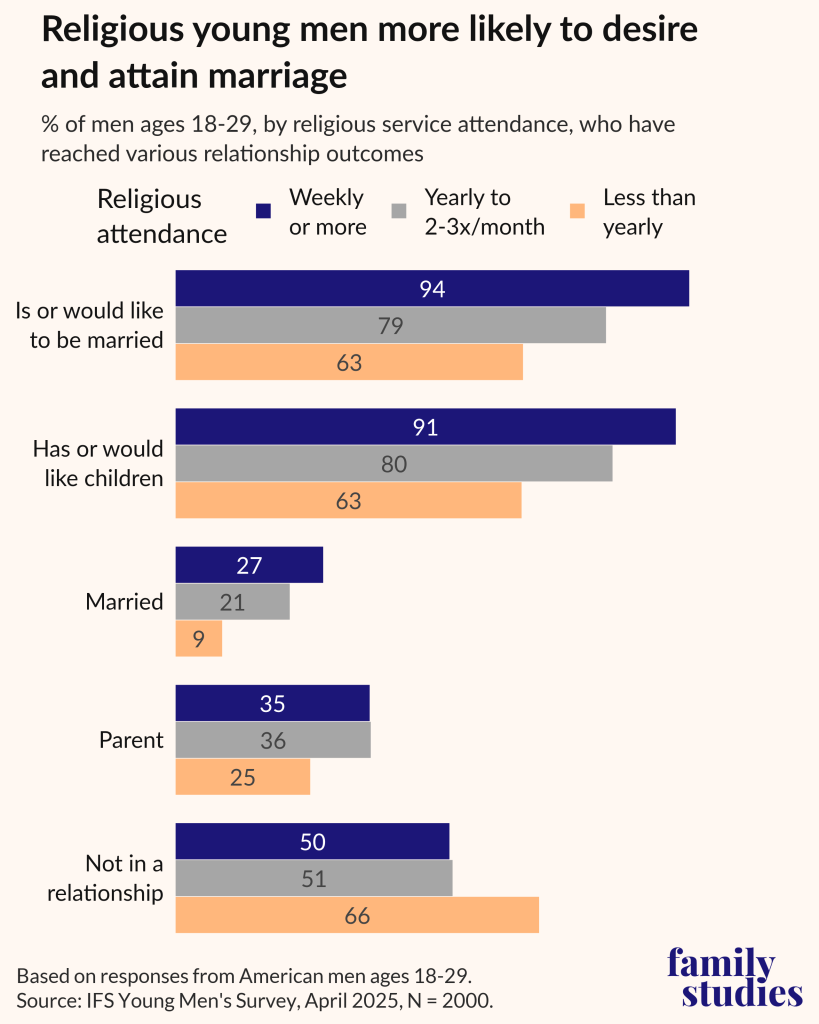
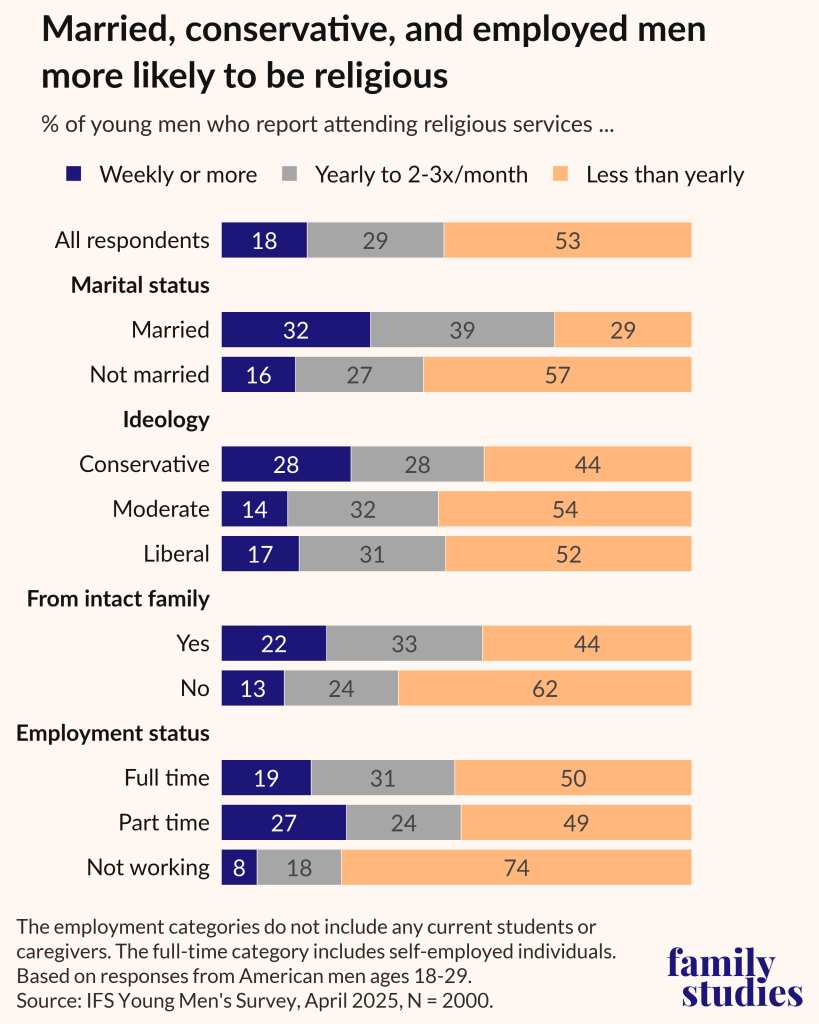
The findings come from the Institute for Family Studies’ Young Men’s Survey, conducted in April 2025. They show that only 18 percent of young American men attend religious services weekly, while 53 percent attend less than once a year or not at all. At the same time, the men who do maintain regular religious practice report markedly different outcomes in several areas of life.
The contrast is particularly striking when marriage enters the picture. Twenty-seven percent of religious men aged 18 to 29 are married, compared with just 9 percent of secular men. Among weekly attendees, 94 percent are either married or want to marry, compared with 63 percent among those who attend less frequently. Religious young men are also more likely to have children or express a desire to have them.
This matters because the collapse of marriage among young adults is often treated as an independent cultural development, disconnected from religious practice. The figures suggest that the two worlds are more closely related than that assumption allows. Religious practice does not merely transmit doctrines; it places people in communities where marriage, family and long-term commitment remain intelligible as ordinary possibilities.
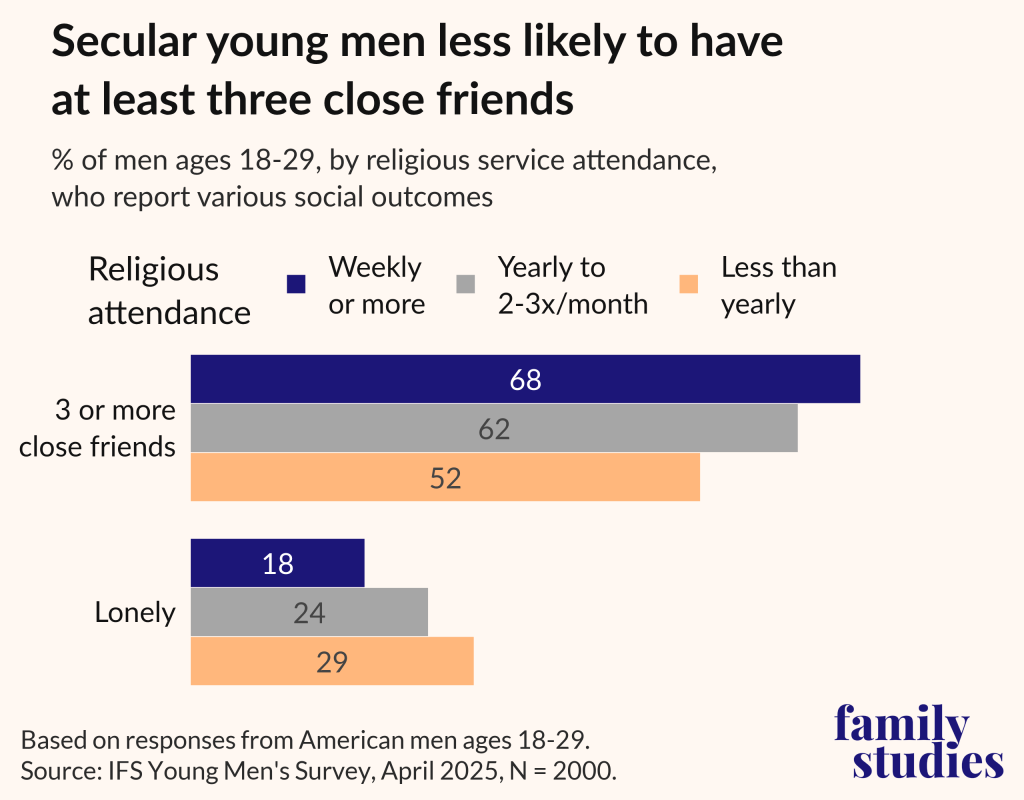
The same pattern appears in the social lives of young men. Sixty-eight percent of those attending religious services weekly have three or more close friends, compared with 52 percent among those who rarely or never attend. Only 18 percent of religious young men report feeling lonely, compared with 29 percent of secular young men.
That may be one of the most important findings in the entire study. Churches do not simply provide places for worship. They can function as social infrastructure: places where people encounter one another repeatedly, form friendships, assume responsibilities and acquire a sense of belonging that is not dependent on professional success or digital popularity.
For a Church worried about evangelizing younger generations, this presents an uncomfortable paradox. Young men are increasingly isolated, yet regular religious participation is associated with precisely the opposite condition. The answer, therefore, may not lie primarily in making the Church resemble the culture from which young men are retreating. It may lie in recovering the capacity of Catholic communities to offer something that the surrounding culture is increasingly unable to provide.
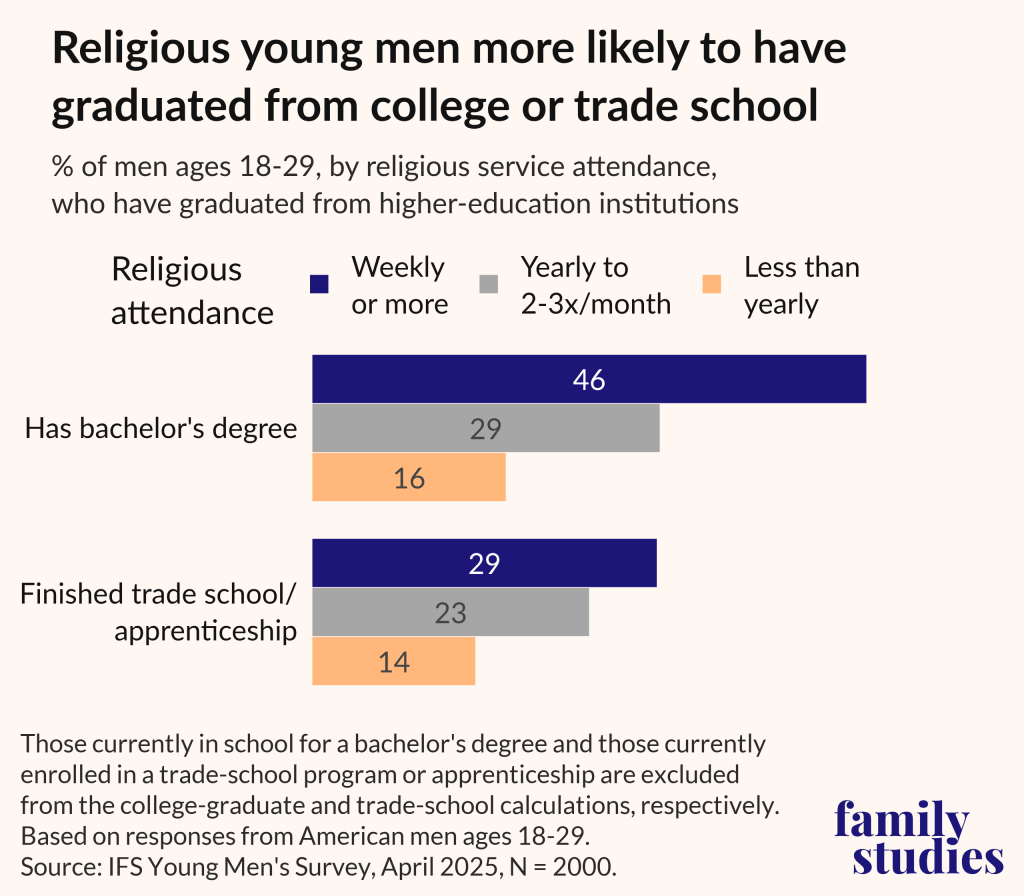
The evidence also challenges the familiar idea that religious commitment necessarily works against personal advancement. Forty-six percent of religious young men in the survey have a bachelor’s degree, compared with 29 percent of nominally religious men and 16 percent of secular men. Among men aged 24 to 29, the gap widens further: 61 percent of religious men have a bachelor’s degree, compared with 40 percent of nonreligious men and 25 percent of secular men. Religious men in that age group are also substantially more likely to have completed vocational education or an apprenticeship.
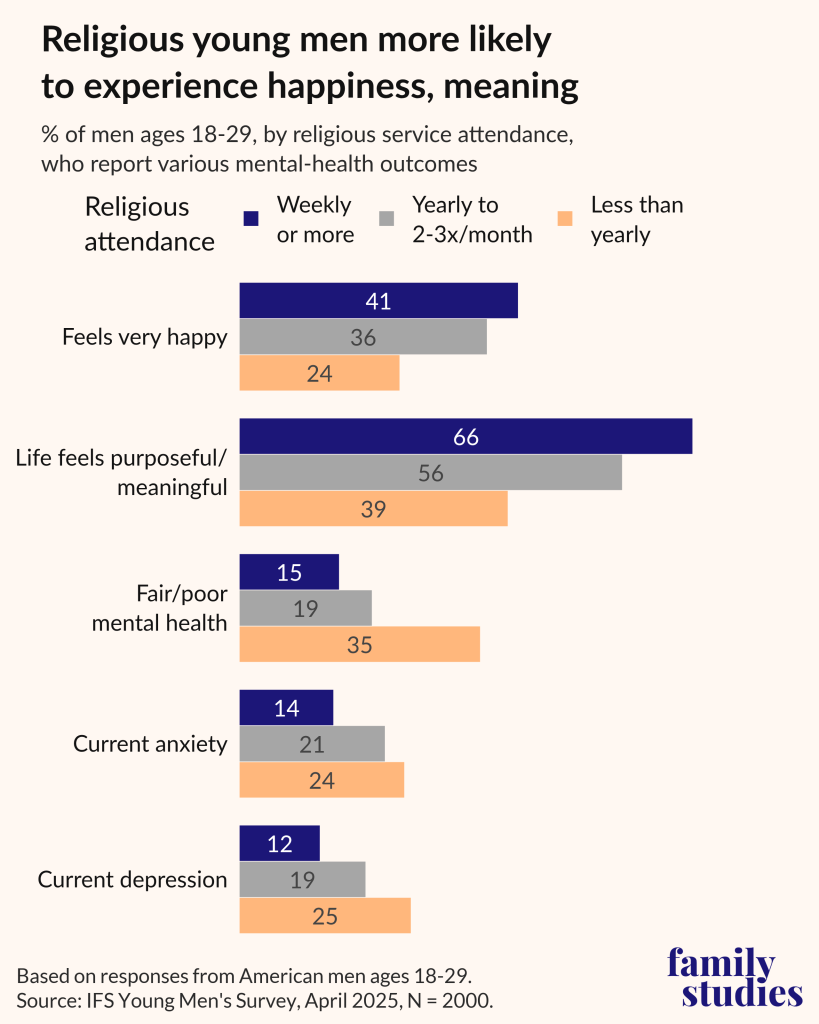
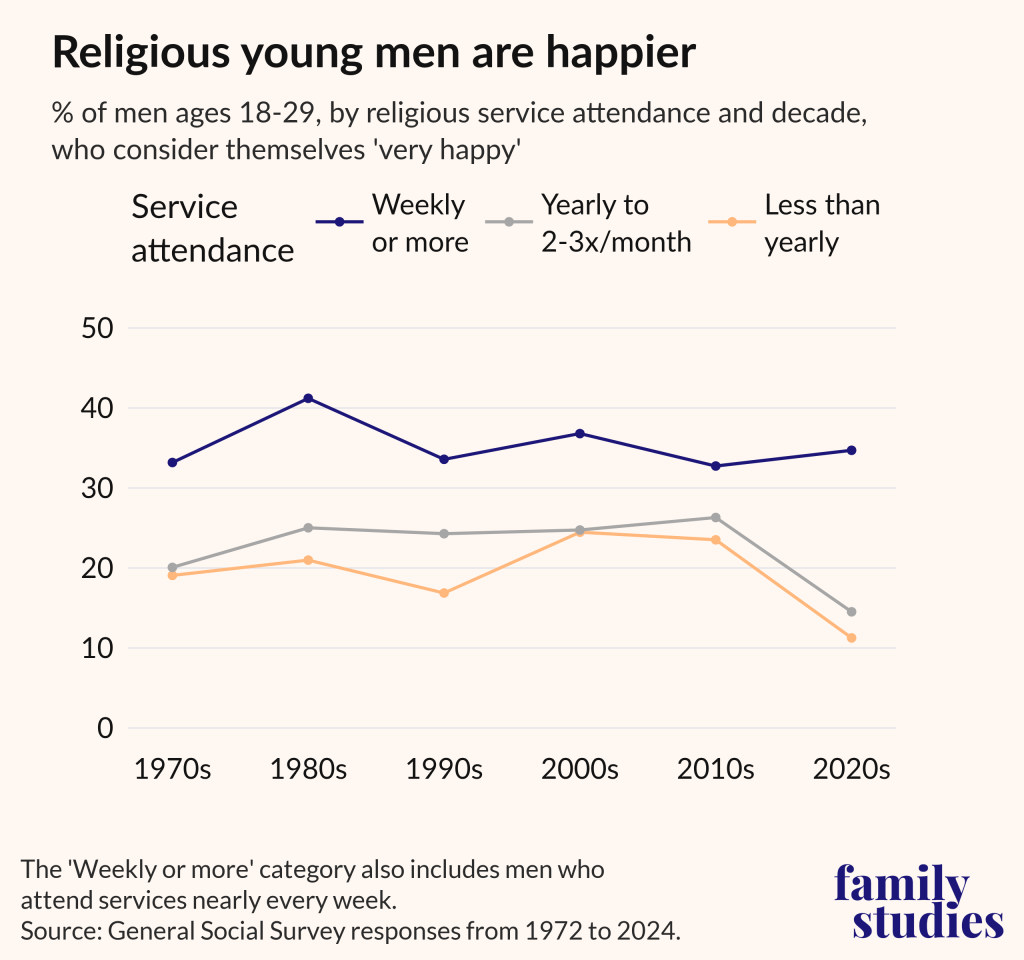
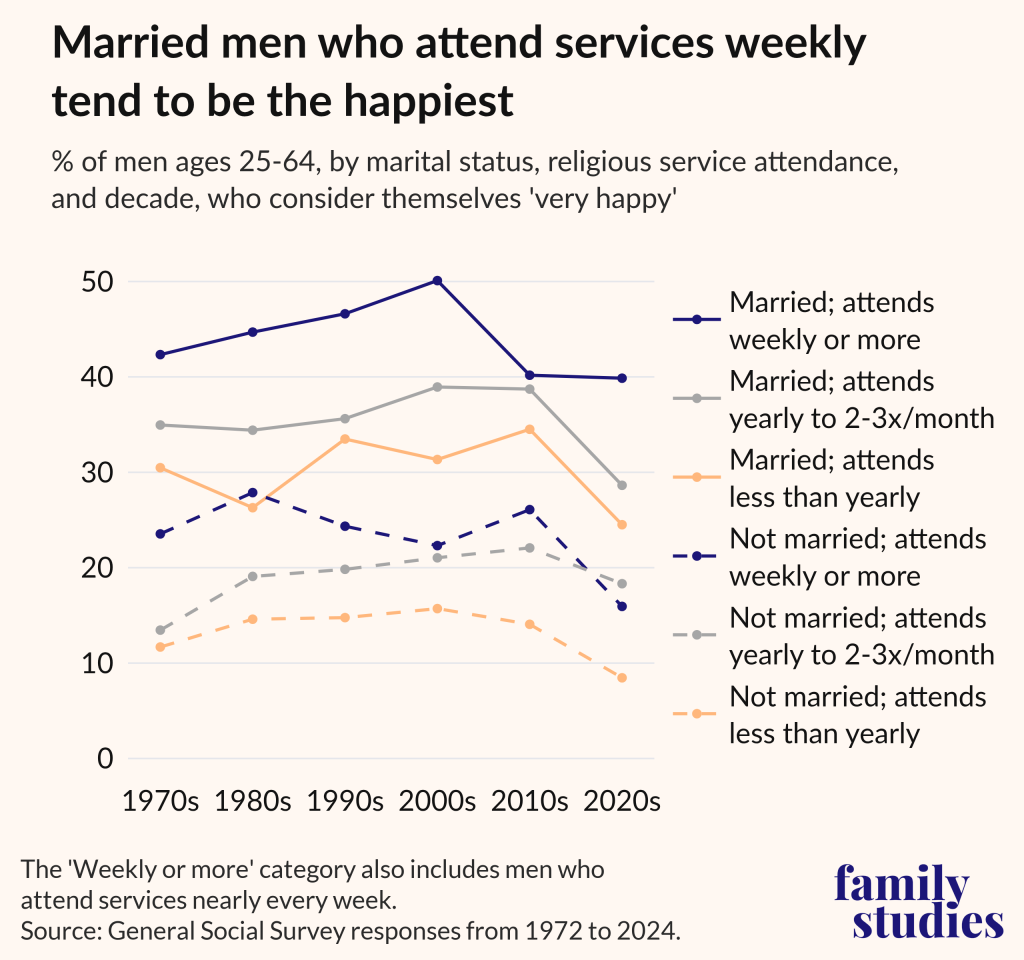
Nor does regular religious practice appear to coincide with diminished wellbeing. Forty-one percent of religious young men describe themselves as very happy, compared with 24 percent of secular men. Thirty-five percent of secular men report regular or poor mental health, more than twice the 15 percent recorded among religious men. Roughly two-thirds of religious young men also say that their lives have purpose or meaning, compared with about four in ten secular men.
None of this proves that going to church causes happiness, marriage, educational achievement or better mental health. The survey captures a particular moment rather than establishing causation. Marriage, for example, may itself make regular religious attendance more likely. Family background, political preferences or other factors may influence both religious practice and life outcomes. The researchers explicitly warn against reading the figures as proof that religion automatically produces worldly success.
That qualification is essential. Christianity is not a program for maximizing happiness. Christian faith can demand sacrifice, discipline and fidelity, and its central figures do not present belief as a guarantee of comfort.
But precisely because the Church should not reduce faith to its social benefits, it should not ignore what these social effects reveal. The data suggest that regular participation in a religious community can coincide with stronger relationships, greater purpose and a greater openness to marriage and family life. Those are not trivial by-products in a society where loneliness, delayed marriage and weakened social bonds are increasingly visible.
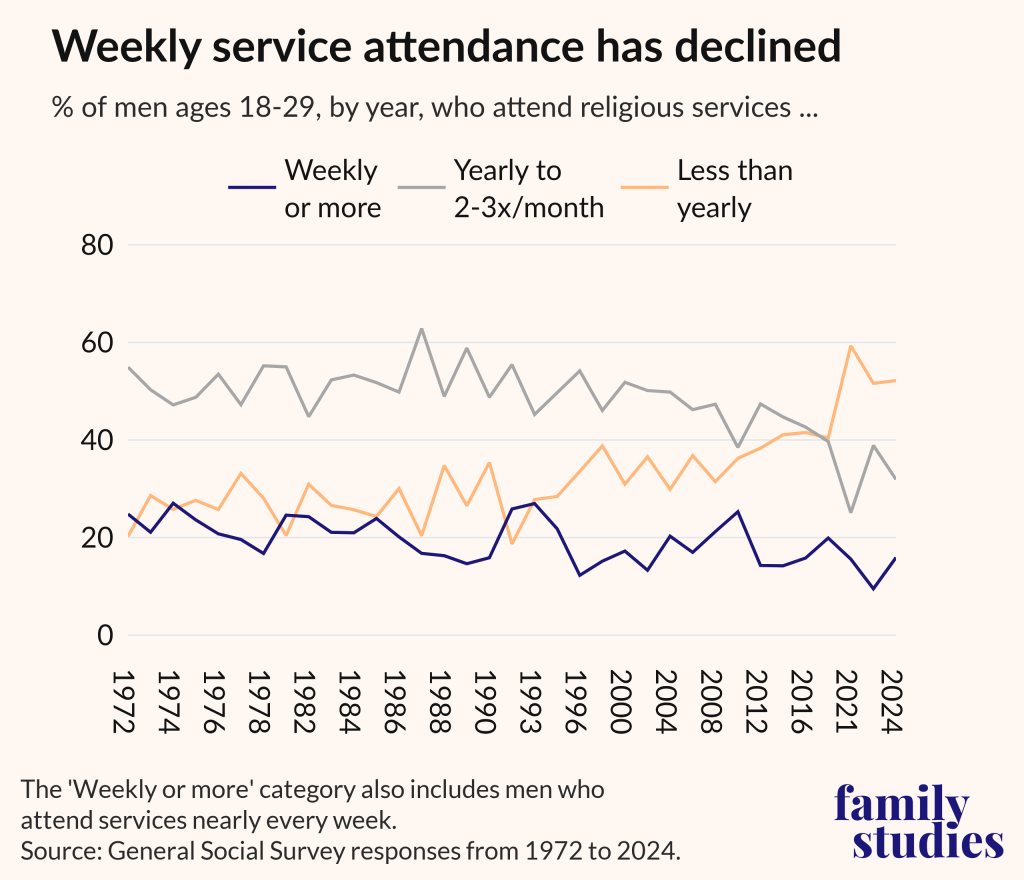
The findings also contain an important warning about the scale of the challenge. Weekly religious attendance among young men has been a minority practice since the 1970s, but today’s rates are lower than those recorded during previous decades. Only 18 percent now attend weekly.
For Catholic leaders, the strategic question is therefore larger than how to communicate more effectively with young adults. It is whether the Church is creating communities in which young men can actually form friendships, encounter marriage as a credible vocation, assume responsibility and discover a purpose larger than themselves.
This is also where any discussion of ecclesial renewal must confront reality. Listening to young people is important, but listening cannot substitute for giving them something worth belonging to. A Church may become more attentive to the voices of its members while still failing to reach those who have stopped coming. The more fundamental task is not simply to invite young men into a conversation about the Church, but to make visible why Christian life deserves their commitment.
There are signs that this question may become increasingly relevant. Anecdotal reports have suggested renewed interest in Christianity among some members of Generation Z, although the evidence for a broad religious revival remains limited. If a significant number of young men do begin returning to religious practice, the Church will need more than a welcoming message. It will need communities capable of sustaining the friendships, family life, discipline and transcendent purpose that these men may be seeking.
The most revealing statistic may therefore be the simplest one: only a minority of young men are still showing up.
Thank you for reading our content. If you would like to receive ZENIT’s daily e-mail news, you can subscribe for free through this link.

Publicaciones relacionadas:
 How To Ensure That a Child Remains Catholic When He Grows Up?
 The Future of Marriage in the United States: Studies Reveal that One Out of Three Young People Will Never Marry
 Research shows benefits of students studying at Catholic universities
 According to The New York Times, Progressive Priests Have No Generational Replacement in the American Clergy
