

(ZENIT News / Taybeh, 10.09.2026).- As renewed violence in Gaza claims civilian lives and restrictions and attacks threaten the livelihoods of Palestinian farmers in the West Bank, Catholic priests are warning that the future of Christian communities in the Holy Land depends on more than the survival of their churches. It also depends on whether families can live safely, work their land and raise their children without fear.
In Gaza, Father Gabriel Romanelli, parish priest of the Holy Family Church, received a personal message of solidarity from Pope Leo XIV after an Israeli airstrike struck a residential building in the Rimal district of Gaza City on October 3, killing five civilians. Among the dead were Maysa Khader Ibrahim Abu Daoud and her daughter, Mary Hafez Michel Najjar, members of the Greek Orthodox Christian community who had recently found shelter as they tried to rebuild their lives amid the devastation.
The Pope told Romanelli that he was praying for the two women, their families and the entire community in Gaza, asking: “How long, Lord?” For the priest, the message was a source of comfort in a community exhausted by repeated losses. He recalled that 62 Christians had died during the war, 25 of them killed in bombings, and said the latest attack brought back some of the darkest moments of the conflict.
Although large-scale bombardments had reportedly stopped in October 2025, Romanelli stressed that this had not brought normal life back to Gaza. Humanitarian assistance remains insufficient, food supplies are under pressure, and hundreds of displaced people continue to depend on the parish and the Missionaries of Charity for practical and spiritual support. The approaching winter adds another threat: many of Gaza’s 2.3 million inhabitants are living in makeshift shelters on waterlogged, contaminated ground, where rain could make already precarious conditions even more dangerous.
For Romanelli, the Church cannot respond to suffering through emergency aid alone. Prayer, pastoral care and the work of building peace must continue even when the scale of destruction appears overwhelming. On October 7, the anniversary of the Hamas-led attacks in Israel that triggered the current war, the parish planned to pray the Rosary, celebrate Mass and hold a symbolic procession calling for an end to the conflict, justice and peace between Israelis and Palestinians.
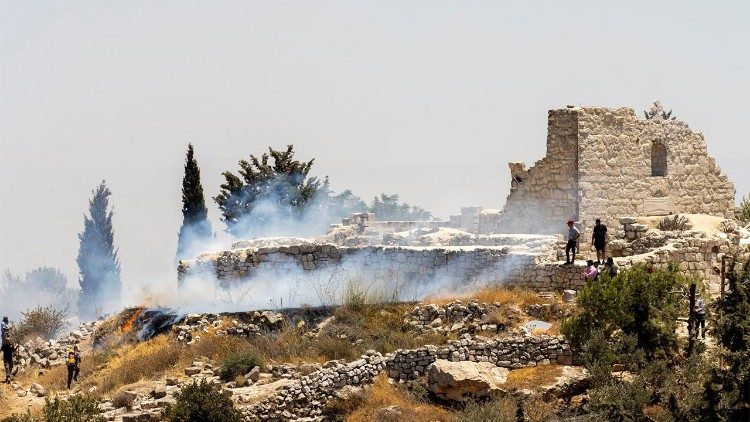
The same struggle to preserve a future for Christian families is unfolding in Taybeh, the only entirely Christian village in the West Bank. There, Father Bashar Fawadleh has reported repeated incursions into privately owned olive groves during the 2026 harvest, which began amid growing anxiety among local residents.
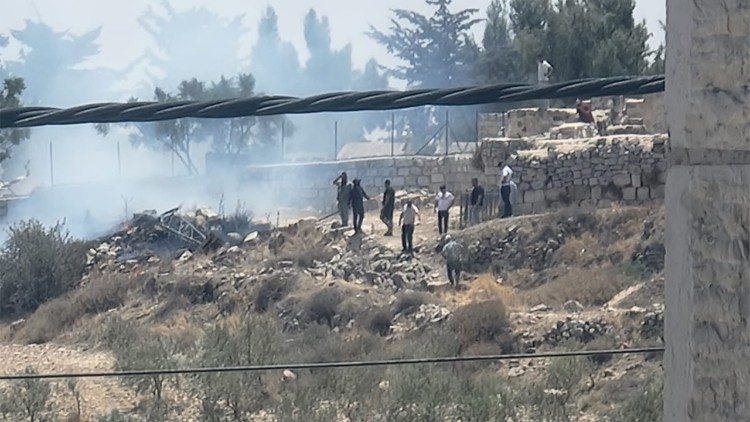
According to the priest, groups of Israeli settlers entered agricultural land in the Jabbas area east of the village on October 4 and in subsequent days, collecting olives from trees belonging to Palestinian families. Footage cited by Fawadleh reportedly shows branches being broken and trees damaged. He has also described reports of livestock grazing on agricultural land and the alleged use of equipment taken from Palestinian landowners. These allegations have not been independently established in the material provided.
The dispute is compounded by restrictions on movement. Fawadleh says that village entrances have been closed and that some agricultural areas have been designated as military exclusion zones, preventing owners from reaching their own property safely. He describes a stark contradiction: Palestinian farmers fear entering their groves or are unable to do so, while settlers can reportedly access the same land and harvest its fruit.
The consequences extend well beyond a single season. Taybeh has more than 16,000 dunams of land planted with olive trees, equivalent to over 1,600 hectares. Olive oil has sustained household economies for generations, supplied local families and reached markets beyond Palestine. When farmers lose access to their trees, they risk losing both income and the oil they would normally produce for their own homes. Damage to branches may also reduce yields in future years, while uncertainty about access makes it difficult to assess the full extent of the losses.
In Taybeh, the harvest is also a family tradition. Grandparents, parents and children work together among trees cared for across generations, passing on practical knowledge and a deep attachment to the land. Fawadleh warns that when families cannot cultivate their property safely, the damage is not merely agricultural: it weakens their ability to remain in their homes and sustain a community with a future.
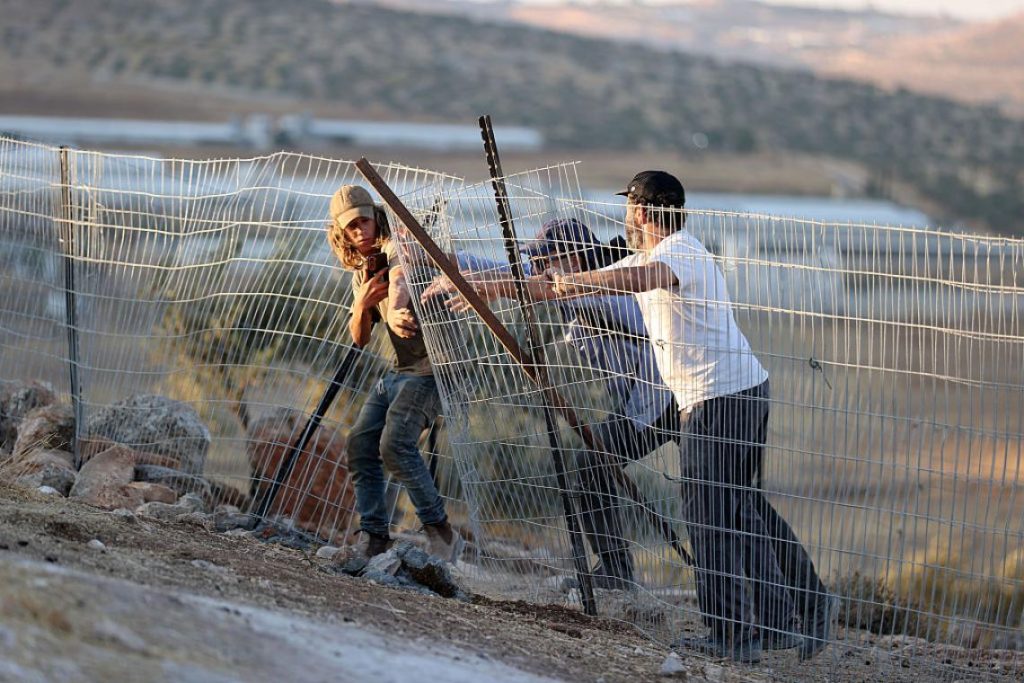
The priest has appealed to the authorities and the international community to guarantee safe access to the groves, protect farmers throughout the harvest and prevent attacks, interference and appropriation of crops. He has also urged foreign diplomats, churches and international activists to visit Taybeh and witness conditions on the ground. Reports supplied about the latest incidents additionally describe an activist being attacked after filming alleged violence and two other foreign activists being arrested, while Israeli authorities considered measures to remove activists assisting Palestinian farmers.
The two communities face different immediate crises, but their appeals converge on a central issue: peace requires conditions in which civilians can live with dignity and security. In Gaza, that means sufficient aid, shelter, freedom and an end to the bombs. In Taybeh, it means being able to reach private land, harvest its produce and protect the livelihoods inherited by the next generation.
Thank you for reading our content. If you would like to receive ZENIT’s daily e-mail news, you can subscribe for free through this link.

Publicaciones relacionadas:
 Gaza: two dead, seven injured in latest attack on Church complex
 Israel destroys homes of Catholics in southern Lebanon
 Israeli army attacks and destroys Caritas center in Deir al-Balah, Gaza
 Israeli court sentences Jewish man who attacked and kicked a Catholic nun in Jerusalem to 6 years in a psychiatric hospital
