

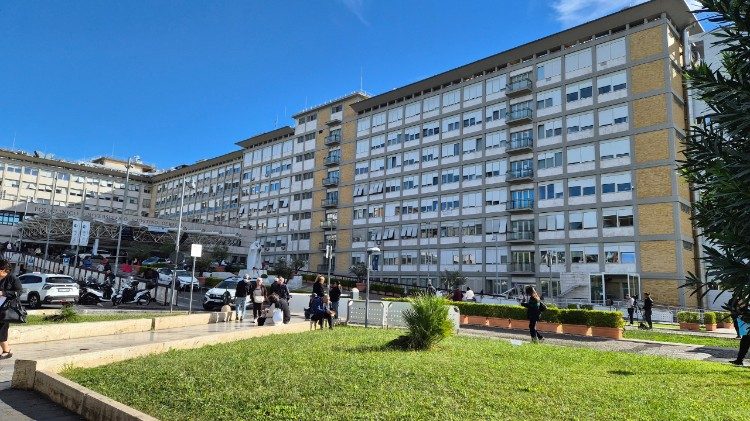
(ZENIT News / Rome, 10.14.2026).- Pope Leo XIV spent a stable first day recovering at Rome’s Gemelli Hospital after surgeons removed the lower lobe of his right lung to treat an adenocarcinoma, a common form of lung cancer. Medical reports issued on Wednesday, October 14, described a recovery proceeding as expected, with normal postoperative test results, respiratory physiotherapy and the resumption of walking and eating. Yet the crucial question remains unanswered: whether the cancer was confined to the removed tissue or had spread elsewhere.
The 71-year-old pontiff underwent surgery on Tuesday after preliminary investigations identified a localized lung nodule. According to the Vatican, the operation was successful and there were no complications. His doctors, Luigi Carbone and Stefano Margaritora, reported that blood tests and a chest X-ray showed results within the expected range for the procedure. Leo began walking around his hospital room, resumed his regular diet and, later that afternoon, concelebrated Mass with his secretaries in a room specially prepared on the hospital’s tenth floor.
The encouraging signs have prompted cautious optimism, but they do not yet provide a complete picture of his prognosis. The Vatican has confirmed that the cancerous tissue was removed, while the results needed to establish whether the disease had spread have not been made public. The medical team is expected to use those findings to determine whether further treatment is necessary. Chemotherapy has not been announced as part of the Pope’s current treatment plan.
Before the operation, Leo underwent a series of diagnostic procedures, including a robotic bronchoscopy with biopsy, a contrast-enhanced chest CT scan and a positron emission tomography scan, commonly known as a PET scan. These tests help doctors examine the tumor and assess whether cancer may have spread beyond its original location. Reports also indicate that lymph nodes were sampled for analysis, although the results remain undisclosed.
Adenocarcinoma is the most common type of lung cancer, but the diagnosis alone does not determine the outlook. Specialists consulted in reports on the Pope’s condition stressed that the stage of the disease, the involvement of lymph nodes and any evidence of spread will be decisive in determining the next steps. If the cancer is localized, surgery may be sufficient; if it has spread, treatment could involve chemotherapy, immunotherapy or targeted medication, depending on the findings.
The immediate recovery has been positive enough for the Vatican to maintain a relatively short initial hospital timetable. Vatican spokesman Matteo Bruni said the expected postoperative period was approximately one week. That estimate, however, should not be confused with a definitive assessment of the Pope’s readiness for an extensive international trip.
Leo is scheduled to visit Uruguay, Argentina and Peru from November 6 to 17. The journey would cover more than 31,000 kilometers, involve around a dozen flights and include two helicopter transfers, as well as significant changes in altitude in Peru. The Vatican has not announced any changes to the itinerary, and Bruni confirmed that the Pope wishes and intends to travel. But medical recovery, further treatment and the demands of the schedule will determine whether that intention can be fulfilled.
Peruvian President Keiko Fujimori expressed hope that the visit would proceed while acknowledging that the Pope’s health could require adjustments. Millions of Peruvians are praying for his recovery, she said. The country holds particular significance for Leo, who spent approximately two decades as a missionary there and holds Peruvian citizenship. Any decision about the trip, however, will ultimately have to place his health ahead of diplomatic expectations or public enthusiasm.
There is also a personal dimension to the diagnosis. Leo’s older brother, Louis Prevost, is himself undergoing experimental treatment for a tumor in Tampa, Florida, while the Pope’s mother died of cancer in 1990. Speaking to American television, Louis said he had received reassuring information that the operation had gone well and that his brother was awake, comfortable and in good hands. He described the discovery of the lung nodule as a shock, particularly given his own illness, but said the family remained hopeful after learning that doctors believed the tumor had been detected in time.
Beyond the medical details, the episode marks a notable departure from the Vatican’s traditionally guarded approach to papal health. Leo announced the discovery of the lung nodule himself after the Angelus on Sunday 11, before undergoing surgery. Subsequent medical communications provided a clearer account of the diagnosis and treatment. Church historian Giovanni Maria Vian, former editor of the Vatican newspaper L’Osservatore Romano, described the announcement as a striking break with established practice.
Historically, the health of popes has often been disclosed sparingly, sometimes leaving the public unaware of serious illnesses until very late. Leo’s decision to speak openly about his condition, followed by regular medical updates, has offered a different model of communication—one that gives the faithful and the wider public more information while the outcome remains uncertain.
Thank you for reading our content. If you would like to receive ZENIT’s daily e-mail news, you can subscribe for free through this link.

Publicaciones relacionadas:
 This is the 197-inch sculpture dedicated to Pope Leo XIV in his former Peruvian diocese
 Following complaints from cardinals in pre-Conclave meetings, Pope Leo XIV summons cardinals to Rome for early 2026
 The end of time and the drama of loneliness that permeates all forms of poverty, according to Pope Leo XIV
 What does it mean to be part of a choir? Liturgical music (and singing) reflected upon by Pope Leo XIV
