(ZENIT News / Rome, 10.14.2026).- Catholic support for Donald Trump has weakened significantly since the beginning of his second presidential term, according to a new Pew Research Center survey that points to a potentially consequential shift ahead of the November 3 midterm elections. Although Catholic voters narrowly favor Democratic candidates for the House of Representatives overall, the figures conceal a striking divide between white and Hispanic Catholics, two constituencies whose contrasting political preferences could complicate Republican efforts to retain control of Congress.
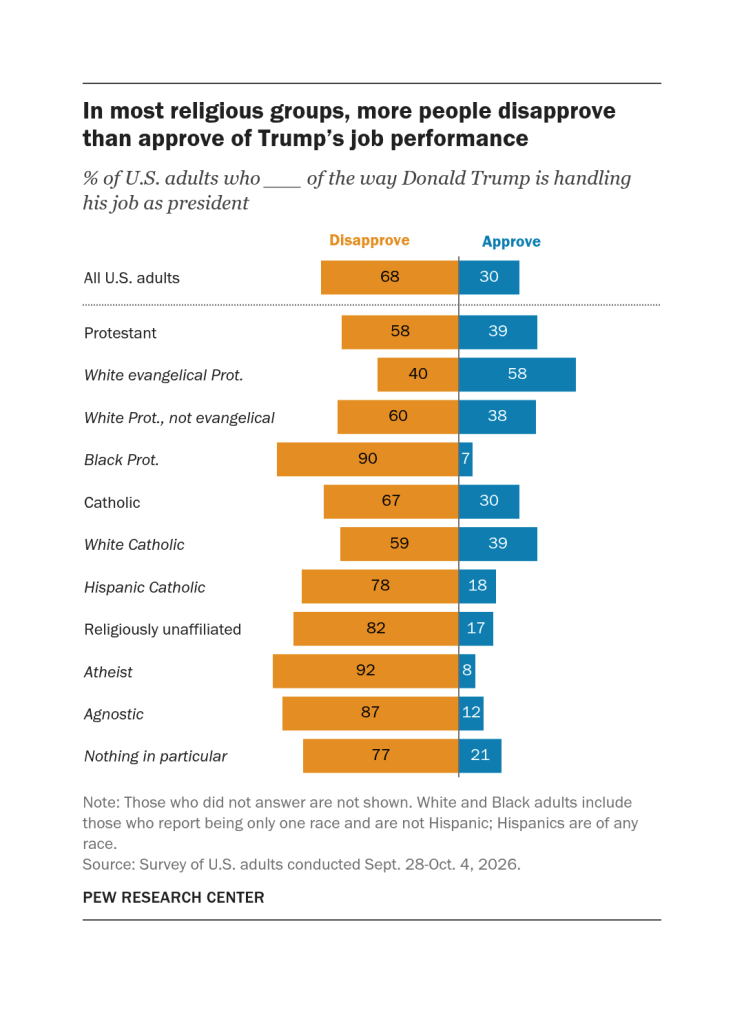
The survey, conducted from September 28 to October 4 among 5,062 American adults, including 3,917 registered voters, found that Catholics favor Democratic House candidates over Republicans by 42% to 39%. The margin is narrow, but the broader picture is less encouraging for Trump: just 30% of Catholics approve of his presidential performance, while 67% disapprove. In January 2025, his approval rating among Catholics stood at approximately 47%.
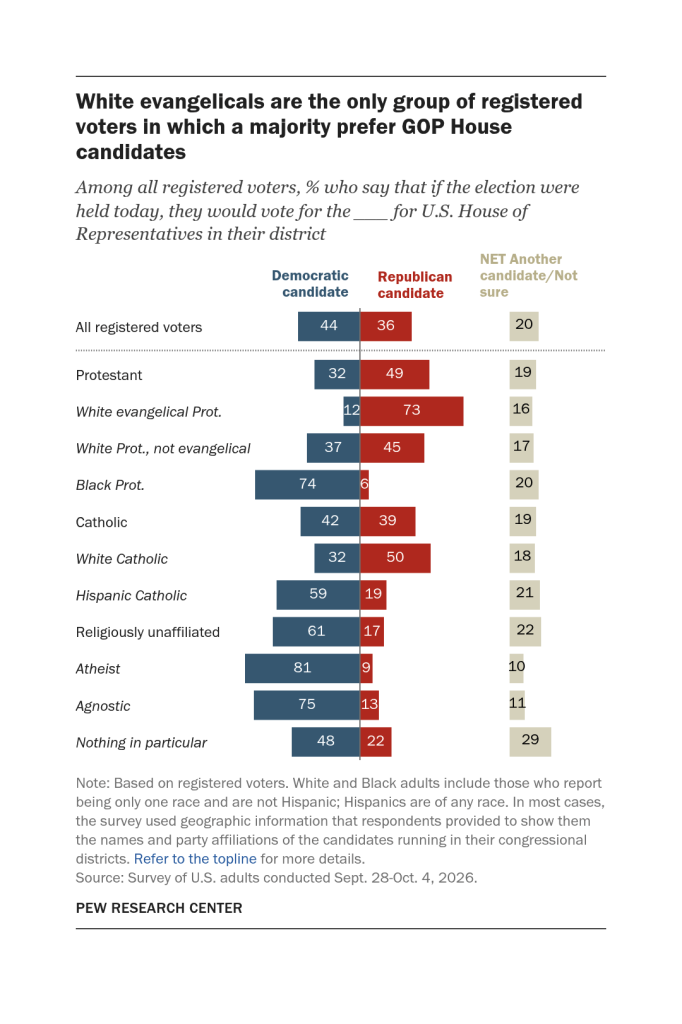
The findings are particularly noteworthy given the importance of Catholic voters in Trump’s 2024 electoral victory. Their support helped return him to the White House, making the subsequent erosion of his standing within this religious constituency an important indicator of the political challenges facing his administration.
The Catholic vote, however, is far from uniform.
Among white Catholics, 50% say they would vote Republican in their congressional district, compared with 32% who favor Democrats. Hispanic Catholics display almost the opposite pattern: 59% support Democratic candidates, while just 19% favor Republicans. The contrast is equally evident in presidential approval ratings. Only 39% of white Catholics approve of Trump’s performance, against 59% who disapprove. Among Hispanic Catholics, approval falls to 18%, while 78% express disapproval.
These differences illustrate why treating Catholics as a single political bloc can be misleading. Shared religious beliefs do not necessarily translate into identical electoral priorities, and the political behavior of Catholic communities varies considerably according to their social and demographic circumstances.
The religious landscape also reveals a broader challenge for Republicans. White evangelical Protestants remain Trump’s most dependable religious constituency and are the only group in which a majority of registered voters favors Republican House candidates by a substantial margin. According to Pew, 73% of white evangelical Protestant voters support Republicans, compared with 12% who favor Democrats.
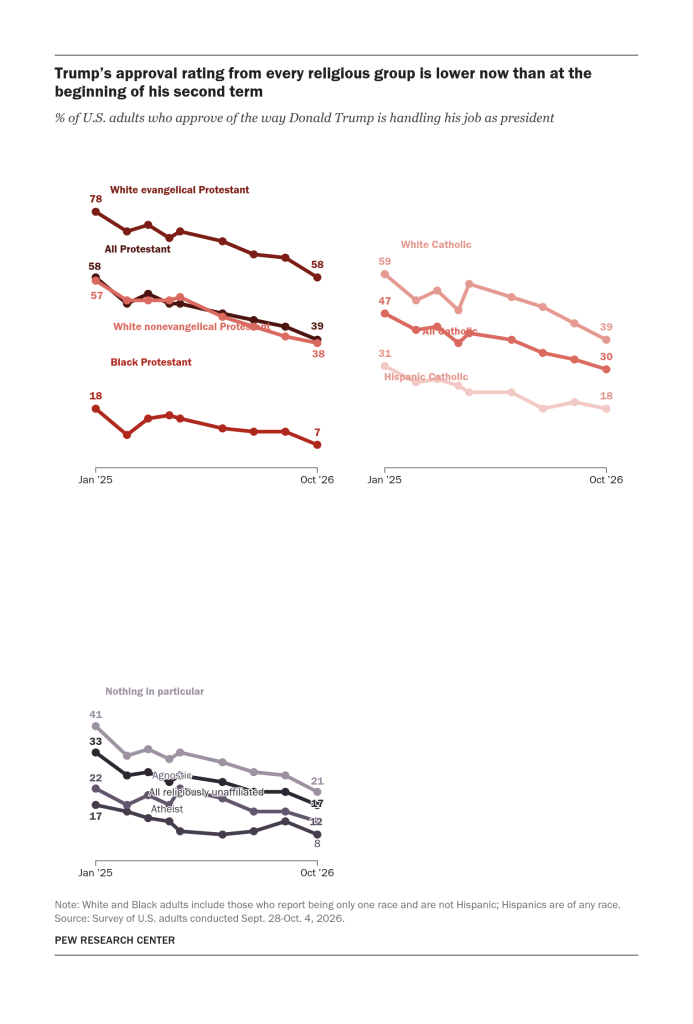
White Catholics lean Republican as well, but their preference is considerably less pronounced. Meanwhile, white non-evangelical Protestants are divided, with 45% supporting Republicans and 37% Democrats, a difference that is not statistically significant. Black Protestants, Hispanic Catholics, atheists, agnostics and Americans without a particular religious affiliation are more inclined toward Democratic candidates.
Presidential approval ratings reinforce this pattern. White evangelical Protestants are the only religious group in which more adults approve of Trump’s performance than disapprove, by 58% to 40%. Every other group examined by Pew records a negative balance, with atheists, agnostics and Black Protestants among the most critical.
The decline extends beyond religion. Among registered voters nationwide, Democrats hold a 44% to 36% advantage in congressional preferences, while Trump’s overall approval rating stands at 30%, compared with 68% disapproval. Pew’s findings also indicate that Democratic-leaning voters are more engaged and motivated to participate in the midterms than those who favor Republicans, a potentially important factor in determining the outcome.
Nevertheless, a preference expressed in a survey is not the same as a vote cast on election day. Midterm turnout is often substantially lower than participation in presidential elections: only 46% of eligible voters cast ballots in the 2022 midterms. The extent to which current preferences translate into actual participation will therefore be crucial.
The results also carry implications for the relationship between Catholic identity and American politics. Questions such as abortion, religious freedom, family policy, immigration and the treatment of vulnerable communities have long shaped Catholic engagement in public life, although voters differ in how they rank these issues and weigh them against economic and other concerns. The survey does not establish which particular issues account for Catholics’ declining approval of Trump, and its findings should not be interpreted as evidence that religious convictions have suddenly changed.
The survey offers no guarantee of an electoral outcome, but it identifies a vulnerability that could prove significant: a coalition that helped secure the presidency in 2024 is now showing clear signs of strain, and the Catholic vote remains divided along lines that could shape the balance of power in Congress.
Thank you for reading our content. If you would like to receive ZENIT’s daily e-mail news, you can subscribe for free through this link.