

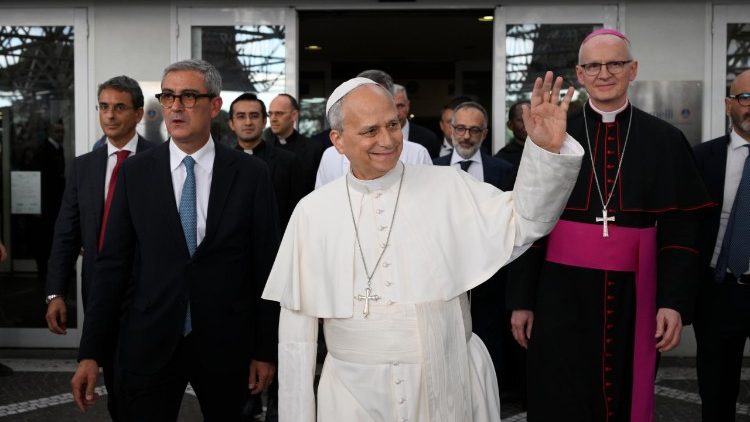
(ZENIT News / Rome, 10.17.2026).- Pope Leo XIV returned to the Vatican on Saturday, October 17, after four days at Rome’s Gemelli Hospital following surgery for lung cancer. His discharge came with encouraging medical assessments and a cautiously optimistic outlook from the surgeon who operated on him, who believes there are no clinical reasons at present to rule out the Pope’s planned November visit to Uruguay, Argentina and Peru. Yet the day’s most moving moment came outside the hospital, when Leo reunited with a 13-year-old Ukrainian girl whose own recovery from cancer had been strengthened by an encounter with him months earlier.
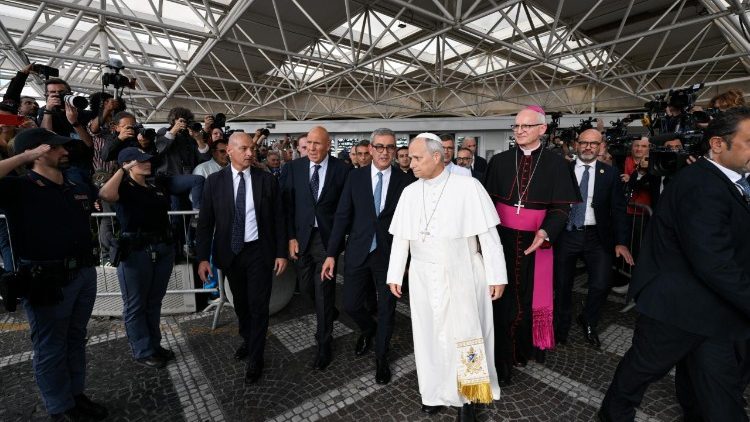
The Pope left the Gemelli Hospital at approximately 3:30 p.m., greeted by applause from patients, hospital visitors, faithful and members of the media who had gathered to wish him well. Before departing, he thanked the medical staff who had cared for him and exchanged greetings with Professor Stefano Margaritora, the thoracic surgeon who led his operation. Asked about his condition by reporters, Leo replied in English: “Much better, thank you.”
His discharge followed morning blood tests, a chest X-ray and a clinical assessment by his medical team, which deemed him fit to leave hospital. The examinations confirmed that his postoperative recovery was proceeding normally. On Sunday, October 18, he was scheduled to recite the Angelus from the window of the papal apartments, marking his return to the Vatican’s familiar setting while continuing his convalescence.
Leo underwent surgery on October 13 after doctors discovered a suspicious spot at the base of his right lung. The operation, lasting approximately 90 minutes, confirmed an adenocarcinoma, a malignant tumor that required removal of the lower lobe of the right lung. The procedure was performed using video-assisted surgery, a minimally invasive technique that allows surgeons to operate through small incisions with the aid of a camera.
In an interview following the Pope’s discharge, Margaritora described his patient’s condition as satisfactory. Blood tests were normal, cardiac function was sound, and the remaining lung tissue was expanding as expected. The surgeon reported that the operation had proceeded without complications and that the Pope had followed the prescribed diet and respiratory physiotherapy with exceptional commitment.
Margaritora nevertheless emphasized that a full physical recovery takes time. In his assessment, approximately two weeks are generally needed to recover fully from this type of operation. With the Pope already several days into that process, the surgeon estimated that another ten days could be sufficient for a complete recovery.
Asked about Leo’s planned November 6–17 journey to South America, Margaritora said there were no clinical reasons to exclude the trip. His assessment provides reassurance, but it is not a definitive announcement that the itinerary will proceed unchanged. The demands of long-distance air travel and a busy pastoral schedule will have to be considered alongside the Pope’s continued recovery.
The surgeon also explained how the cancer was discovered. The suspicious spot was identified incidentally during routine imaging of the abdomen, which also revealed the lower portions of the lungs. Leo had not experienced respiratory symptoms. Margaritora used the case to stress the importance of prevention and early detection, particularly among people at elevated risk, noting that lung cancer can remain asymptomatic in its initial stages. His comments support greater attention to appropriate screening, although the tests recommended for individuals depend on their risk factors and medical circumstances.
For Margaritora, the operation carried an unusual emotional weight despite being medically routine. He described the challenge of treating a Pope as a patient while remaining focused on a procedure he had performed many times. As Leo entered the operating room, the surgeon introduced the assembled team as their “dream team,” prompting a smile from the pontiff before anesthesia began.
Margaritora also praised Leo’s attitude throughout his hospitalization, describing him as calm, cooperative and unusually motivated during rehabilitation. The Pope had resumed eating normally and celebrating Mass soon after surgery, and he was eager to regain his independence. The surgeon recalled finding him arranging chairs in the hospital chapel, even though members of the team were ready to help.
The physician used the opportunity to recognize the wider hospital workforce, including nurses, laboratory and radiology technicians, physiotherapists and other professionals whose contributions are essential to patient recovery but often receive less public attention.
The gratitude was echoed by Elena Beccalli, rector of the Catholic University of the Sacred Heart, which is associated with Gemelli Hospital. She described caring for the Pope as both a responsibility and a privilege and expressed the university community’s wishes for his full recovery.
Italian President Sergio Mattarella also sent Leo a message wishing him a peaceful convalescence. He noted the widespread expressions of affection and concern from ordinary people, political leaders and Catholic communities around the world, and extended his wishes for a swift and complete recovery on behalf of Italy.
Among those waiting outside the hospital was Varvara, a 13-year-old Ukrainian girl who had met Leo in St. Peter’s Square on December 31, when she was preparing to undergo cancer treatment. The Pope had embraced and encouraged her at the time. Now, after medical examinations confirmed that her cancer had been overcome, she had traveled with her parents from Castellamonte, near Turin, hoping to pray for the pontiff outside the hospital:
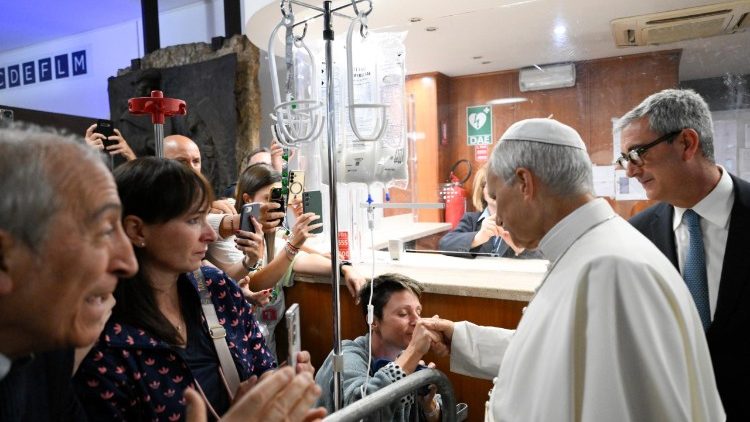
In fact, she was able to greet him personally as he left. With the help of a Ukrainian priest acting as interpreter, Varvara told Leo that their earlier embrace had given her strength during treatment. She asked for his blessing and gave him a framed photograph of their December encounter, together with a small felt doll she had made by hand in his likeness.
The gift carried a deeply personal meaning. During her family’s flight from the war in Ukraine, Varvara had relied on a stuffed toy named Basik as a companion through displacement, unfamiliar surroundings and hospital treatment. She wanted the Pope to have a similar companion to accompany him on his own road to recovery.
Varvara and her family had found refuge in Italy after fleeing the violence in Ukraine. With support from the humanitarian association La Memoria Viva, she was brought to Italy for treatment at the Regina Margherita Children’s Hospital in Turin. Her story also illustrates the particular vulnerability of families displaced by war, whose access to medical care can be disrupted by attacks, damaged infrastructure and unreliable electricity supplies.
The Pope spent the night of Saturday, October 17, at the Vatican.
Thank you for reading our content. If you would like to receive ZENIT’s daily e-mail news, you can subscribe for free through this link.

Publicaciones relacionadas:
 Lion XIV inherits 52 million followers on X and opens Instagram surpassing 400 thousand followers first day
 What Days Will Masses with the Pope Be Held in June 2025? The Vatican Releases Its Official Calendar.
 3 Criteria for Discernment in a Consistory Based on the Common Good of the Church: Leo XIV’s Guidelines to the Cardinals
 Leo XIV Reveals The Four Things He Will Do While on Vacation, Which Might Also Inspire Other Catholics’ Vacation
