
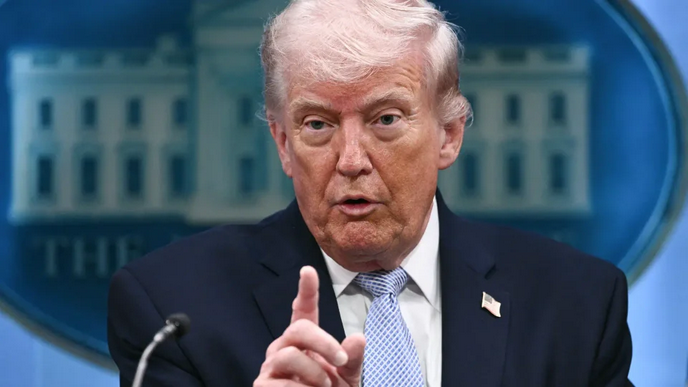
(ZENIT News / Washington, 10.17.2026).- President Donald Trump has reversed his administration’s plans to broadcast the execution of Nidal Malik Hasan, the former Army psychiatrist responsible for the 2009 Fort Hood massacre, following strong objections from Catholic bishops and criticism from lawmakers in both parties. In a Truth Social post on October 15, Trump confirmed that the execution would take place by firing squad on December 3, but said it would not be shown live, acknowledging that many Americans would prefer not to watch a condemned man die.
The decision marks a retreat from a proposal that had prompted an unusually forceful response from the Catholic Church, which challenged not only the proposed public spectacle but also the moral implications of capital punishment itself.
Trump had approved Hasan’s execution by October 5, according to Pentagon spokesman Sean Parnell. Three days later, Defense Secretary Pete Hegseth said in an interview with Real America’s Voice that the execution would be livestreamed from Fort Hood, in Killeen, Texas, where Hasan carried out the attack. The shooting killed 14 people, including an unborn child, and wounded 32 others.
Trump initially defended the proposed broadcast as a potential deterrent, arguing that it could allow the world to witness how the United States treats convicted terrorists. However, on October 15, he acknowledged that many people of goodwill would not want to see Hasan die, whether in person or through a screen. He also stated that the victims’ immediate family members would be permitted to attend the execution.
The retreat from a public broadcast does not alter the announced execution date, but it removes a measure that had drawn condemnation from religious leaders and politicians alike.
Catholic bishops challenge the spectacle of execution
The opposition from Catholic leaders was rooted in the distinction between seeking justice for victims and turning a condemned person’s death into a public spectacle.
Archbishop Timothy Broglio, head of the Archdiocese for the Military Services, USA, joined Texas Catholic bishops in a statement on October 12 urging Trump to reconsider the livestream proposal. Broglio described the prospect as a “barbaric killing of our adversaries” and emphasized the dignity of every human person, including those convicted of terrible crimes.
He also urged Catholic military personnel assigned to the firing squad to request exemption from participating, arguing that carrying out the execution would conflict with the Church’s teaching.
Bishop Daniel García of Austin, whose diocese includes Fort Hood, warned that publicly broadcasting Hasan’s death would turn it into entertainment. Archbishop Paul Coakley, president of the U.S. Conference of Catholic Bishops, had likewise expressed “shock and great sadness” over the administration’s original plan in a statement issued October 9.
The Vatican also intervened. On October 9, Cardinal Pietro Parolin, the Holy See’s secretary of state, called the proposed livestream unacceptable and questioned why anyone would resort to such a method in the modern era.
The following day, on the World Day Against the Death Penalty, Pope Leo XIV reiterated the Church’s position in a social media message: “The death penalty is inadmissible because it attacks the inviolability and dignity of the person.”
The pope’s statement reflects the Catholic Church’s revised teaching on capital punishment, expressed in the Catechism of the Catholic Church in 2018. The Church maintains that human dignity does not disappear even after a person commits a grave crime, and that modern penal systems can provide effective means of protecting society without executing offenders.
This position does not deny the gravity of Hasan’s crimes or the suffering inflicted on victims and their families. Rather, it rejects the idea that justice requires the deliberate taking of another human life when society can be protected by other means.
Bipartisan criticism of the proposed broadcast
The livestream proposal also faced criticism beyond Catholic circles, exposing a rare area of agreement between political opponents.
Republican Senator Thom Tillis of North Carolina condemned the idea, arguing that public executions are associated with oppressive dictatorships such as Iran and Afghanistan. He described the proposal as deeply repugnant.
Democratic Senator Chris Murphy of Connecticut also denounced the plan, calling it “disgusting” and “medieval.” Their objections reflected concern that broadcasting an execution would undermine the dignity of the judicial process rather than strengthen public confidence in justice.
Trump’s decision to abandon the livestream removes the most controversial element of the plan, but it does not resolve the wider dispute over capital punishment.
Thank you for reading our content. If you would like to receive ZENIT’s daily e-mail news, you can subscribe for free through this link.