

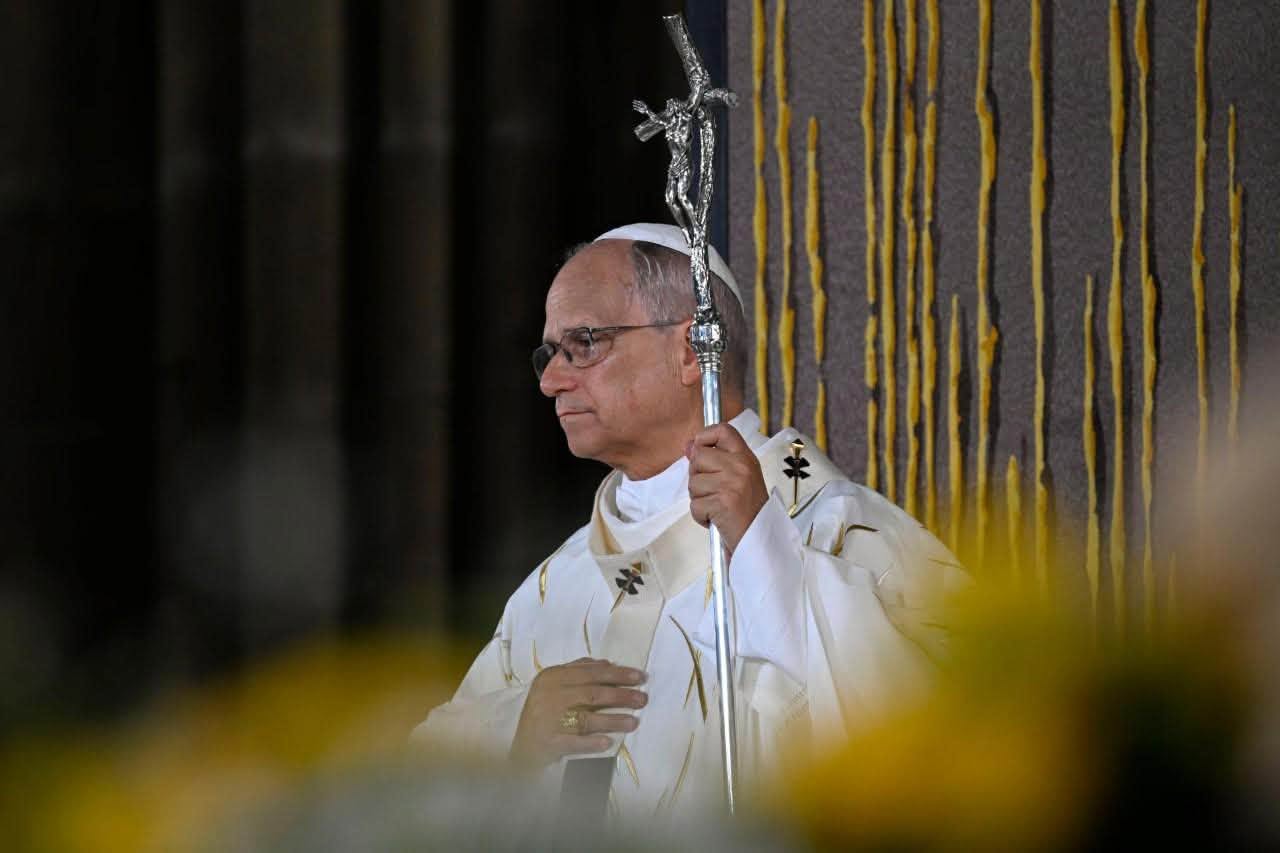
(ZENIT News / Rome, 10.12.2026).- Pope Leo XIV will be admitted to the Gemelli Polyclinic in Rome on Tuesday, October 13, to undergo a procedure to remove a pulmonary nodule detected during a recent medical check-up. The 71-year-old Pontiff personally announced the news at the conclusion of the Angelus prayer on Sunday, October 11, explaining that the lesion had been identified at a very early stage and was well-defined. Doctors have recommended its removal, and the initial expectation is that he will remain hospitalized for about a week.
The news took the faithful gathered in St. Peter’s Square by surprise and once again brought a particularly delicate issue for the Holy See to the forefront: the health of the man who leads the Catholic Church and the consequences of a potential temporary interruption of his activities.
Leo XIV announced the decision calmly, without dramatizing the situation or offering a diagnosis that is not yet known. «Following their [the doctors’] advice, I have decided to undergo surgery to remove it,» he explained, before expressing gratitude for the expressions of support and asking for prayers. The Holy See later clarified that he would be admitted on the morning of Tuesday, October 13, and that the procedure would take place early in the week. Speculation suggests the operation will occur on Wednesday, October 14.
The pulmonary growth was discovered following tests performed at the Gemelli-Isola facility, initially intended to investigate what was considered a possible inflammation. According to information provided by the Vatican, the check-up was not prompted by a specific health issue but was a routine medical examination.
The nature of the nodule has not been made public. It is therefore important to distinguish between the need for intervention and a cancer diagnosis; they are not the same thing. Pulmonary nodules can be benign or malignant, and their assessment depends on factors such as size, density, progression, and the patient’s medical history. When indicated, surgical removal allows for tissue analysis and the determination of subsequent steps. Without additional clinical information, it is impossible to ascertain the specifics of the Pontiff’s case.
The decision to take action at an early stage reflects the importance of evaluating such lesions without unnecessary delay when specialists deem surgery appropriate.
The Medical Team Already Known to the Vatican
The team attending to the Pope will be led by Luigi Carbone, a physician with years of experience in the medical care of Pontiffs and the current head of the Directorate of Health and Hygiene for the Governorate of Vatican City State. Carbone, who also accompanied Pope Francis on his Apostolic Journeys, will be assisted by specialists from the Rome-based hospital.
Joining him will be Massimiliano Strappetti, a nurse with extensive experience in caring for Popes. Professionally trained at the Gemelli itself, he attended to John Paul II and remained close to Benedict XVI until the end of his life. During Francis’s pontificate, he also became a trusted figure in monitoring the Pope’s health.
The choice of the Gemelli also holds significant historical meaning. The Catholic University Hospital, part of the Catholic University of the Sacred Heart, features facilities specially equipped for Pontiffs, including a private chapel on the tenth floor.
John Paul II spent a total of 153 days hospitalized there during his pontificate and famously referred to the center as «Vatican III.» Pope Francis was also admitted on numerous occasions, totaling nearly 38 days of hospitalization, according to available records. His most recent, prolonged admission, marked by severe respiratory complications, ended up being one of the most difficult episodes of his pontificate.
The arrival of the Pope at the same center inevitably brings those memories back to the minds of Catholics. However, the medical circumstances of each Pontiff differ, making it impossible to draw direct parallels regarding the current Pope’s progress.
A Suspended Schedule and a Trip That Remains in the Plans
The hospitalization will have immediate consequences for papal activities. The Prefecture of the Papal Household has announced the cancellation of audiences and scheduled events through Tuesday, October 20; this includes the meeting regarding Amoris Laetitia, the document on the family issued by Pope Francis, marking the tenth anniversary of its publication.
Cardinals Mario Grech and Kevin Farrell announced that the meeting took place as planned, though a summary will not be released publicly for the time being. Once the Pope has completed his convalescence, they will present him with the assembly’s results, the texts of the interventions, and the reports from the 16 working groups, pending his instructions.
The interruption of the schedule does not, in itself, mean that the Pope ceases to exercise his authority. Canon Law does not establish a specific procedure for transferring the governance of the Church in the event of a Pontiff’s total incapacity. Precedents show that Popes have continued to make decisions during hospitalizations, while Roman Curia officials maintain the ordinary functioning of the institutions. The possibility of prolonged incapacity cannot be assumed as a certainty. Vatican sources estimate that the Pope will remain hospitalized for a week, implying he could potentially leave the hospital on Monday, October 19, or Tuesday, October 20. However, even after discharge, he will need to spend another week recovering, meaning he would likely resume his full schedule around October 26 or 27.
In the short term, the pontificate’s agenda includes a major commitment: the Apostolic Journey scheduled for November 6–17 to Uruguay, Argentina, and Peru. The itinerary involves about ten flights, two helicopter trips, and significant changes in altitude while in Peru. The Holy See maintains that the Pope remains firm in his plans to travel; however, the outcome of the operation and the subsequent recovery could necessitate a reconsideration. The Pontiff, born in Chicago on September 14, 1955, has thus far demonstrated remarkable physical vitality. His recent activities, including his movements during the visit to France, the trip to Lampedusa, and his vacation at Castel Gandolfo, gave no public indication that a procedure of this nature would be required. Nevertheless, while his good physical condition and the early detection of a lesion present potentially favourable circumstances, they alone cannot predict the medical outcome.
The Pope’s Brothers
Among the first reactions to the announcement regarding Pope Leo XIV was that of Louis Prevost, the Pope’s 74-year-old older brother living in Florida, who asked for prayers that the procedure would proceed without complications. «I am sure he will make a full recovery and continue his mission of guiding the Catholic Church,» he stated. Louis is currently undergoing hospital treatment for cancer, a circumstance that adds a personal dimension to his words.
Although Louis holds political views that differ from his brother’s, both have sought to preserve their family relationship. Louis has publicly acknowledged their disagreements, including on issues such as immigration, without letting them prevent the brothers from staying in touch.
Bishops in the United States also invited the faithful to pray for both the Pope and the medical team attending to him. In Italy, President Sergio Mattarella conveyed a message of solidarity to the Pontiff on behalf of the many people, believers and non-believers alike, who are following his situation with concern. Prime Minister Giorgia Meloni highlighted the serenity with which Leo XIV shared the news.
The procedure also comes just days after the Pope approved the appointment of Filipino Cardinal Luis Antonio Tagle as Dean of the College of Cardinals, on October 9. Tagle, 69, replaces 92-year-old Cardinal Giovanni Battista Re, whose term had been extended by Francis. The Dean plays a significant role during the transition between pontificates and in the preparation for the Conclave, although the appointment is not necessarily linked to the hospitalization.
For the moment, the crucial fact remains that doctors have recommended the removal of a localized pulmonary lesion that was detected at an early stage. Prudence dictates that this information should not be confused with a more serious diagnosis, nor should the Pope’s calm demeanor be interpreted as a guarantee of a specific clinical outcome. As the hospitalization begins and the Holy See reorganizes its activities, the Church faces this period with a simple request from the Pope himself: to accompany him in prayer and await the answers that the medical progress of his condition will provide.

Publicaciones relacionadas:
 The Ascension of the Lord and Us: An Explanation by Pope Leo XIV
 Seven Things You Should Know Before the Publication of Leo XIV’s First Major Magisterial Document
 PHOTO GALLERY: A look back at the visit of the leader of Lebanon’s Armenian community to Pope Leo XIV
 Confirmed: Leo XIV to Visit a Second Microstate: San Marino
