

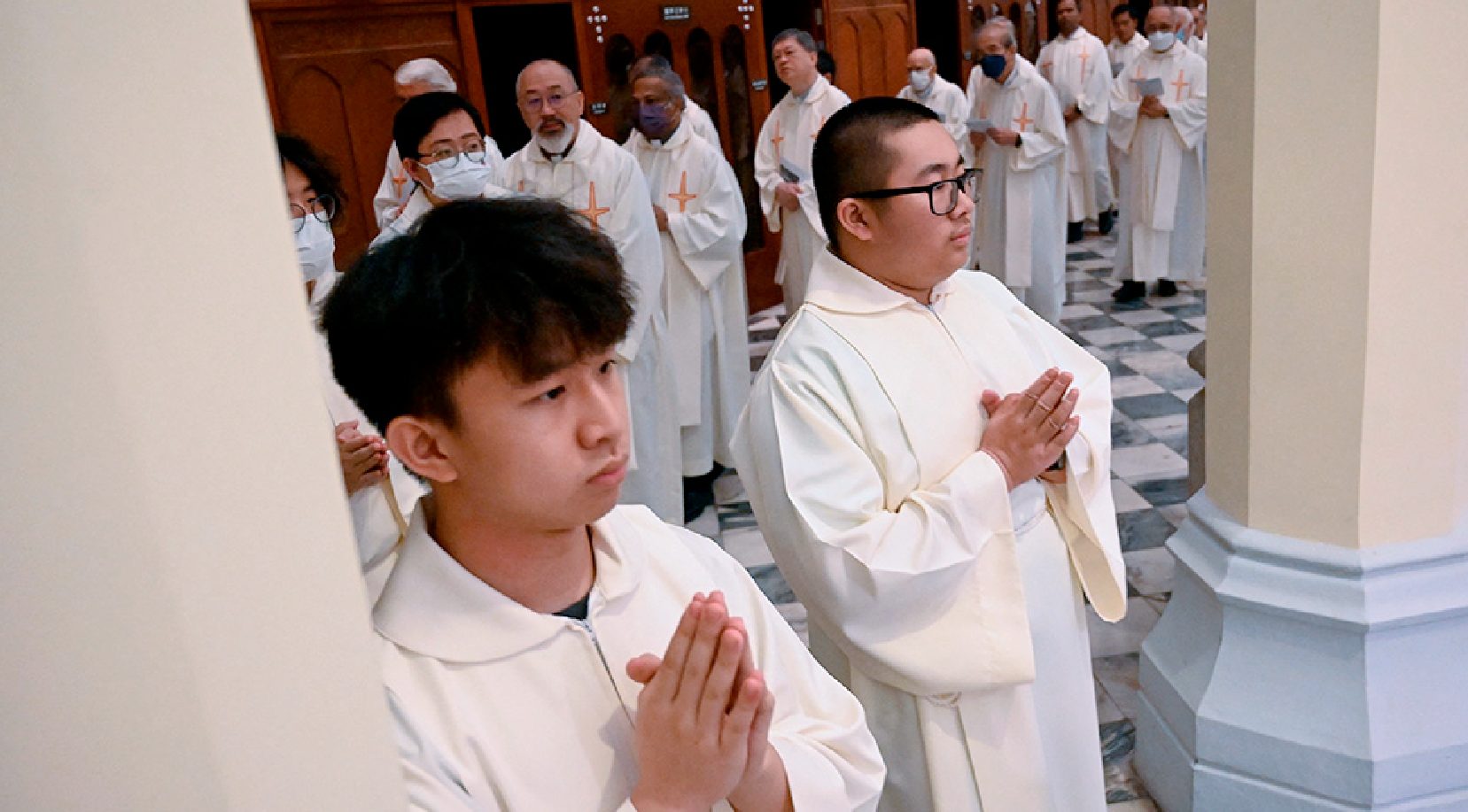
(ZENIT News / Beijing, 04.15.2026).- In the coastal province of Shandong, a series of retreats held in March has offered a revealing snapshot of how Catholic life is being reshaped within the political architecture of contemporary China. Organized under communist state-sanctioned ecclesial structures, the sessions brought together priests and religious sisters not only for spiritual formation, but also for sustained engagement with the ideological priorities of the country’s leadership.
According to official reports released at the end of March, clergy gathered from 16 to 20 March 2026, followed by a separate program for women religious from 23 to 26 March. Both initiatives were coordinated by provincial branches of the Catholic Patriotic Association and the local episcopal conference—institutions that operate under government oversight and are not recognized by the Holy See as part of the universal Church’s canonical structure.
At first glance, the format resembled a conventional ecclesiastical retreat: conferences on priestly identity, spiritual renewal and pastoral responsibility. Yet the content reveals a broader agenda. Central to the sessions was the assimilation of principles articulated during China’s 2021 National Conference on Religious Work, where President Xi Jinping emphasized that religious expression must be rooted in Chinese culture and remain free from foreign influence. This concept—commonly referred to as the “Sinicization” of religion—has become the guiding framework for state policy toward all faith communities.
In practical terms, this means that clergy formation now includes systematic instruction in political doctrine. Participants were encouraged to internalize and disseminate the “spirit” of the National People’s Congress and the Chinese People’s Political Consultative Conference, two key institutions in the country’s governance system. Bishop Fang Xingyao, a leading figure in the state-recognized Catholic structures, drew explicitly on his own participation in these bodies to underscore the expectation that religious leaders align their pastoral work with national priorities.
The program also incorporated detailed study of regulatory texts governing religious life. Among them were guidelines promoting frugality and moral discipline within the clergy, administrative norms for appointing senior religious personnel, and a code of conduct designed to standardize behavior across Catholic communities. These documents are part of a broader legal framework that requires all religious activity to be registered and supervised by the state.
The pedagogical approach combined political formation with spiritual introspection. Conferences addressed themes such as self-assessment, the challenges facing contemporary clergy, and the meaning of priestly vocation in what organizers described as a “new era.” The stated objective was to strengthen not only doctrinal understanding, but also what officials termed the “political quality” and cohesion of the religious community.
For women religious, the structure was similar, though led by a different set of instructors. Their sessions likewise sought to integrate spiritual life with civic responsibility, reinforcing the expectation that consecrated life should contribute to social stability and national development.
This dual emphasis reflects a longstanding tension within Chinese Catholicism. The country’s millions of Catholics remain divided between the state-approved Church and an underground community that maintains direct allegiance to Rome and the Pope. While a provisional agreement between Beijing and the Vatican on the appointment of bishops has created limited areas of convergence, the underlying ecclesiological divide persists.
The situation raises complex questions about the nature of religious freedom in China. The constitution formally guarantees such freedom, yet international human rights organizations consistently rank the country among the most restrictive environments for religious practice. The requirement that all clergy and institutions register with the state effectively places the boundaries of religious life under governmental control.
In this context, the Shandong retreats can be read as more than routine formation. They illustrate how religious identity is being reframed within a system that seeks to harmonize faith with political loyalty. The language used—emphasizing patriotism, discipline and alignment with national goals—suggests that the Church, at least in its official expression, is expected to function not only as a spiritual community but also as a partner in state-building.
For the Catholic Church, the developments in China pose a delicate challenge. On one hand, they reveal the resilience of religious practice under restrictive conditions; on the other, they highlight the extent to which that practice is being reshaped by external authority.
Thank you for reading our content. If you would like to receive ZENIT’s daily e-mail news, you can subscribe for free through this link.

Publicaciones relacionadas:
 Chinese Communist government replaces church crosses with Communist Party leader
 Faith at 35,000 Feet: United Airlines, Catholic Doctrine, and the Limits of Corporate Tolerance
 The Jewish state of Israel bans Caritas, the charitable arm of the Church (and more than 20 humanitarian organizations), from Gaza
 After one month of Nicolás Maduro’s imprisonment, the Venezuelan government restores Cardinal Porras’ passport
