

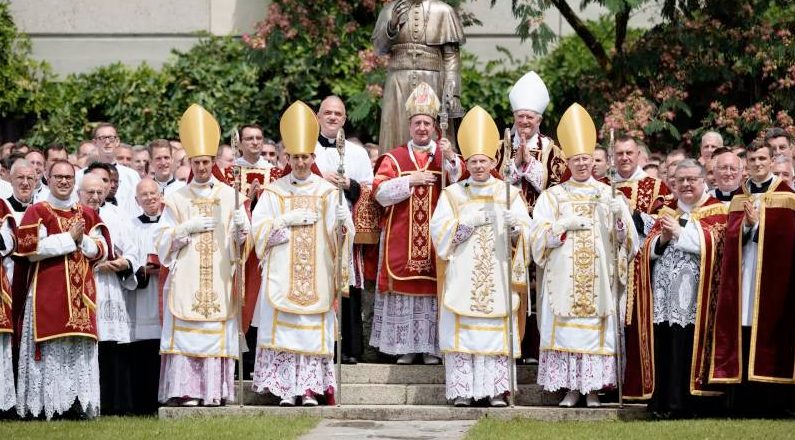
(ZENIT News / Rome, 07.08.2026).- The crisis sparked by the episcopal consecrations performed without a papal mandate by the Priestly Fraternity of Saint Pius X (FSSPX) is having an unexpected effect within the Catholic Church. While the Holy See and numerous Bishops insist on the gravity of the schismatic act and call upon the faithful to remain in full communion with Pope Leo XIV, a current of thought is also growing among the episcopate that proposes a clear distinction between rejecting an ecclesial rupture and offering a pastoral welcome to those who find a legitimate source of spiritual life in the traditional liturgy.
On July 1, the FSSPX consecrated four new Bishops in Ecône, Switzerland, without the authorization of the Roman Pontiff. The following day, the Dicastery for the Doctrine of the Faith confirmed that both the four new prelates and the two consecrating Bishops had automatically incurred excommunication; it characterized the event as a schismatic act and underscored the canonical consequences affecting the administration of certain sacraments by the Fraternity’s clergy.
The response from numerous Bishops has not been limited to merely recalling canonical sanctions. In many cases, a pastoral tone has prevailed, aimed at preventing those who attend the Fraternity’s celebrations from drifting away from the Church.
One of the most significant examples comes from Norway. The Bishop of Oslo, Fredrik Hansen, urged the faithful drawn to the liturgy that predates Vatican Council II reforms, to remain united with the Pope and their diocesan Bishop. He acknowledged that the situation creates uncertainty for many but assured them that the celebration of Mass according to the 1962 Missal would continue every Sunday at St. Joseph’s Church in Oslo; he even left open the possibility of expanding this liturgical offering if it would foster the spiritual well-being of the faithful.
His Pastoral Letter, in addition to recalling the teachings of the First and Second Vatican Councils regarding the visible unity of the Church around the Bishop of Rome, invites the faithful to pray the Rosary for ecclesial unity and asks them to refrain from participating in celebrations organized by the Fraternity.
Czesław Kozon, the Bishop of Copenhagen, expressed similar views. Although he described the FSSPX episcopal consecrations as «schismatic» and detrimental to Church unity, he maintained that the so-called traditional Mass should not disappear as long as there are faithful believers sincerely attached to it. In his view, the liturgical form following Vatican Council II constitutes the Church’s ordinary liturgy and can be celebrated in all its richness, but this does not require marginalizing those who find profound spiritual nourishment in the earlier form.
This same idea is beginning to spread among other prelates of recognized ecclesial weight.
Cardinal Antonio María Rouco Varela, Archbishop Emeritus of Madrid, has called for a return to the spirit of the document Summorum Pontificum, promulgated by Benedict XVI in 2007. According to the Cardinal, the respectful coexistence of the two forms of the Roman Rite contributed for years to reducing liturgical tensions and yielded positive results in the Archdiocese of Madrid. At the same time, he called for the correction of liturgical abuses that may occur in ordinary celebrations, insisting that fidelity to Vatican Council II and respect for those who prefer the traditional liturgy are not incompatible goals.
Archbishop Georg Gänswein, formerly Benedict XVI’s personal secretary and currently the Apostolic Nuncio to the Baltic States, also defended clearly the Holy See’s decision. He recalled that the consecration of Bishops without a papal mandate automatically entails excommunication, explaining that this penalty is not a definitive condemnation but a medicinal measure intended to foster repentance and a return to full communion. At the same time, however, he deemed it appropriate for Rome to consider a more flexible application of the norms regarding the celebration of the traditional Mass, bearing in mind the pastoral fruits yielded by Summorum Pontificum.
A similar reflection was offered by Cardinal Kurt Koch, Prefect of the Dicastery for Promoting Christian Unity, who suggested reviewing the application of the restrictions introduced in 2021 in order to provide pastoral care for the faithful who love the traditional liturgy without sharing the doctrinal positions of the Fraternity of Saint Pius X.
In Italy, Cardinal Angelo Bagnasco, former president of the Council of European Bishops’ Conferences, recalled that Benedict XVI never created a new rite but rather recognized two forms of celebrating the same Roman Rite. In his view, the coexistence of both liturgical expressions does not threaten the unity of the Church, provided they do not become opposing ideological banners. True communion, he affirmed, rests on shared faith rather than on uniformity of spiritual sensibilities.
Meanwhile, in the United States, various Bishops — including Bernard Hebda, Frank Caggiano, Donald Hying, James Johnston, Douglas Lucia, Terry LaValley, and Shawn McKnight — have issued similar guidelines. All insist that Catholics must refrain from participating in SSPX celebrations and remind the faithful that communion with the Successor of Peter is an essential element of Catholic identity. At the same time, however, many express understanding toward families who attend these chapels out of love for the traditional liturgy, inviting them instead to join parishes where Mass according to the 1962 Missal is legitimately celebrated.
Ultimately, the current debate transcends purely liturgical questions. Most of the Bishops who have weighed in agree that the core issue lies not in a preference for a particular form of celebrating the Eucharist, but in the rupture of ecclesial communion. Consequently, the prevailing message combines two inseparable ideas: firmness in the face of schism and pastoral closeness to the faithful.
That balance could mark a new phase in addressing an issue that has generated tensions within the Church for years. Far from automatically equating attachment to the traditional liturgy with schismatic stances, a growing number of pastors propose the exact opposite: offering a fully Catholic place for these faithful so that legitimate liturgical diversity strengthens, and does not weaken, the unity that the Church regards as one of its most precious assets.
In a March 2025 message to the French Episcopate, Pope Leo XIV expressly asked the Bishops to seek inclusive solutions for Catholics attached to the Old Missal.

Publicaciones relacionadas:
 Pope Francis removes Belgian bishop convicted of abuse from the clerical state
 Why did the Holy See not sign the declaration in favor of Ukraine at the Swiss Summit?
 Catholic Leader in the Holy Land Visits Gaza Following Events at Catholic Parish
 Becciu case: Vatican appeal trial enters uncharted waters amid questions about the role of the prosecution
