

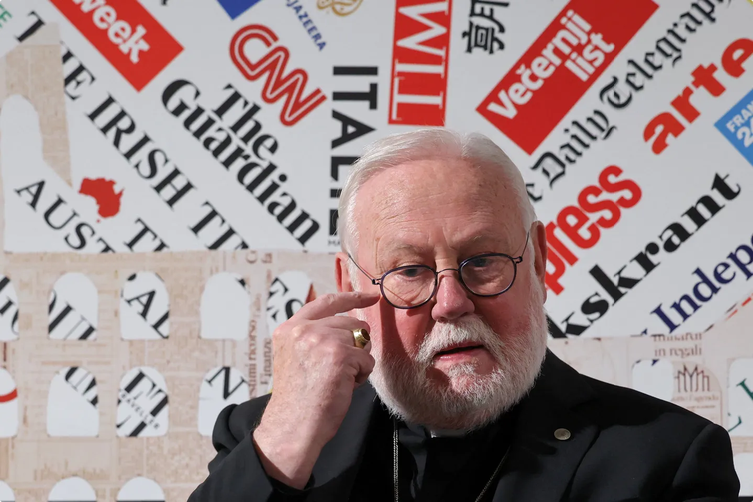
(ZENIT News / Rome, 10.28.2026).- Pope Leo XIV’s recent cancer diagnosis has introduced an unexpected human dimension into a pontificate that began at remarkable speed. Yet, according to the Vatican’s chief diplomatic official, the illness is unlikely to derail the Pope’s plans. Instead, it may alter how both the Church and the wider world perceive a pontiff whose energy and composure had encouraged almost superhuman expectations.
Archbishop Paul Richard Gallagher, the Holy See’s Secretary for Relations with States and International Organizations, offered this assessment during a meeting with journalists in Rome on October 27. Leo, he said, had initially given the impression of a “Superman, a super-Pope” after his election in 2025, moving quickly into the responsibilities left by the prolonged illness and death of Francis. His own illness, Gallagher suggested, is a reminder that the man leading the Catholic Church is as mortal and vulnerable as anyone else.
The 71-year-old Pope underwent surgery on October 13 to remove the lower lobe of his right lung after doctors detected a tumour, subsequently diagnosed as adenocarcinoma, the most common type of lung cancer. According to the medical information released by the Vatican, the operation was successful, subsequent tests found no need for further treatment, and his recovery has been progressing well. Gallagher nevertheless described the diagnosis as a turning point, even while expressing considerable optimism about the clinical outlook.
There is, for now, little indication that Leo intends to reduce his international commitments. The Vatican has confirmed that his November 6–17 journey to Uruguay, Argentina and Peru will proceed according to schedule. The demanding itinerary involves approximately twelve flights and two helicopter journeys, covering some 19,000 miles. It will be the longest foreign trip of his pontificate so far.
Gallagher explained that the Pope wanted to make the journey and felt able to do so in light of the positive medical assessments. Peru, in particular, carries a personal significance. Leo spent two decades as a missionary priest there, holds Peruvian citizenship and retains a close attachment to the people and to his former diocese of Chiclayo. The visit will therefore be more than another item on a diplomatic calendar: it will bring him back to a country that played a formative role in his priestly life.
The journey also offers a glimpse of the international ambitions of the new pontificate. Gallagher indicated that a visit to the United States, Leo’s country of birth, is likely in the not-too-distant future. The timing, however, remains uncertain. The outcome of the American midterm elections could influence whether a visit takes place in 2027 or later, since the Vatican generally seeks to avoid papal journeys that might be drawn into domestic electoral campaigns.
A possible visit could include the United Nations General Assembly in New York, while a stop in Mexico has also been discussed as a possibility. Gallagher said the Pope was particularly keen to visit the Shrine of Our Lady of Guadalupe, one of the most important Catholic pilgrimage destinations in the world. No definitive arrangements have been made. The Vatican diplomat also considered a papal visit to Australia in 2028 very likely, potentially to conclude the International Eucharistic Congress in Sydney. A journey to South Korea in August 2027 for World Youth Day is another major event on the horizon.
Gallagher’s remarks also offered an unusually revealing portrait of the Pope’s working methods. Having served in the Vatican diplomatic service since 1984 and worked under four pontiffs, the archbishop described Leo as reflective, methodical and exceptionally well informed. The Pope, who studied mathematics, is comfortable with financial data and spreadsheets, asks detailed follow-up questions and often knows much of what is being presented to him before his weekly meetings with the Secretariat of State.
His temperament, Gallagher suggested, contrasts with the more spontaneous and occasionally unpredictable style of Francis. Leo is reserved about his intentions and rarely discloses plans far in advance. Even Gallagher was unaware of the Pope’s impending surgery until Leo announced it publicly on October 11. The archbishop also rejected suggestions that the Roman Curia might overwhelm an American pontiff unfamiliar with its internal workings. Leo, he said with humour, would prove that he had an appetite of his own.
But the interview was not confined to the Pope’s health and travel plans. Gallagher also addressed one of the most delicate questions facing the Holy See: its agreement with China on the appointment of Catholic bishops. Eight years after the provisional pact was signed in September 2018, its terms remain confidential, and its implementation continues to expose tensions between Rome and Beijing.
Gallagher acknowledged that the agreement’s shortcomings were evident, but defended the decision to maintain it. Dialogue with the Chinese authorities, he argued, is difficult, yet the present situation is better than the one that existed before the agreement. He pointed in particular to the fact that all bishops in China are now in communion with the Pope.
That assessment, however, does not settle the wider question of religious freedom in the country. The agreement was designed to address the longstanding division between communities loyal to Rome and the state-recognised Catholic structures, particularly over the appointment of bishops. It has not made public the precise procedures through which candidates are selected, nor has it ended the Communist Party’s extensive control over religious life.
The gap between the Vatican’s understanding and Beijing’s presentation of the process remains significant. In the recent appointment of Bishop Ignatius Ding Zuyao of Haimen, the Holy See stated that Leo XIV had approved the candidate and appointed him under the provisional agreement. Chinese official ecclesiastical bodies, by contrast, presented the appointment as approved by the state-recognised episcopal conference, without mentioning the Pope’s role. Such differences illustrate why the agreement remains controversial even when both sides proceed with episcopal ordinations.
The government’s policy of religious “sinicisation” further requires religious activity to conform to the priorities of the Communist Party.
The Holy See, for its part, maintains that engagement is preferable to a breakdown in relations. The agreement has been renewed several times, most recently in October 2024, when its validity was extended for another four years. Gallagher’s comments indicate that the Vatican has no immediate intention of abandoning this course, although the diplomat did not suggest that the arrangement had resolved the fundamental problems.
He also acknowledged that the possibility of establishing some form of cultural presence in Beijing had been explored. But negotiations would involve conditions that the Holy See was not currently prepared to accept. The Vatican maintains diplomatic relations with Taiwan and has a study mission in Hong Kong, but no official diplomatic representation in mainland China.
Gallagher stressed that Leo’s responsibility extends to the universal Church and that China does not occupy a uniquely privileged place in his attention. That global perspective is consistent with the picture he painted of a Pope who proceeds cautiously, gathers information and prefers to address problems without dramatic gestures.
Thank you for reading our content. If you would like to receive ZENIT’s daily e-mail news, you can subscribe for free through this link.

Publicaciones relacionadas:
 Leo XIV turns the consistory into a laboratory for mission and governance
 Cardinal Makrickas takes the helm of the Roman basilica of St. Mary Major: the oldest Marian church in the West
 Pope Leo XIV summons bishops to Rome to discuss the reimplementation of the controversial Amoris Laetitia
 This is what the latest criticisms of synodality from prominent episcopal voices are saying: fatigue, ambiguity, and the risk of losing sight of the Church’s mission
