

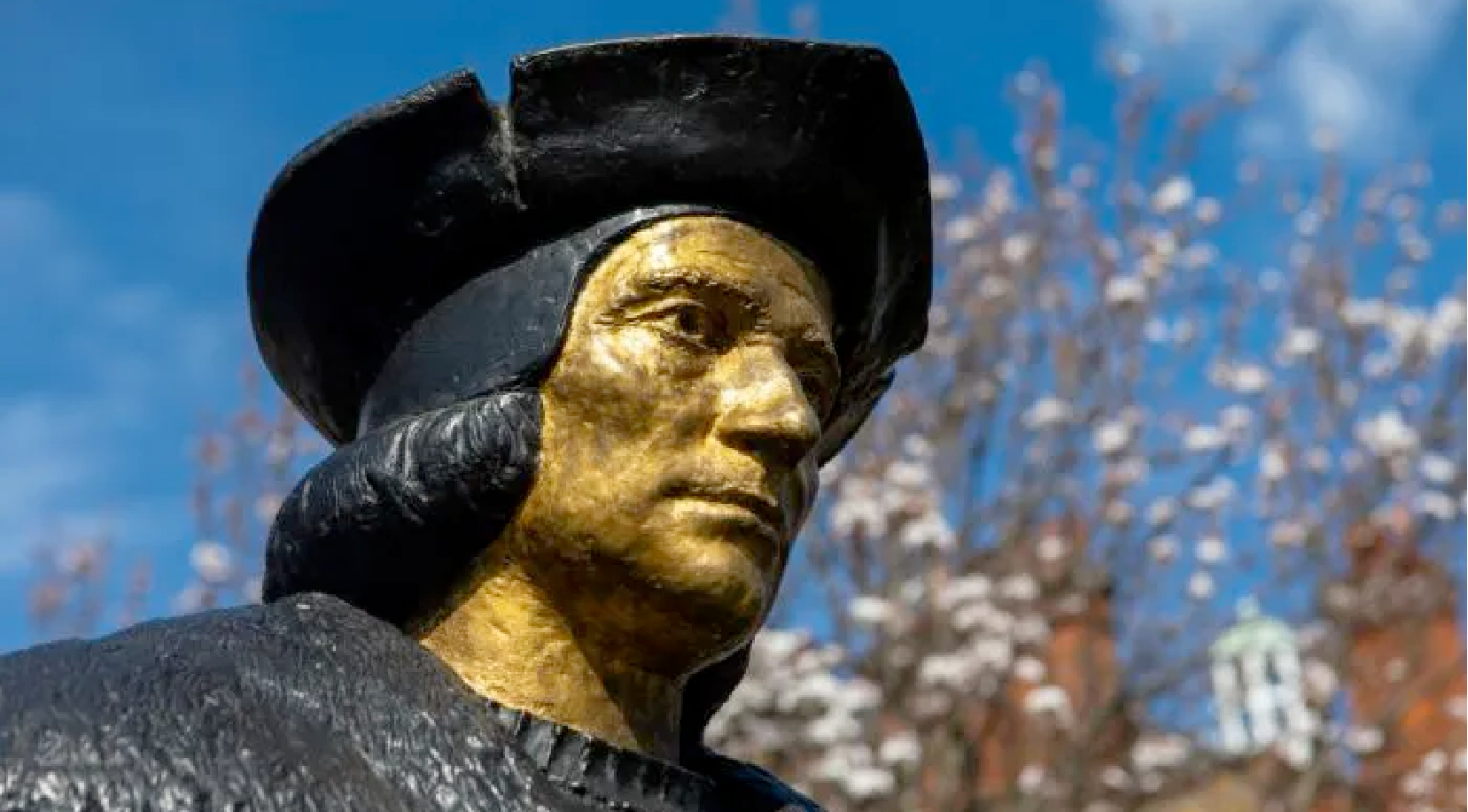
(ZENIT News / London, 07.25.2025).- In a quiet corner of Canterbury, inside the Anglican church of St Dunstan, history rests beneath the stone floor — or more precisely, what remains of the head of one of the most revered martyrs of the English Reformation. But now, as the 500th anniversary of his execution looms on the horizon, the long-silent relic of St Thomas More may once again speak to the world.
The church, which has held the skull of the saint since the mid-16th century, has begun early steps toward what could become one of the most significant ecumenical commemorations in modern British religious life. Local parish leaders are exploring the possibility of exhuming and preserving the relic, in time for the 2035 anniversary of More’s martyrdom under Henry VIII.
While relics are commonplace in Catholic devotion, their presence in Anglican churches is exceptional — and even more so when they belong to a Catholic saint canonized after the Reformation. Yet for the Parochial Church Council of St Dunstan’s, this rare circumstance is less a source of tension than of opportunity.
“This is not just about a piece of bone,” said Sue Palmer, a trustee of the PCC. “It’s about memory, conscience, and the role this man plays in the spiritual imagination of Christians around the world. We are stewards of something far bigger than ourselves.”
More’s head, once placed on a pike above London Bridge as a warning to traitors, was rescued by his daughter, Margaret Roper. After her death, both she and the relic were interred in the Roper family vault beneath St Dunstan’s — a space that has been opened several times in the past two centuries, most recently in 1997, confirming the presence of the skull in a niche.
Today, that niche draws pilgrims daily. Some leave flowers, others simply sit in silence. But increasing numbers have begun to question whether the relic, hidden from view, is being cared for in a way that befits its significance.
The church acknowledges these concerns, and in a statement released on July 6 — the 490th anniversary of More’s execution — it announced its intent to consult broadly with ecclesial, academic, and community voices, including the Vatican. No final decision has been made, and the process of obtaining formal permissions through diocesan and legal channels could take years.
Still, the implications are substantial. If the relic is exhumed, carefully preserved, and placed in a setting that allows prayerful veneration, it could transform the church into a vital locus of pilgrimage and ecumenical encounter — especially given the impossibility of identifying More’s body, which lies somewhere beneath the crowded floor of the Chapel of St Peter ad Vincula inside the Tower of London.
“We’re not trying to turn the church into a museum,” Palmer insisted. “We’re seeking to honor a legacy in a way that is reverent, unifying, and spiritually alive.”
The church remains open daily, and visitors continue to arrive, often with quiet reverence, to be near what is believed to be the last physical remnant of the man declared a saint in 1935 and the patron of statesmen, lawyers, and those who resist political coercion on grounds of conscience.
Thank you for reading our content. If you would like to receive ZENIT’s daily e-mail news, you can subscribe for free through this link.

Publicaciones relacionadas:
 Ukraine: Greek-Catholics open process of beatification of the predecessor of their current major archbishop: Ljubomyr Husar
 U.S. bishops move forward with cause for beatification of visionary of Marian apparition in the country
 Ecumenism: Pope Francis includes Isaac of Nineveh in Roman Martyrology – Context? Visit of Assyrian East Patriarch
 Vatican approves beatification of Fulton Sheen, the American bishop who won an Emmy
