

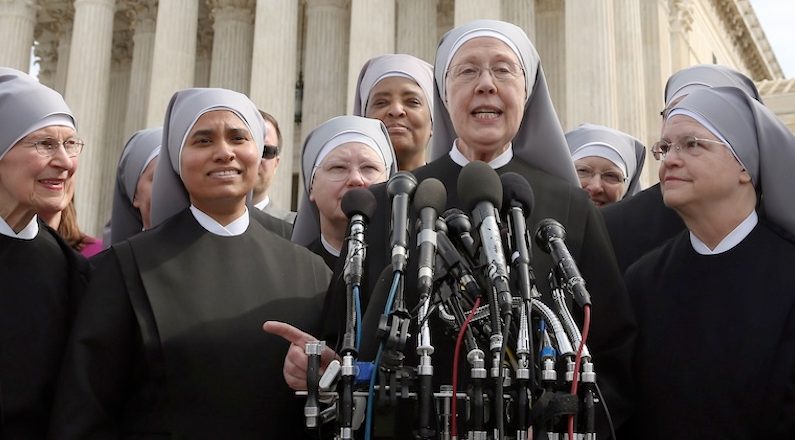
(ZENIT News / Philadelphia, 07.09.2026).- Nearly a decade and a half after their legal battle began, the Little Sisters of the Poor are once again defending their right to operate their charitable ministry without being required to provide health coverage for contraceptives. The latest hearing before a federal appeals court underscores how one of the most significant religious liberty cases in recent American history remains unresolved despite repeated victories for the Catholic order before the U.S. Supreme Court.
On July 7, the Little Sisters appeared before the U.S. Court of Appeals for the Third Circuit in Philadelphia, asking the court to overturn a lower court ruling that once again placed their religious exemption in jeopardy. The case stems from the contraceptive mandate introduced during the Obama administration under the Affordable Care Act, commonly known as Obamacare, which required many employers to include contraceptive coverage in employee health insurance plans.
From the outset, the Little Sisters of the Poor maintained that complying with the mandate would violate their Catholic faith. The congregation, which has served impoverished elderly people for nearly two centuries, argued that it could not participate in providing coverage for contraceptives, including products it believes may have abortifacient effects.
The dispute has generated one of the longest-running religious liberty cases in the United States. In 2020, the U.S. Supreme Court ruled by a 7-2 majority that the first Trump administration had acted lawfully in creating exemptions for religious employers with conscientious objections to the mandate. Nevertheless, Pennsylvania and New Jersey continued challenging those exemptions in court.
That effort gained new momentum in August 2025, when a federal district court in Philadelphia ruled in favor of the two states, prompting the latest appeal.
Representing the sisters before the Third Circuit is the Becket Fund for Religious Liberty, which has defended the congregation throughout much of the litigation. Becket president Mark Rienzi described the continuing legal battle as an unnecessary campaign against a religious community whose mission has remained unchanged throughout the dispute.
«The states have no right to strip the Little Sisters of the Poor of their federal civil rights,» Rienzi argued, urging the appeals court to dismiss the lawsuit and preserve protections that the Supreme Court has already recognized.
Mother Loraine Marie Maguire likewise expressed frustration that a congregation devoted to caring for elderly people nearing the end of life has spent so many years engaged in litigation instead of focusing exclusively on its charitable work.
«For almost 200 years, our order has welcomed poor and dying elderly people into our homes as if they were Christ Himself,» she said. «We simply want to continue that mission without being forced to violate our faith.»
Following oral arguments, Becket attorney Lori Windham expressed confidence that the lower court’s decision should be reversed, noting that the legal conflict has now stretched across approximately 15 years. A ruling from the Third Circuit is expected before the end of the year.
Although the legal dispute centers primarily on religious liberty rather than medical policy, the case continues to reflect a broader ethical debate surrounding certain contraceptive drugs.
More recently, in 2023, the U.S. Food and Drug Administration updated the labeling for Plan B to state that it does not terminate an established pregnancy. However, organizations representing pro-life physicians, including the American Association of Pro-Life Obstetricians and Gynecologists, continue to argue that depending on the timing within a woman’s reproductive cycle, emergency contraceptive drugs may not only delay ovulation but could also prevent implantation after fertilization. Citing published studies, these physicians maintain that the biological effects may vary according to when the medication is taken.
For the Little Sisters of the Poor, however, the courtroom battle extends beyond scientific disputes. At its core lies a constitutional question that has repeatedly reached the nation’s highest courts: whether religious organizations can continue serving society according to their deeply held beliefs without being compelled by government policy to act against their moral convictions.
Thank you for reading our content. If you would like to receive ZENIT’s daily e-mail news, you can subscribe for free through this link.

Publicaciones relacionadas:
 French Court Upholds Ban on Religious Symbols in Local Council, Reigniting National Debate
 Pulpits, politics and the limits of free speech: a US court ruling keeps a 70-year barrier in place while Washington prepares new guidance
 Between altar and state: Catholic clergy formation in China reflects the tightening framework of “Sinicized” religion
 Canada: Parliament Makes It a Crime to Speak Publicly About What the Bible Says Regarding Homosexuality
