

(ZENIT News / Madrid, 06.10.2026).- The debate surrounding Spain’s most controversial religious and historical monument entered a new phase this week as preparatory work for the government’s planned transformation of the Valley of the Fallen began while Pope Leo XIV was making his apostolic visit to the country.
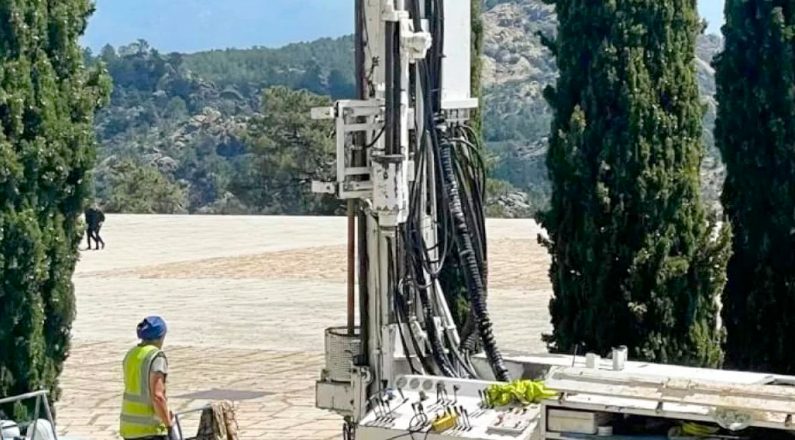
Heavy drilling equipment appeared on June 8 in the esplanade surrounding the basilica, initiating geological and geotechnical surveys that form part of the preliminary stages of the government’s long-discussed “re-signification” project. The timing immediately attracted attention. The works began on the very day the Pope delivered his historic address before the Spanish Parliament, prompting criticism from organizations opposed to the project and adding fresh tension to a dispute that has already divided politicians, historians, Catholics, and civil society groups.
At the center of the controversy stands a site unlike any other in Europe. Officially renamed the Valley of Cuelgamuros following Spain’s Democratic Memory legislation, the complex remains known internationally as the Valley of the Fallen. Built after the Spanish Civil War and dominated by what is widely regarded as the largest cross in Christendom, it contains a pontifical basilica, a Benedictine abbey, a choir school, and the remains of thousands of victims of the conflict.
The government approved its redevelopment plan in late 2025, coinciding with the fiftieth anniversary of General Francisco Franco’s death. The winning architectural proposal, entitled “The Base and the Cross,” seeks to reshape the visitor experience through a major intervention that would alter the monument’s traditional visual axis. Central to the project is the creation of a large architectural fissure leading visitors into a circular open-air space intended to symbolize dialogue, plurality, and democratic coexistence.
Spanish authorities have allocated €30 million to the initiative. Of that amount, €4 million has already been devoted to the international design competition and project planning, while the remaining €26 million is expected to finance construction, interpretation facilities, museum installations, and broader landscape modifications.
Supporters of the plan argue that the site must be reinterpreted in a manner that reflects contemporary democratic values while acknowledging the complexity of Spain’s historical memory. Critics, however, contend that the project risks diminishing the religious identity of a place that remains, first and foremost, a functioning sanctuary and place of prayer.
The controversy intensified when representatives of the Association for the Defense of the Valley of the Fallen described the timing of the works as a deliberate provocation. Their objections focus not only on the transformation itself but also on the symbolic coincidence of beginning visible activity while the Pope was carrying out one of the most significant events of his Spanish visit.
Questions have also emerged regarding procedures. According to various reports, some local authorities and observers claim they were not formally informed before the surveys began. Others have questioned whether all necessary permits and approvals have been secured at this stage of the process.
The Benedictine community responsible for the abbey adopted a markedly different tone. In an official statement, the monks confirmed that drilling operations had taken place near the basilica and acknowledged that they had learned of the works informally. At the same time, they emphasized that disagreements over the future of the site should be resolved through lawful means and under judicial supervision.
Their statement took on added significance after the drilling machinery was vandalized and covered with offensive graffiti directed at public authorities. The monks strongly condemned the damage, insisting that neither the sacred character of the site nor legitimate public debate can justify acts of vandalism. They reiterated that the defense of the basilica’s religious status, the rights of the faithful, and the preservation of legal guarantees must proceed through peaceful and lawful channels.
Beyond the immediate political dispute lies an intriguing paradox. At a time when the government is investing millions of euros to transform the monument, public interest in the site has actually increased. According to official figures, 254,157 visitors entered the complex during 2025, compared with 213,949 the previous year—an increase of 18.8 percent. Revenue also rose significantly, reaching €1,044,652, up 16.8 percent from 2024.
The longer historical trend is more complex. Visitor numbers remain well below the 379,000 recorded in 2018, yet attendance has grown steadily since 2021. From 135,848 visitors that year, the figure climbed to more than 254,000 in 2025, suggesting that public debate itself may be fueling renewed curiosity about the monument.
For Catholics, the dispute touches on issues that extend beyond politics and historical interpretation. The Valley is not merely an architectural landmark; it is also a consecrated place of worship where the Eucharist is celebrated daily and where thousands of dead are buried. This dual identity—as both a historical symbol and a sacred space—helps explain why every proposal concerning its future generates such intense reactions.
Thank you for reading our content. If you would like to receive ZENIT’s daily e-mail news, you can subscribe for free through this link.

Publicaciones relacionadas:
 Pope Leo’s visit to Argentina unofficially confirmed after audience with President Milei
 This is the first YouTube video message from Pope Leo XIV to USA
 Pope Leo XIV receives documented report on religious persecution in Nicaragua
 Ireland: After 500 years, Pope Leo XIV could solve the problem of Dublin’s lack of a cathedral
