

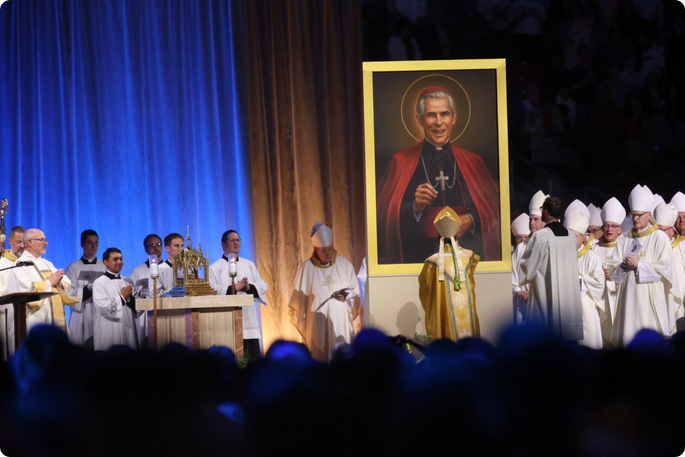
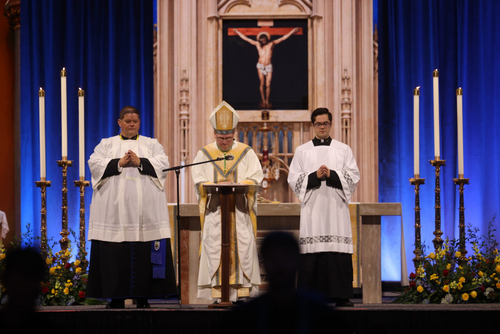
(ZENIT News / St. Louis, 09.25.2026).- More than 50,000 pilgrims gathered in St. Louis on September 24 to witness the beatification of Archbishop Fulton J. Sheen, the American Catholic preacher whose radio and television broadcasts brought the Gospel into millions of homes. The solemn liturgy, led by Cardinal Luis Antonio Tagle as papal representative, marked a historic first: Sheen is the first U.S.-born bishop to be declared blessed.
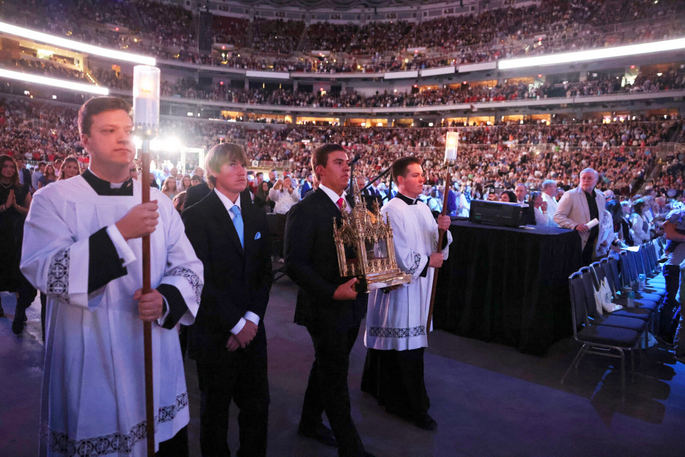
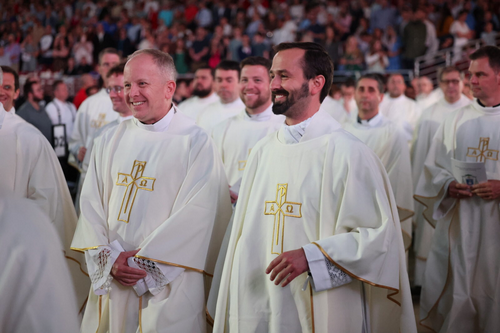
Pope Leo XIV, who grew up listening to Sheen, sent his greetings and described him in the apostolic letter for the occasion as an “untiring preacher of the Gospel through modern means of communication” and a pastor driven by missionary zeal. The multilingual celebration brought together nearly 90 bishops and around 1,000 priests, with readings and prayers in several languages. After the Mass, pilgrims queued to venerate a relic of Sheen’s jaw—the instrument, as one speaker observed, that had carried his preaching to audiences around the world.
View this post on Instagram
The ceremony celebrated a figure whose public influence was matched, in Tagle’s homily, by two less conspicuous qualities: a refusal to make himself the center of his ministry and a deep solidarity with people living in poverty.
Sheen, born Peter John Sheen in El Paso, Illinois, in 1895, was ordained for the Diocese of Peoria in 1919. He studied philosophy and theology, earned a doctorate from the Catholic University of Louvain in 1923, and taught at institutions including The Catholic University of America in Washington. His public career began with the radio program The Catholic Hour, which he hosted for two decades, and reached a much wider audience through television. Life Is Worth Living, launched in 1951, made him a household name; in 1953, he won an Emmy for most outstanding television personality, beating Lucille Ball.
But Tagle warned against confusing the reach of an evangelizer with the source of the message. Drawing on St. Paul, he said the mission is to proclaim Jesus Christ as Lord, not to promote the preacher. Sheen himself once told Pope Pius XII that he had never counted the conversions attributed to his preaching, lest he be tempted to believe they belonged to him. He preferred to think of himself as a doorkeeper, guiding people toward the open door of God’s house.
The second theme of Tagle’s homily was Sheen’s concern for the poor, especially in the developing world. As national director of the Society for the Propagation of the Faith from 1950 to 1966, Sheen supported missionary and humanitarian work across the globe. He also directed the proceeds of his media appearances and lectures toward churches in need.
At the Second Vatican Council, on November 9, 1964, Sheen urged the bishops to give poverty a prominent place in their deliberations. He pointed to the stark divide between global wealth and need, noting that prosperity was concentrated largely north of the 30th parallel, while much of the world’s poverty lay to the south, in Africa, Asia and Latin America. “Only a Church wounded by poverty,” he argued, could convert a world wounded by doubt. Tagle emphasized that care for the poor was not an ideological gesture for Sheen, but an essential expression of following Christ.
He illustrated the point with a story Sheen had told about visiting a leprosy hospital in Buluba, Uganda, where 500 patients lived. While handing out silver crosses, Sheen recoiled at the damaged hand of the first man who approached him. He dropped the cross onto what remained of the man’s hand, then recognized the contradiction between his instinctive fear and the message of the crucifix he was offering. Remembering that Christ had made himself vulnerable to bring new life to the sick and wounded, Sheen began touching and holding the patients’ injured flesh. He later called himself “the 5,001st leper.” Tagle presented the episode as a moment when the preacher himself was converted by encountering Christ in another person’s suffering.
Sheen’s legacy also includes his work as a bishop. Named an auxiliary bishop of New York in 1951 by Pius XII, he was appointed bishop of Rochester in 1966 by Paul VI, serving there for just under three years. During that period, he spoke out for racial justice and became increasingly critical of U.S. involvement in Vietnam. He died in 1979, while praying before the Blessed Sacrament in his private chapel. Leo XIV has set December 9, the anniversary of his death, as the feast day of Blessed Fulton Sheen.
The Vatican’s recognition followed the approval of a miracle attributed to Sheen’s intercession: the recovery of newborn James Fulton Engstrom, whose heart reportedly stopped beating for 61 minutes after birth in 2010. His mother had prayed for Sheen’s intercession. Beatification permits public veneration in particular places; canonization would require recognition of a further miracle. Bishop Louis Tylka of Peoria said several additional reported miracles could now be examined.
The celebration drew pilgrims from across the United States and abroad, including a Polish priest who said he had travelled 30 hours to attend. Sheen’s writings and broadcasts had become popular in Poland through translations, a reminder that his influence extended far beyond his own country. In a message marking the occasion, U.S. President Donald Trump also praised Sheen’s use of broadcasting to preach the Gospel, noting the millions who watched his programs.
Yet the homily’s final emphasis was not on audience figures, awards or national recognition. It was on the spiritual discipline behind the public voice: Sheen’s daily hour of prayer before the Eucharist, and his conviction that the preacher must remain close to Christ and to those who suffer. For Tagle, the measure of Sheen’s missionary achievement was not simply how many people heard him, but whether his words led them toward Jesus—and whether he himself was willing to meet Jesus in the wounded.
Thank you for reading our content. If you would like to receive ZENIT’s daily e-mail news, you can subscribe for free through this link.

Publicaciones relacionadas:
 Barcelona: Antonio Gaudí’s Beatification Process Advances
 Vincent, the boy alive thanks to a miracle attributed to Cardinal George Pell
 From Christopher Columbus to Mother Cabrini: The patron saint of migrants wins the vote for a statue in Chicago
 A Forgotten Apostle of Molokai: Hawaii Establishes a Day to Honor Brother Joseph Dutton
