
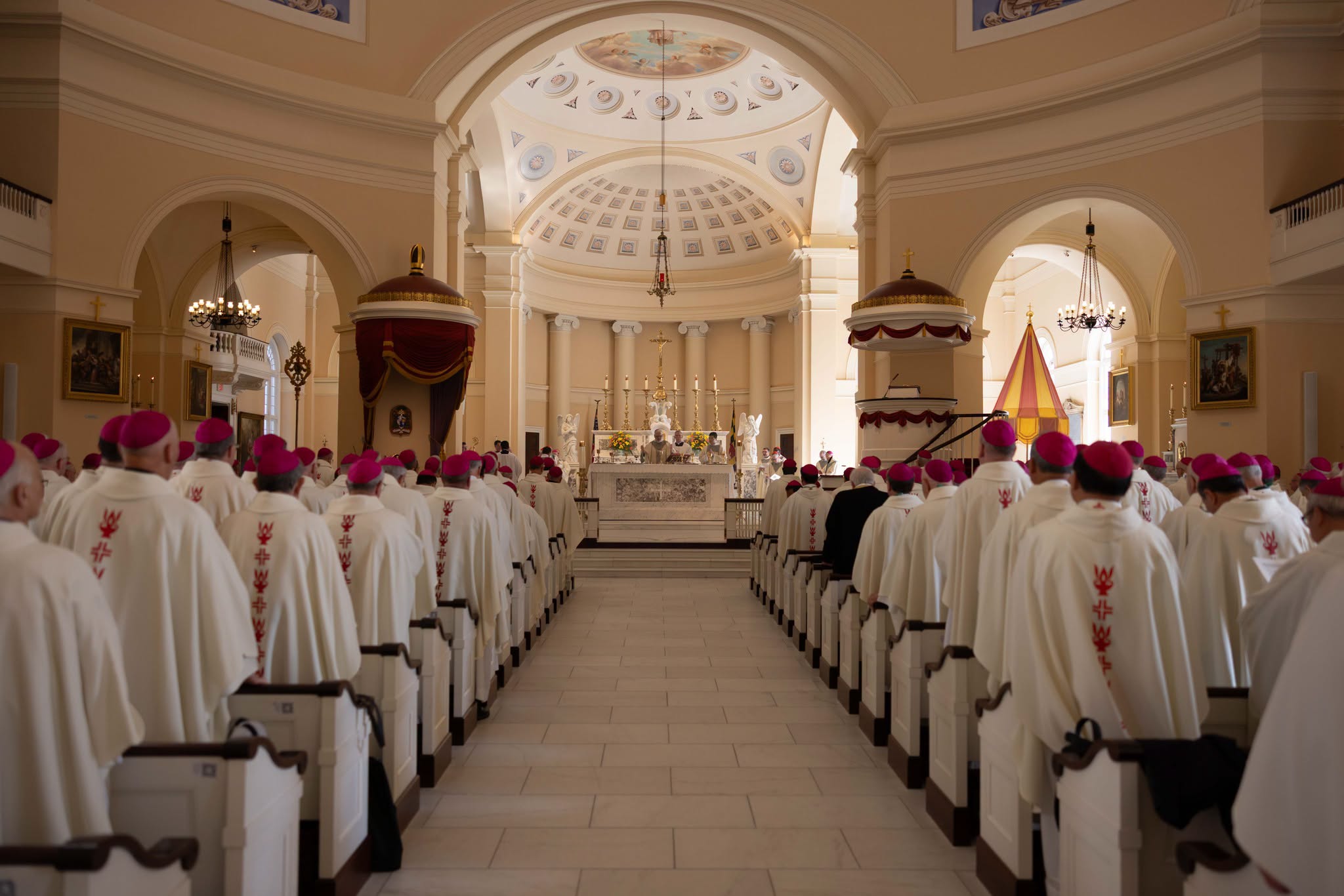
(ZENIT News / Baltimore, 11.19.2026).- The Catholic Church in the United States is preparing to confront some of the most consequential moral and social questions of the coming years, from the ethical boundaries of artificial intelligence and immigration enforcement to the protection of human life. At their autumn plenary assembly in Baltimore on November 17–18, U.S. bishops approved new investment restrictions, initiated a revision of their 25-year-old pro-life pastoral plan, and adopted a new Bible translation for liturgical use, while also reshaping the leadership of the episcopal conference.
The decisions reflect an effort to translate Catholic moral principles into institutional policies, public advocacy and pastoral priorities at a time of technological change and political polarization.
One of the most concrete steps was the approval of revised investment guidelines that exclude companies involved in private prisons and detention centers, alongside new restrictions on businesses whose artificial intelligence systems pose risks to human dignity. The bishops’ framework bars investments in companies developing autonomous weapons or automated targeting systems for military, security or immigration purposes without meaningful human oversight. It also targets AI designed to foster addiction, manipulate users, damage the mental health of young people, facilitate prohibited reproductive technologies, or enable intrusive surveillance and discrimination.
The guidelines go beyond simply withdrawing financial support. Drawing on the Vatican’s 2022 document Mensuram Bonam, they encourage shareholder engagement as a means of pressing companies to address deepfakes, pornography, privacy violations, labor rights and environmental concerns. The bishops also raised questions about cryptocurrency’s environmental footprint and criminal uses, as well as prediction markets that could encourage insider trading or turn human suffering into a commodity.
View this post on Instagram
Bishop Oscar Cantú of San José, California, who leads the conference’s task force on human dignity and artificial intelligence, has sought to temper apprehension about the technology while insisting on safeguards. Citing Pope Leo XIV’s Magnifica Humanitas, he urged bishops not simply to fear AI but to help shape its development around the human person. The task force plans to bring bishops into direct contact with technology engineers and is exploring public discussions involving parishioners, educators, workers and community leaders. Child protection, privacy and financial security are among the initial regulatory priorities it hopes to advance.
Immigration remains another major point of confrontation with the federal government. Bishop Brendan Cahill, who leads the bishops’ migration committee, sharply criticized mass deportation strategies that he said undermine human dignity and the common good. The conference is advocating for vulnerable migrants, including Haitians and others whose Temporary Protected Status is threatened, as well as young people brought to the United States as children under DACA and related protections.
Cahill nevertheless expressed hope that significant immigration reform could eventually become politically possible, arguing that the question should be when, rather than whether, meaningful changes will occur. He stressed the importance of dialogue even with political opponents, while dioceses continue providing pastoral assistance to detainees and families facing uncertainty. In San Diego, Bishop Michael Pham is helping develop faith-based accompaniment initiatives, including efforts aimed at supporting people in detention.
The bishops are also preparing to renew their national pastoral plan on pro-life activities, unanimously authorizing the process of drafting a replacement for the document issued in 2001. Bishop Daniel Thomas of Toledo, who heads the committee, pointed to developments that have fundamentally changed the landscape over the past quarter-century: the Supreme Court’s Dobbs decision, the growing availability of abortion-inducing drugs, the expansion of assisted suicide laws, the widespread use of in vitro fertilization, and the Church’s increasingly emphatic opposition to capital punishment.
The initiative comes amid political setbacks for pro-life advocates in several state ballot campaigns. Thomas said the Church should not measure its mission primarily by electoral results, but by whether it faithfully communicates and lives the Gospel. He acknowledged the difficulty of finding political partners willing to openly support Catholic positions on abortion and reproductive technologies, insisting that the bishops’ engagement is rooted in the Gospel and the common good rather than partisan allegiance.
Leadership decisions and liturgical changes rounded out the assembly’s agenda. Bishop Kevin Rhoades of Fort Wayne-South Bend, Indiana, was re-elected USCCB secretary by a vote of 157 to 59. He will complete his current term in November 2027 and serve an additional three years, through November 2030. The bishops also elected new committee leaders, including Bishop James Conley for Catholic education, Bishop William Joensen for doctrine, Bishop Donald Hying for pro-life activities, and Bishop Louis Tylka for communications.
In a separate vote of 196 to 5, the bishops approved a new translation of the lectionaries used at Mass, based on the American Catholic Bible translation. The move is intended to bring the biblical text heard during liturgy into closer alignment with the version Catholics use for personal reading. The translation, approved for personal Bibles in 2025 and expected to become available in February 2027, incorporates a revised Old Testament based on the New American Bible Revised Edition, a new Psalms and Canticles translation by monks of Conception Abbey in Missouri, and a revised New Testament. The liturgical books must still receive approval from the Vatican’s Dicastery for Divine Worship before their implementation date can be determined.
Other initiatives included approval of a proposal to designate the last Sunday of October as a national day of prayer for racial justice, receiving support from 180 bishops, or 89 percent of those voting.
Taken together, the Baltimore decisions suggest an episcopal conference seeking to exert influence beyond church walls: through financial choices that reflect moral teaching, engagement with technology companies, advocacy for migrants, renewed pro-life formation and greater consistency in the Scriptures Catholics hear and read. Whether these initiatives translate into measurable changes in public policy or Catholic life remains to be seen, but the bishops have set out a broad agenda for the years ahead.
Thank you for reading our content. If you would like to receive ZENIT’s daily e-mail news, you can subscribe for free through this link.