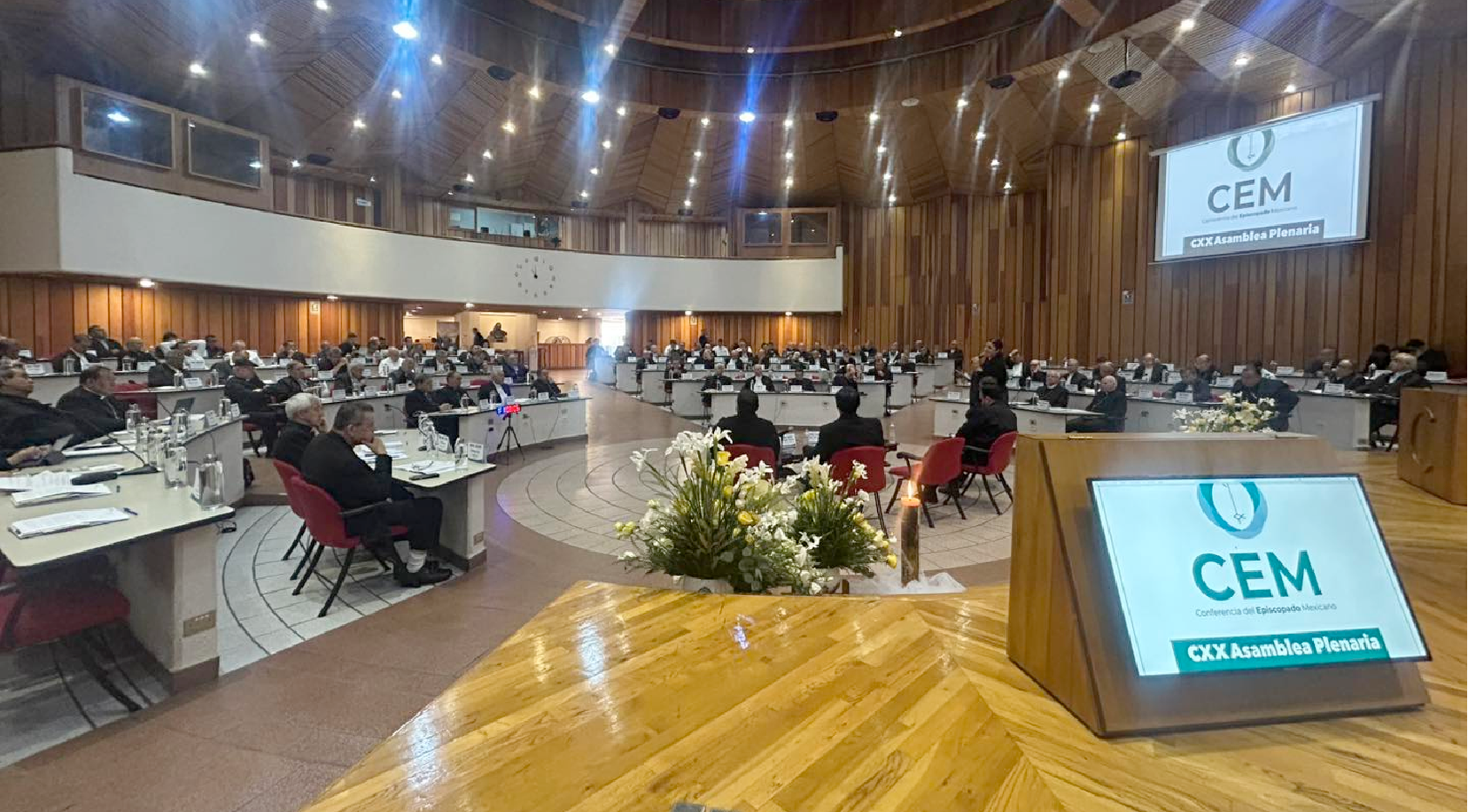
(ZENIT News / Mexico City, 04.20.2026).- As Mexico continues to grapple with entrenched insecurity, its Catholic bishops have issued one of their most direct moral appeals in recent years, arguing that remaining silent in the face of violence is not neutrality but a betrayal of the Gospel itself. Their message, released at the conclusion of the plenary assembly held on 16 April in Cuautitlán Izcalli, frames the country’s crisis not only as a political or social emergency, but as a profound ethical and spiritual challenge.
The statement, signed by the president of the episcopal conference, Ramón Castro Castro, and its secretary general, Héctor Mario Pérez Villarreal, describes a nation in which violence has become dangerously normalized. Such normalization, the bishops warn, leads to a deeper erosion: a society that grows accustomed to death ultimately “loses life,” not only in a physical sense but in its collective capacity for hope. Violence, they note, does more than destroy individual lives; it corrodes the very possibility of a shared future.
Against this backdrop, the bishops insist that peace cannot be reduced to rhetoric or enforced through coercion. It must instead be built through sustained, concrete action—beginning with the courage to identify and confront the root causes of violence, including those who profit from the suffering of others. Their appeal is directed not only at political authorities but at civil society as a whole, emphasizing a shared responsibility grounded in ethical commitment.
The intervention comes at a time when global instability further complicates national realities. The bishops situate Mexico’s struggle within a wider international context marked by war, cultural tensions, and what they describe as hardened hearts. Yet they also point to an alternative horizon: reconciliation and fraternity. Echoing words recently spoken by Pope Leo XIV during a prayer vigil in Saint Peter’s Basilica on 11 April, they repeat a stark call to reject self-idolatry, the absolutization of wealth, and the glorification of force. These, in their view, are not abstract spiritual dangers but concrete drivers of conflict.
One of the more historically resonant aspects of the message is its reference to the centenary of the persecution of Catholics during the Cristero War, which began in 1926. Rather than invoking this memory as a source of division, the bishops propose it as an opportunity for reflection and learning. The martyrs of that period are remembered not to reopen wounds, but to inspire a commitment to rebuilding a fractured social fabric. In this sense, memory becomes a tool for reconciliation rather than confrontation.
The pastoral dimension of the document is equally significant. The bishops highlight the centrality of human dignity and the concept of vocation, extending it beyond priestly or religious life to encompass every person’s responsibility in shaping society. This perspective is particularly relevant for younger generations, many of whom are searching for meaning amid uncertainty and instability. The Church’s proposal, rooted in the commandment to love one another as Christ has loved, is presented as a practical pathway toward healing deep social divisions.
This emphasis on love is not framed in sentimental terms, but as a demanding ethical principle capable of restoring relationships and rebuilding trust. In a country where fear and fragmentation often dominate public life, the bishops argue that only a renewed commitment to the dignity of every human life—especially the most vulnerable—can reverse the current trajectory.
Interestingly, the message also looks ahead to a global event far removed from ecclesial structures: the upcoming football World Cup, scheduled from 11 June to 19 July across the United States, Mexico, and Canada. Far from being a mere sporting spectacle, the bishops see in it a symbolic opportunity. They invite participants and spectators alike to interpret the tournament as a sign of humanity’s vocation to communion, a reminder that unity does not require uniformity but can flourish through mutual respect and recognition of a shared human family.
Thank you for reading our content. If you would like to receive ZENIT’s daily e-mail news, you can subscribe for free through this link.