

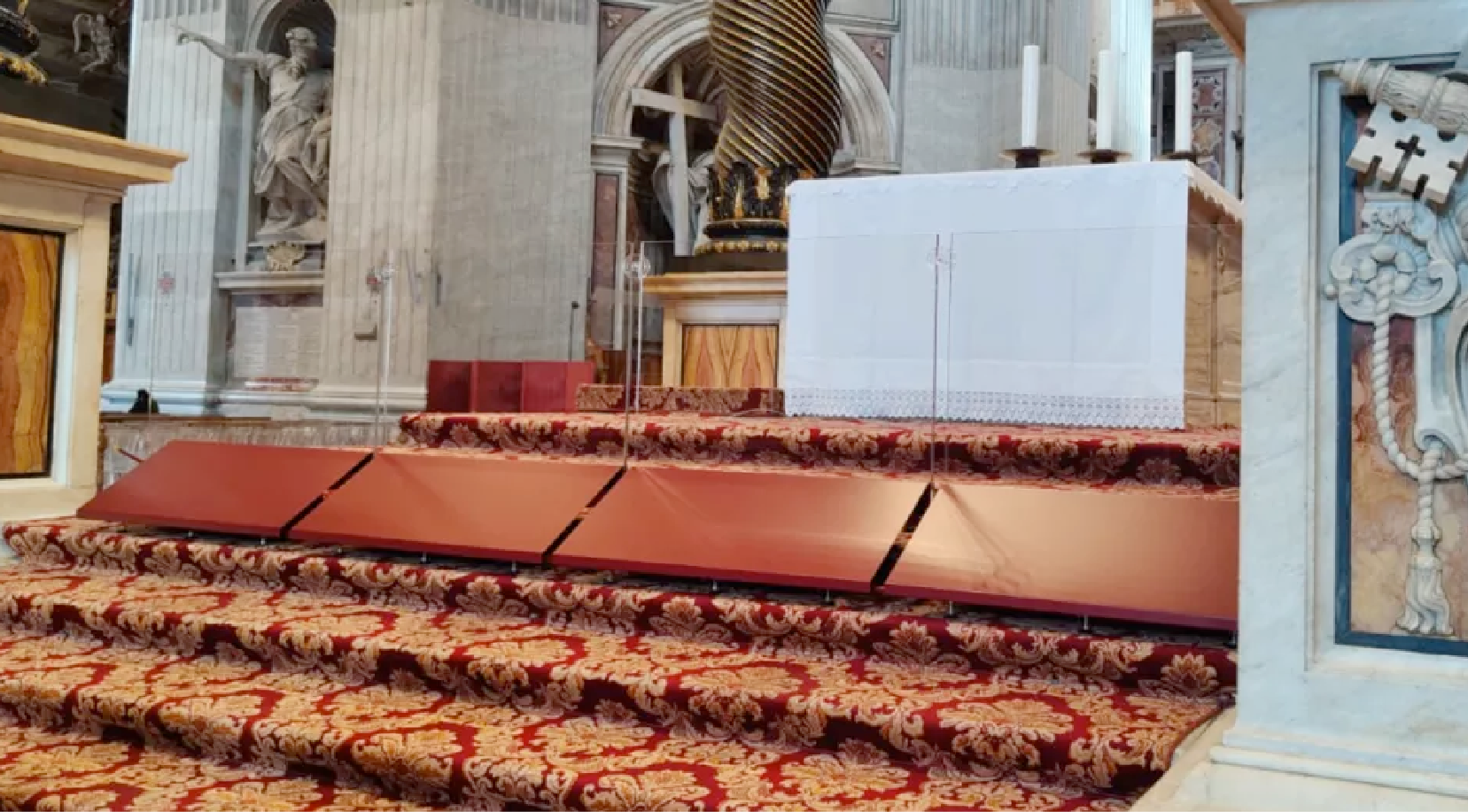
(ZENIT News / Vatican City, 03.17.2026).- In the vast interior of St. Peter’s Basilica—a space designed to evoke transcendence rather than control—a significant change has appeared. Around the Altar of the Confession, directly beneath Baldachin of St. Peter’s Basilica, low panels now form a protective perimeter. The intervention is discreet, yet it reflects a growing concern within the Vatican: how to safeguard one of Christianity’s most sacred spaces without compromising its openness.
The decision follows a series of incidents throughout 2025 that have unsettled both Vatican officials and pilgrims. In February, a man climbed onto the altar and knocked over six 19th-century candelabra—dating from 1865 and valued collectively at around 30,000 euros—causing visible damage. Months later, on October 10, another individual breached security and urinated near the main altar in full view of visitors, an act that required a formal penitential rite to restore the dignity of the temple. In a separate episode, a protester stripped naked at the same site, displaying a message referencing the war in Ukraine.
Such acts, while isolated, have targeted a focal point of immense symbolic and theological importance. The Altar of the Confession is not merely an architectural centerpiece; it stands above the tomb of the Apostle Peter, making it one of the most sensitive liturgical spaces in Catholicism. Any violation there resonates far beyond material damage.
According to the basilica’s workshop, the newly installed barrier consists of mobile polycarbonate panels that can be dismantled when necessary. The choice of material and design is telling: resistant enough to deter intrusion, yet enough to preserve visual continuity. It is, in essence, an attempt to reconcile two competing imperatives—security and accessibility.
Cardinal Mauro Gambetti, who oversees the basilica, has been careful to frame the issue in proportion. During presentations linked to the upcoming 400th anniversary of the church’s dedication, he emphasized that these incidents must be viewed against the scale of the site itself: approximately 20 million pilgrims and visitors passed through the basilica in 2025, a Jubilee year. From this perspective, the disturbances represent a minuscule fraction of overall attendance.
Yet Gambetti does not dismiss their significance. Rather, he situates them within what he describes as a broader “crisis of values,” compounded by the dynamics of digital culture. In his analysis, social media platforms and the viral logic they promote have created patterns of imitation that can encourage transgressive behavior. What once might have been an isolated act now risks becoming a performative gesture, amplified and replicated online.
The basilica’s security apparatus—typically involving between 40 and 60 personnel—had already been in place, but recent events exposed its limitations. Until now, access to the altar area was controlled primarily by cordons and human oversight, a system that relied heavily on compliance rather than physical restraint. The new barriers mark a shift, albeit a measured one, toward structural prevention.
Still, the Vatican is acutely aware of the symbolic stakes. Transforming a place of worship into a heavily fortified environment would contradict its spiritual purpose. Gambetti has explicitly warned against the “militarization” of sacred space, insisting that visitors must continue to experience what he calls a “sense of freedom” upon entering the basilica. The current solution—low, removable panels—reflects that balancing act.
There is also a liturgical dimension to these episodes that often goes unnoticed. Each act of desecration is followed by a penitential rite, a formal ceremony intended to repair the spiritual harm inflicted on the temple. This response underscores a fundamental distinction: while physical damage can be repaired with restoration techniques, sacrilege requires ritual reconciliation.
What is unfolding in St. Peter’s is, in many ways, emblematic of a wider challenge facing major religious sites worldwide. As they attract ever-growing numbers of tourists—many of whom approach them as cultural landmarks rather than places of worship—the line between sacred and public space becomes increasingly porous.
The panels now encircling the altar may appear modest, but they signal a deeper question: how does the Church preserve the integrity of its most sacred in an age defined by mass tourism, digital exposure and shifting cultural norms? For the Vatican, the answer, at least for now, lies not in closing doors, but in drawing boundaries that remain as invisible as possible.
Thank you for reading our content. If you would like to receive ZENIT’s daily e-mail news, you can subscribe for free through this link.

Publicaciones relacionadas:
 Pope Warns Synod: Either the Church Is the Holy People of God or It Ends Up Being a Service Company
 Iranian Foreign Minister calls Pope’s representative over situation in Gaza
 Dicastery for the Doctrine of the Faith Responds to Doubts Regarding Baptism of Transexuals and Homosexuals as Godparents in Sacraments
 Habemus Papam: Cardinal Robert Francis Prevost, O.S.A. Elected New Successor of Peter
