

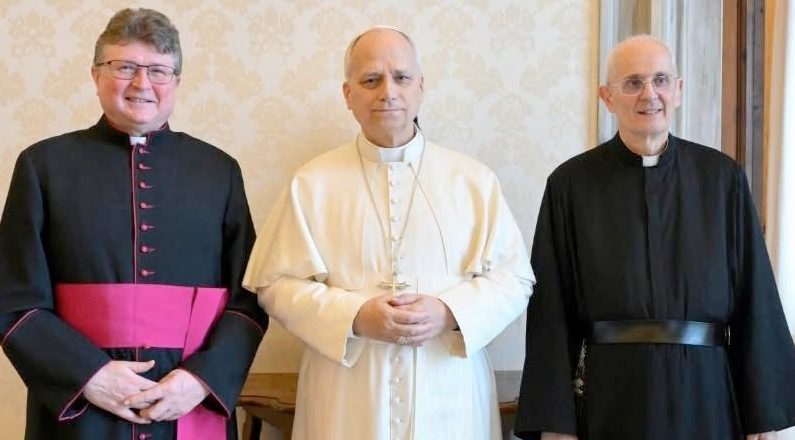
(ZENIT News / Vatican City, 03.14.2026).- In a private audience that sheds light on one of the Catholic Church’s most discreet pastoral ministries, Pope Leo XIV received the leadership of the International Association of Exorcists on March 13, 2026, for a half-hour conversation focused on the current challenges of the Church’s ministry of exorcism and the growing need for trained priests capable of addressing spiritual distress.
The meeting brought together the Pope with Bishop Karel Orlita, president of the association, and Father Francesco Bamonte, vice president and member of the religious congregation Servants of the Immaculate Heart of Mary. According to information released afterward, the encounter unfolded in an atmosphere described as cordial and attentive, with the pontiff listening closely as the two representatives outlined the situation facing exorcists across the global Church.
During the conversation, Orlita and Bamonte explained the structure and mission of the International Association of Exorcists, an organization that in recent decades has become a key reference point for priests entrusted with this specialized pastoral responsibility. Drawing on the association’s accumulated experience, they presented an overview of how the ministry is currently practiced and what its practitioners believe will be necessary in the years ahead.
One of the central themes discussed was the formation of exorcists. The association emphasized its ongoing commitment to providing both initial and continuing training for priests appointed to this ministry. Such preparation, they noted, is essential because the Church requires exorcists not only to possess spiritual discernment but also to understand the complex boundary between spiritual phenomena and psychological or medical conditions.
For that reason, the conversation also highlighted the importance of cooperation between exorcists and professionals in the medical field, including doctors, psychiatrists and psychologists. The Church traditionally insists that cases suspected of demonic influence be carefully examined in order to rule out mental illness or other natural explanations before any formal exorcism is considered.
Another point raised during the audience was the association’s view that every diocese in the world should have at least one priest specifically appointed as an exorcist. In practice, however, the availability of such priests varies widely from country to country. The association therefore advocates clearer pastoral planning so that bishops can ensure the faithful have access to properly trained clergy when needed.
The discussion also touched on priestly formation more broadly. According to the report presented to the Pope, the association believes seminarians should receive basic instruction during their theological studies about the Church’s teaching on the existence of the demonic and the ways in which the Church confronts what it calls “extraordinary diabolical action.” Such instruction, the exorcists argue, would help future priests approach these issues with theological clarity rather than confusion or sensationalism.
Alongside the training of priests, the association also suggested that newly appointed bishops receive a brief course on exorcistic pastoral care as part of the formation programs normally offered to bishops at the beginning of their episcopal ministry.
In presenting their report, the representatives also spoke about what they described as a troubling pastoral reality increasingly encountered by exorcists: individuals who suffer serious disturbances after involvement with occult groups or practices. According to the association, such situations can cause profound personal suffering and require careful pastoral accompaniment. The Church’s use of exorcism, they stressed, is intended not as spectacle but as a sacramental prayer meant to bring spiritual relief in Christ’s name.
The ministry of exorcism occupies a unique place within Catholic pastoral life. It is rarely discussed publicly and is governed by strict liturgical norms. Only a priest specifically authorized by a diocesan bishop may perform the solemn rite of exorcism, which is regulated by the Church’s official ritual and typically carried out privately.
Orlita and Bamonte also shared a historical note that delighted the Pope: Leo XIV had personally known and appreciated Father Gabriele Amorth, the Italian priest who founded the International Association of Exorcists and who for decades served as one of the most widely known exorcists in the Church. Amorth’s writings and interviews played a major role in bringing public awareness to the Church’s teaching on spiritual warfare, though he consistently emphasized the need for prudence and pastoral balance.
The meeting concluded with a symbolic exchange of gifts. The exorcists presented the Pope with a metal image of the Archangel Michael originating from the shrine dedicated to the archangel in Monte Sant’Angelo, a historic pilgrimage site in southern Italy associated with the veneration of St. Michael as a protector against evil.
They also offered the pontiff two copies—one in Italian and one in English—of a book published by the association in 2019 titled Guidelines for the Ministry of Exorcism. Over the past several years the volume has become a widely used reference for clergy, catechists and laypeople seeking reliable information about the Church’s understanding of this delicate ministry.
Pope Leo XIV thanked his guests for their service and for the gifts they had brought. Before the meeting concluded, he in turn presented them with a rosary, a gesture traditionally used by pontiffs to express spiritual closeness and gratitude.
Although brief, the encounter signals the Vatican’s continued attention to a ministry that remains largely hidden from public view but that many pastors consider pastorally necessary. For the Church, the goal is not to encourage fascination with the demonic but to ensure that those who experience profound spiritual distress can find help within a framework of faith, discernment and pastoral care.
Thank you for reading our content. If you would like to receive ZENIT’s daily e-mail news, you can subscribe for free through this link.

Publicaciones relacionadas:
 For the first time, a pope (Leo XIV) will receive the U.S. Medal of Freedom: here’s what you need to know
 A Church Against the Logic of War: Vatican Voices, Middle East Realities, and the Risk of a Vanishing Christianity
 Trump responds to Pope Leo XIV: I don’t want a ceasefire
 Some reflections on the inner dimension of vocation: a 100% vocational message from Pope Leo XIV
