

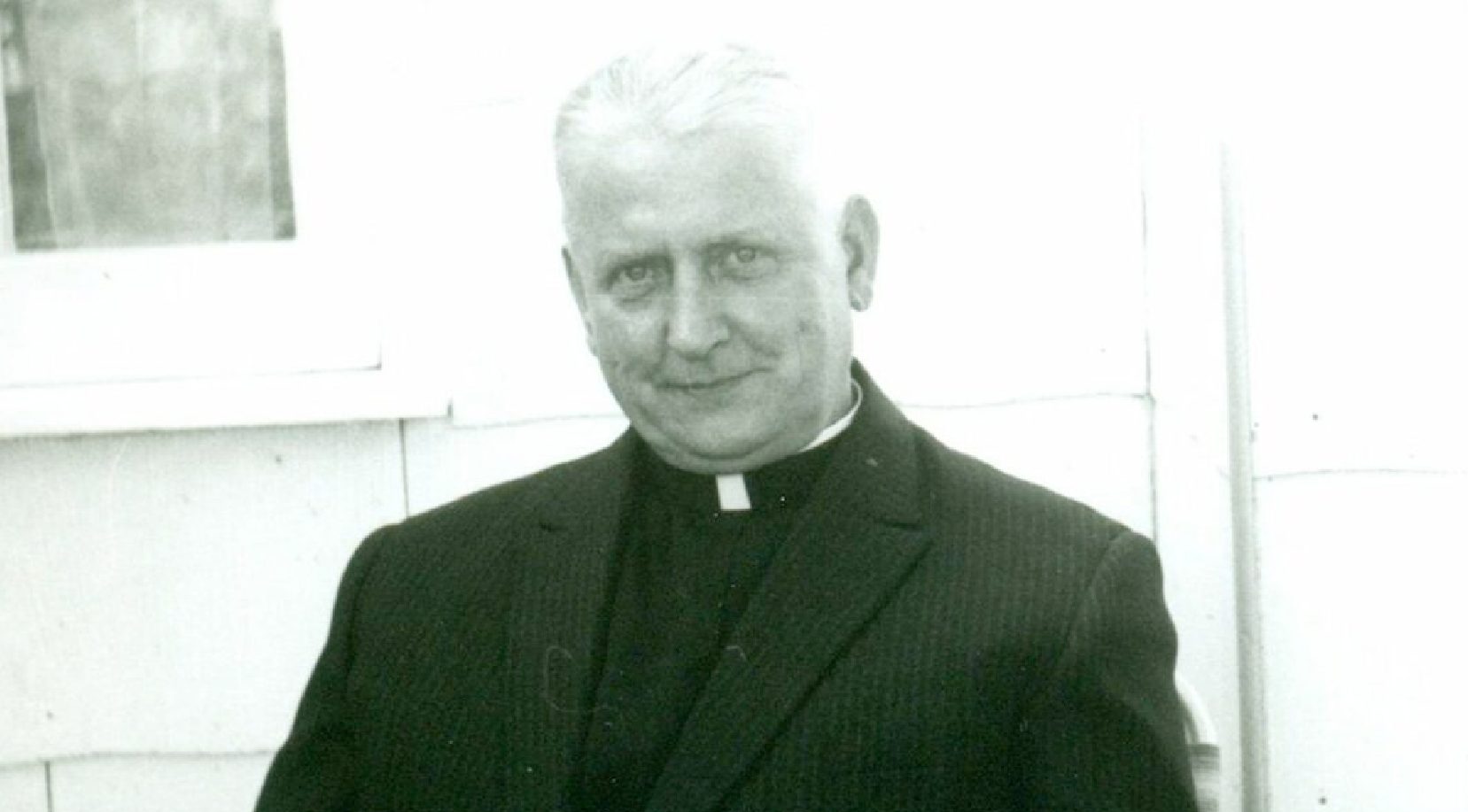
(ZENIT News / Rome, 04.18.2026).- The trajectory of one of the most compelling spiritual figures of the twentieth century has come to an unexpected pause. The Holy See has halted the cause for the beatification and canonization of Walter Ciszek, a decision communicated on April 9 after decades of documentation, testimony, and anticipation among those who regarded him as a witness of extraordinary faith under persecution.
The announcement, conveyed through ecclesial channels in the United States, made clear that the process would not advance further at this stage. According to those involved in promoting the cause, the documentation submitted—despite its breadth—was judged insufficient to sustain progression within the rigorous evaluative framework applied by the Vatican. The decision reflects a procedural conclusion rather than a moral judgment on Ciszek’s life, a distinction repeatedly emphasized by Church authorities seeking to temper the disappointment of the faithful.
Few modern candidates for sainthood have embodied so vividly the intersection of geopolitics and spiritual endurance. Born in 1904 in Pennsylvania to a family of Polish immigrants, Ciszek entered the Society of Jesus in 1928 and was ordained in 1937 after specialized formation for ministry in the Soviet context. At a time when the Soviet Union sought to eradicate religious expression through state atheism, he answered a call—encouraged by missionary appeals from Pope Pius XI—to bring pastoral care into one of the most hostile environments for Christianity.
His entry into Soviet territory during the upheavals of the Second World War was clandestine, undertaken under a false identity. Living as a laborer in industrial regions of the Ural Mountains, he ministered in secret among workers and believers who practiced their faith under constant threat. The experiment in hidden apostolate was short-lived. Arrested in 1940 by Soviet authorities on suspicion of espionage, Ciszek was drawn into the machinery of repression that defined the era.
What followed was a prolonged ordeal that would shape both his life and his later spiritual writings. He spent years in the notorious Lubyanka prison in Moscow, enduring isolation, interrogation, and psychological pressure. Subsequently condemned to fifteen years of forced labor, he was sent to camps in Siberia, near the Arctic Circle, where survival itself was uncertain. Across more than two decades—roughly 23 years in total—he experienced the full spectrum of the Soviet penal system: extreme cold, hunger, exhausting labor, and constant surveillance.
Yet it was precisely within these conditions that his reputation for spiritual resilience took form. Ciszek continued to exercise his priestly ministry in secret, celebrating Mass with improvised means and hearing confessions among fellow prisoners. For many inmates, he became not only a religious figure but a source of psychological and moral support in a system designed to strip individuals of dignity and hope.
His eventual release in 1963 was itself a product of Cold War diplomacy. Through negotiations led by John F. Kennedy, he was included in a prisoner exchange between the United States and the Soviet Union. At the age of 59, he returned to his homeland after more than two decades of absence, carrying with him a spiritual perspective forged under extreme conditions.
In the years that followed, Ciszek translated his experience into a body of writing that would resonate widely in Catholic circles. His books, including “He Leadeth Me” and “With God in Russia,” are not merely memoirs but reflections on surrender to divine providence, interior freedom, and the meaning of suffering. They contributed to a growing perception of him as a figure of heroic virtue, a prerequisite for canonization in the Catholic tradition.
The formal process toward sainthood began in 1990, when he was declared Servant of God. In 2012, the Vatican authorized further advancement, prompting an extensive effort by Jesuit researchers and collaborators. More than 4,000 archival documents were gathered from ecclesiastical and Russian sources, alongside testimonies and analyses of his writings. Such processes are typically lengthy, often spanning decades, as the Church seeks to verify not only personal holiness but also the consistency and impact of a candidate’s witness.
The recent decision to halt the cause underscores the exacting standards applied by the Dicastery for the Causes of Saints. Canonization is not a recognition of admiration alone; it requires demonstrable evidence of heroic virtue and, in most cases, verified miracles attributed to the candidate’s intercession. When documentation does not meet these thresholds, the process may be suspended, sometimes permanently, sometimes pending new evidence.
This development is not isolated. In the same period, the Vatican also suspended the cause of Jorge Novak, indicating a broader pattern of scrutiny rather than a case-specific anomaly. In both instances, Church authorities stressed that such decisions do not diminish the spiritual value of the individuals involved.
For those who have long promoted Ciszek’s cause, the halt represents a moment of reassessment rather than closure. The organization dedicated to preserving his legacy will continue its work under a new structure, focusing on disseminating his writings and encouraging devotion inspired by his life. This reflects a broader reality within Catholic spirituality: formal recognition by the Church, while significant, is not the sole measure of a figure’s influence.
Indeed, Ciszek’s story retains its force independently of canonical status. His life intersects with some of the defining experiences of the twentieth century—totalitarian repression, global conflict, ideological confrontation—while offering a narrative centered on faith lived under pressure. For many believers, that testimony remains intact, regardless of institutional outcomes.
Thank you for reading our content. If you would like to receive ZENIT’s daily e-mail news, you can subscribe for free through this link.

Publicaciones relacionadas:
 Carmelites Request Opening of Saint Teresa’s Sepulcher for New Studies on Her Relics
 Is she incorrupt? Bishop issues statement on incorruption of Benedictine nun who died in 2019
 First Woman with Dwarfism on the Path to Canonization Thanks to Leo XIV
 Emotion in Assisi: Carlo Acutis sculpture unveiled in the garden near his tomb
