

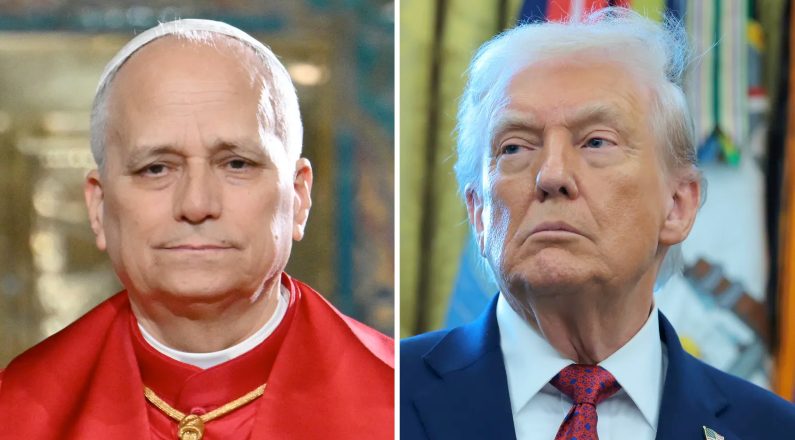
(ZENIT News / Rome, 04.19.2026).- A convergence of polling data and political tension is revealing an unusual dynamic in American public life: a sitting president facing declining support among Catholic voters while a newly elected pope—himself American-born—commands a markedly higher level of trust across the same electorate. The contrast, sharpened by their opposing stances on the war with Iran, is beginning to carry tangible political implications ahead of the 2026 midterm elections.
Recent surveys suggest that Pope Leo XIV has entered the public arena with a degree of moral credibility that few global figures can match. According to a nationwide poll conducted by NBC News between February 27 and March 3, 2026, among 1,000 registered voters, 42 percent of Americans expressed a positive view of the Pope, compared to just 8 percent who viewed him negatively. This translates into a net favorability rating of +34 points. In the same survey, President Donald Trump registered a markedly weaker standing: 41 percent favorable versus 53 percent unfavorable, for a net rating of -12 points. The margin of error for the poll was 3.1 percentage points.
These figures are consistent with earlier data. A Gallup survey conducted in July 2025 among 1,002 Americans found that 57 percent held a favorable opinion of the Pope, while only 11 percent viewed him negatively. Trump’s numbers in that same poll stood at 41 percent favorable and 57 percent unfavorable, reinforcing a pattern in which the pontiff’s personal standing significantly exceeds that of the president.
The divergence becomes even more consequential when examined through the lens of Catholic voters, a constituency that has historically played a decisive role in close elections. Data from Fox News surveys indicate a rapid shift in this group’s political alignment. In a poll conducted between February 28 and March 2, Trump enjoyed a net positive approval rating among Catholics, with 52 percent approving of his performance and 48 percent disapproving. Just weeks later, in a second survey carried out from March 20 to March 23 among 1,001 registered voters, the trend had reversed: 48 percent approved, while 52 percent disapproved, producing a net rating of -4 points. Both surveys were conducted jointly by Beacon Research and Shaw & Company Research, with a margin of error of approximately 3 percentage points.
This abrupt change suggests more than routine fluctuation. It points to a potential realignment driven, at least in part, by the growing visibility of tensions between the White House and the Vatican. Pope Leo XIV has openly criticized aspects of U.S. foreign policy, particularly in relation to the conflict with Iran, framing his position within a broader moral argument against war. Trump, by contrast, has defended his strategy as necessary for national security, with his administration emphasizing decisive action to neutralize threats.
The political stakes of this disagreement are not confined to diplomatic rhetoric. Catholic voters in the United States are not a monolithic bloc, but they have often acted as a swing constituency, capable of shifting electoral outcomes. A movement of even a few percentage points can prove decisive in closely contested races, especially in a midterm context where turnout dynamics are more volatile.
What makes the current situation distinctive is the identity of the Pope himself. As the first pontiff born in the United States, Leo XIV occupies a unique position: he is both a global religious leader and, in a cultural sense, part of the national fabric. This dual identity may amplify his influence among American Catholics, who are now confronted with a visible divergence between their political leadership and the head of their Church.
From a Vatican perspective, such moments are not entirely new, but they are rarely so direct. The Holy See traditionally avoids entanglement in partisan disputes, framing its interventions in universal moral terms rather than national politics. Yet when those moral positions intersect with concrete policy decisions—particularly on questions of war—the distinction can become blurred in public perception.
For the Trump administration, the challenge lies in balancing its security narrative with the sensibilities of a religious electorate that may be receptive to the Pope’s emphasis on peace and ethical restraint. The White House has defended its actions vigorously, arguing that leadership requires the willingness to act decisively in the face of threats. But polling data suggest that this argument may not resonate uniformly among Catholic voters.
As the 2026 midterms approach, the interplay between these two forms of authority—political and moral—will likely remain under close scrutiny. Surveys will continue to track shifts in public opinion, but the underlying question is less about numbers than about alignment: whether voters ultimately prioritize strategic considerations or ethical frameworks when the two appear to diverge.
Thank you for reading our content. If you would like to receive ZENIT’s daily e-mail news, you can subscribe for free through this link.

Publicaciones relacionadas:
 Re-inauguration of Notre Dame de Paris will be in 2024. Macron invites the Pope
 Papua New Guinea’s Christian Nation Declaration Sparks Concern Among Catholic Leaders
 US Congress: bill introduced to prevent revocation of Pope Leo XIV’s citizenship and tax issues
 Pope Leo XIV’s Beautiful Letter To Priests of Madrid (That Every Priest or Future Priest Should Read)
