

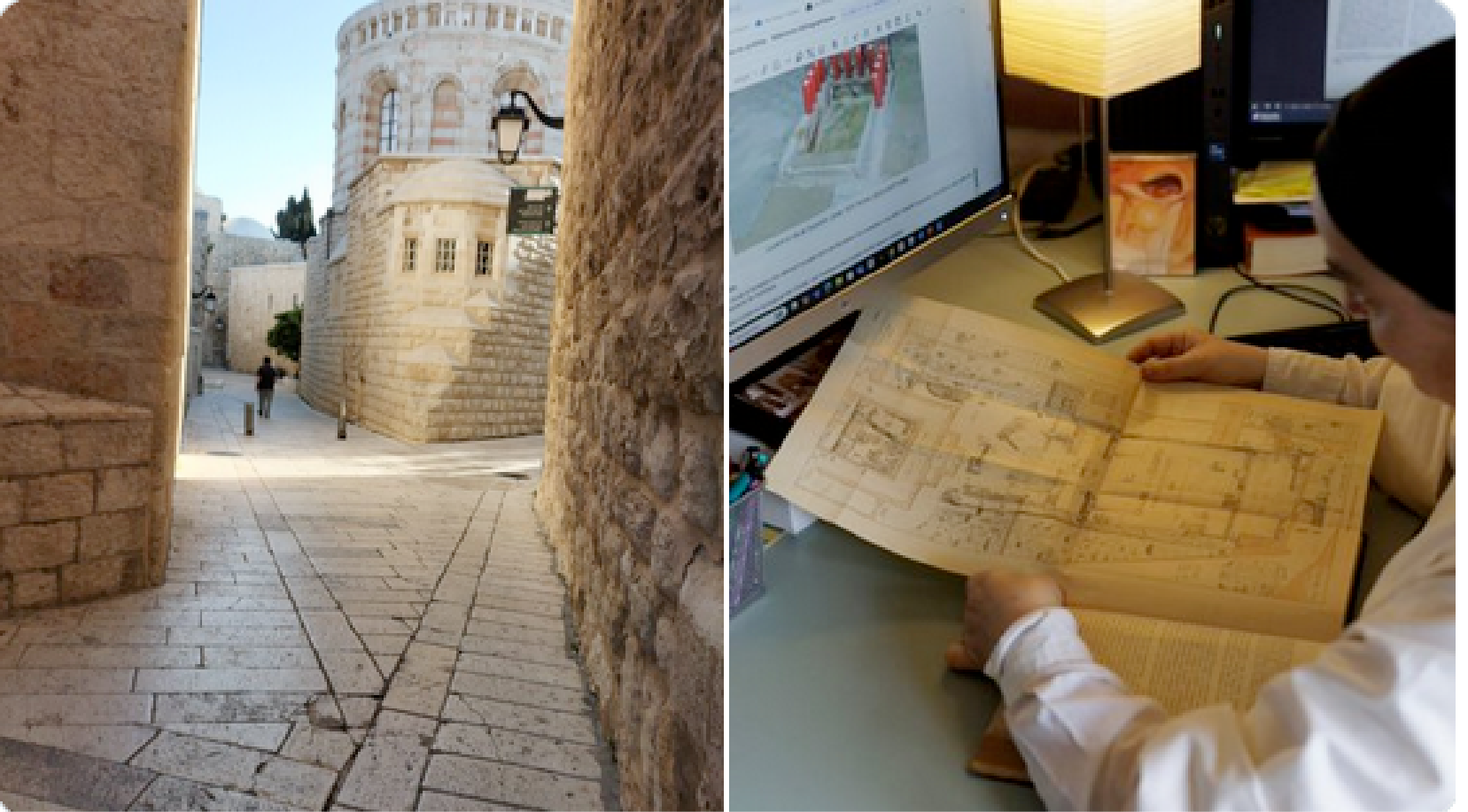
(ZENIT News / Jerusalem, 04.30.2026).- The image is as disturbing as it is symbolic: a consecrated woman walking near one of Jerusalem’s most revered sites is suddenly attacked from behind, thrown to the ground, and repeatedly kicked. The assault, which took place on April 28 near the traditional tomb of King David on Mount Zion, has reignited concerns about the safety of Christian communities in a city that defines itself by its religious diversity.
Israeli police confirmed the arrest of a 36-year-old suspect shortly after the incident, describing the act as one they view with the “utmost severity,” particularly given the possibility of racial or religious motivation. Authorities have stated that the case will be brought before the Jerusalem Magistrate’s Court, with a request to extend the suspect’s detention while the investigation continues.

The victim, a 48-year-old French nun affiliated with the French Biblical and Archaeological School of Jerusalem, sustained visible injuries, including bruising on the right side of her face and a bleeding wound at her temple. According to Father Olivier Poquillon, director of the institution, the attack was entirely unprovoked. The sister, a researcher by vocation, has chosen not to speak publicly about the incident.
Video footage adds clarity—and gravity—to the event. It shows the assailant approaching the nun from behind, pushing her violently to the ground, walking away briefly, and then returning to kick her while she lay defenseless. A passerby appears to intervene, engaging momentarily with the attacker before he flees.
The location of the assault amplifies its resonance. The site, known to Christians as the Cenacle—the place traditionally associated with the Last Supper—and to Jews as the resting place of King David, is emblematic of Jerusalem’s layered sacred geography.
Ver esta publicación en Instagram
Reactions have been swift. The French government issued a strong condemnation, calling for the perpetrator to be brought to justice. Israel’s Foreign Ministry described the act as “shameful,” reaffirming its commitment to safeguarding freedom of religion and worship. The Hebrew University of Jerusalem, which maintains academic ties with the nun’s institution, expressed “deep shock,” warning that such incidents reflect a troubling pattern rather than an isolated occurrence.
Indeed, several observers point to a broader context. Human rights organizations and local church leaders have reported a rise in hostility toward Christians in Jerusalem and the surrounding region. According to data from the Rossing Center for Education and Dialogue and the Religious Freedom Data Center, between 155 and 181 incidents of harassment, vandalism, or assault targeting Christians were recorded in Jerusalem alone in 2025.
Following a report of an assault against a nun in Jerusalem, officers responded immediately, launching an investigation that led to the arrest of a suspect. A request to extend his detention is expected.
The Israel Police treats any attack on members of the clergy and religious… pic.twitter.com/1e0W8bobpo
— Israel Police (@israelpolice) April 29, 2026
Auxiliary Bishop William Shomali has noted that attacks against Christians in the West Bank have been increasing since the beginning of this year. Diplomatic sources in Jerusalem, speaking anonymously, describe a daily reality in which clergy—especially those visibly identifiable by religious attire—are subjected to insults and spitting by extremist elements.
The motivations behind such acts are complex and cannot be reduced to a single cause. In this case, police are examining all possible motives, including racial and religious hatred. Some reports and the video indicate that the suspect was wearing ritual garments associated with Jewish practice, though authorities have not released full details about his identity.
The persistence of these incidents raises deeper questions about the capacity of legal measures alone to address a phenomenon that touches on cultural, ideological, and theological tensions. While rabbinical authorities have in the past condemned acts such as spitting at clergy—sometimes justified by fringe interpretations of religious texts—such practices have not entirely disappeared.
The State of Israel views yesterday’s attack against a nun in Jerusalem with the utmost seriousness. Immediately following the incident, the Israel Police opened an investigation, and the suspect was arrested last night. He remains in custody, underscoring Israel’s firm policy…
— Israel Foreign Ministry (@IsraelMFA) April 29, 2026
Recent tensions have further strained relations. In the weeks leading up to Easter, access restrictions linked to regional security concerns temporarily prevented senior Catholic clergy from entering the Church of the Holy Sepulchre, one of Christianity’s holiest sites. In another incident, Israeli soldiers were disciplined after vandalizing a statue of Jesus in southern Lebanon, drawing international criticism.
Even political allies have voiced concern. The United States ambassador to Israel, Mike Huckabee, an evangelical Christian, has previously criticized what he described as the treatment of Christian organizations as “adversaries,” signaling that the issue resonates beyond local dynamics.
The attack on the French nun takes on a significance that extends beyond the individual case: it touches on the broader principle of religious freedom in a city where three monotheistic traditions converge, each with its own historical claims and sensitivities.
La France condamne fermement l’agression hier à Jérusalem contre une religieuse française de @EBAFJerusalem. Nous souhaitons un prompt rétablissement à la religieuse agressée, dont nous suivons de près l’évolution de la situation. La France appelle à ce que l’auteur de… https://t.co/0wLfVWJWVC
— France à Jérusalem 🇫🇷 🇪🇺 (@FranceJerusalem) April 29, 2026
For the Christian presence in the Holy Land—numerically small but historically and spiritually central—the challenge is not only physical security but also the preservation of a space in which faith can be lived openly and without fear. The concern is particularly acute given the steady emigration of Christians from the region, a trend often linked to insecurity and limited prospects.
Israeli authorities have reiterated a policy of zero tolerance toward such violence, emphasizing their commitment to maintaining Jerusalem as a city open to all faiths. Yet the credibility of that commitment will increasingly depend on the ability to prevent, not merely punish, attacks of this kind.
Thank you for reading our content. If you would like to receive ZENIT’s daily e-mail news, you can subscribe for free through this link.

Publicaciones relacionadas:
 Israeli army attacks Catholic parish of the Holy Family in Gaza
 Christian Leaders Unite Against Jerusalem Municipality’s Move to Seize Armenian Patriarchate Properties
 Syrian bishop on situation in the country: calls for presence of UN blue helmets against internal violence and Israeli attacks
 Jewish persecution of Christians in the Holy Land on the rise, research reveals
