

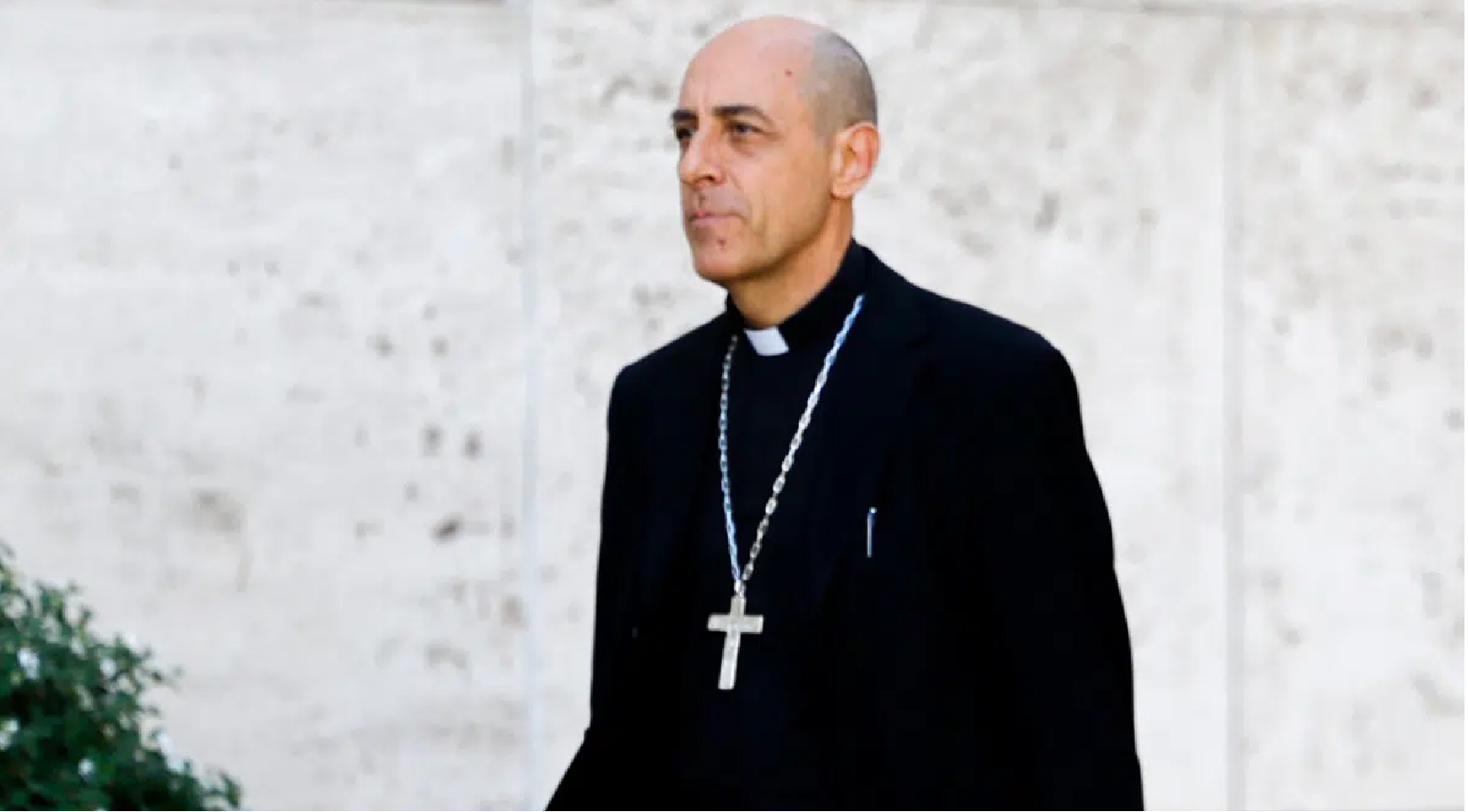
(ZENIT News /Rome, 05.04.2026).- On April 23, on the flight back from Africa to Rome, Pope Leo XIV responded to a question from journalist Verena Stefanie Shälter of ARD Rundfunk, regarding Cardinal Reinhard Marx’s decision, Archbishop of Munich-Freising, to grant permission to bless same-sex couples in his diocese. The Holy Father was emphatic: «The Holy See has made it clear that we do not agree with the formalized blessing of couples — in this case, homosexual couples, as you asked — or of couples in irregular situations, beyond what Pope Francis has specifically permitted by saying that all people receive a blessing.»
On the morning of Monday, April 4, ZENIT’s Editorial Director published on social media X the text to which the Holy Father alluded, a text previously unknown: a letter from the Dicastery for the Doctrine of the Faith addressed to German Bishop Stephan Ackermann (and through him to the German Episcopate). Cardinal Fernández signed the letter, dated November 18, 2024, and it makes things clear: the Vatican’s NO to the ritualization of blessings and to giving the impression of legitimizing such unions.
Below is the English translation of the letter, now also available in its Italian original on the Dicastery’s Website. Cardinal Fernández’s response to a question from Victoria Cardiel of EWTN was made public because the Pope himself referred to it in the press conference mentioned at the beginning.
* * *
Excellency,
By letter of October 24, 2024, you, «also on behalf of the President of the Episcopal Conference, Bishop Georg Bätzing,» kindly sent this Dicastery a copy of a Vademecum, in German and Italian, intended as a resource of «Blessings for Couples in Love.» At the same time, you stated that this Vademecum would be presented «to the German diocesan Bishops» on a future occasion, in order to offer the Prelates «an application of the Declaration Fiducia Supplicans to the social and pastoral situation of the dioceses in Germany.»
In this regard, taking note of your communication, I respectfully submit the following observations:
a) The Declaration Fiducia Supplicans states that: “The Church does not have the power to confer a liturgical blessing when it might in any way offer a form of moral legitimation to a union claiming to be a marriage or to extramarital sexual relations” (n. 11), nor to those who claim “the legitimation of their own status” (cf. n. 31).
Indeed, according to Fiducia Supplicans, such blessings “are not intended to legitimize anything, but only to open one’s life to God” (n. 40), nor to “sanction… anything” (n. 34), but only to ask for God’s help “to live better, and also to invoke the Holy Spirit so that the values of the Gospel may be lived more faithfully” (n. 40).
In the Vademecum text, however, there is talk of a union and an «official regulation» by Pastors of couples who love each other outside of marriage, making them the object of a true «acclamation,» a gesture normally reserved for the marriage ritual. In this sense, it effectively legitimizes the status of these couples, contrary to what is stated in Fiducia Supplicans.
b) The Declaration Fiducia Supplicans, regarding the possibility of blessing extramarital couples, does not admit any type of liturgical rite or form of blessing similar to sacramentals that could create confusion (cf. Introduction), stating that «the form should not be subject to any ritual fixation by ecclesiastical authorities» (n. 31), and preventing such rites from «becoming a liturgical or semi-liturgical act, similar to a sacrament.» (n. 36). «For this reason, a ritual for the blessing of couples in irregular situations should neither be promoted nor provided for» (n. 38).
However, in the Vademecum text, although it initially speaks of «spontaneity and freedom» regarding blessings given to same-sex couples — implying that these should not be institutionalized through ritual forms — it offers a pre-established form for their performance, contradicting what was stated earlier.
In particular, in the final part («Form»), after stating that «the manner in which the blessing is carried out, the place, the overall aesthetics, including the music and singing, should demonstrate appreciation for the people receiving the blessing,» a kind of liturgy or paraliturgical practice is prescribed in regard to the blessing of same-sex couples.
All of this is communicated for your appropriate action.
In communicating the above, I take this opportunity to reiterate my highest regards.

Publicaciones relacionadas:
 Vatican contradicts German bishops: text for blessing same-sex couples was not approved
 Pope Averts Schism in Germany: Full Text of Vatican Letter
 A Cause Halted, A Legacy Questioned: The Vatican Freezes Jorge Novak’s Path to the Altars
 Lawsuit filed against U.S. bishops’ liturgical and financial measures at the Vatican: they’ve already secured their first victory
