(ZENIT News – Caffe Storia / Rome, 05. 22. 2026) – In the hours when Trump is fighting with common sense even before he’s fighting with Pope Leo XIV, the Israeli Army razes another Christian village in Lebanon – Yaroun — in search of suspected Hezbollah terrorists. references to Jesus and peace were published on several official X profiles of Khamenei.
This also forms part of the great paradox of the third Gulf War: the United States possesses a technological and military advantage unrivaled in modern history, yet it is losing ground in symbolic, narrative, and communicative initiative to an economically strangled and politically isolated Islamic Republic.
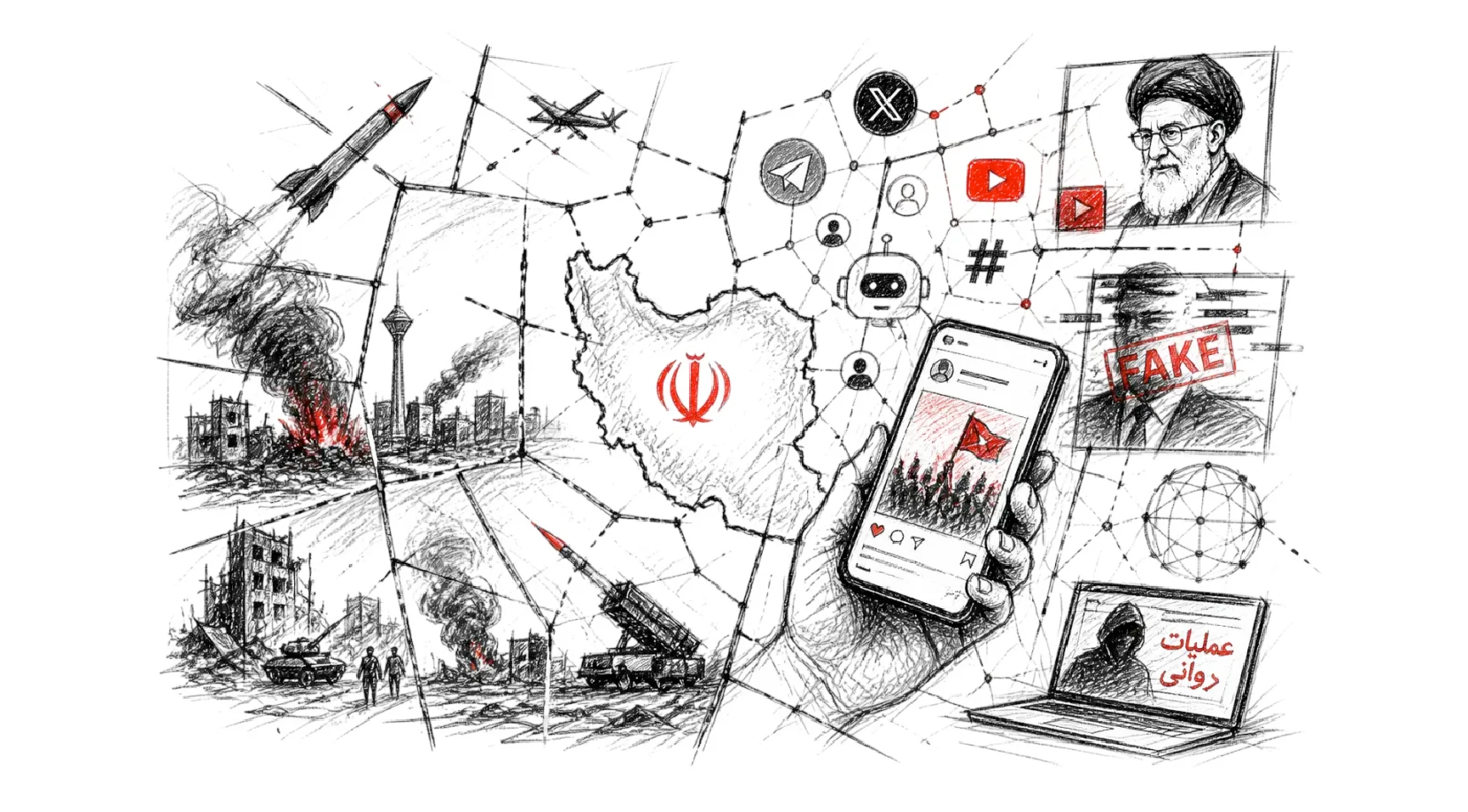
We are immersed in a highly pervasive conflict, fought on simultaneous fronts — nuclear programs, proxy militias, economic blackmail, regional diplomacy — which in recent months has acquired a new dimension — the digital.
«The first ‘TikTok War’ is the first internationally relevant conflict in which we can observe an innovative involvement of artificial intelligence, particularly in its generative form,» explains Rassa Ghaffari, a researcher in Sociology, Migration Studies, and Gender Studies at the University of Genoa. «Generative AI, in fact, has inaugurated new forms of information warfare that target perceptions, information environments, and trust.»
New Mosaic Defense Pieces
To understand what is happening on social media, one must first understand what has already happened on the ground. Mosaic warfare is the military doctrine that Iran has developed over decades to respond to the power asymmetry with the United States and Israel: not a centralized and vulnerable reaction, but a system of systems, a network of partially autonomous nodes that share a common logic without depending on a central authority. If the command is decapitated, the network adapts. We have had this before our eyes since February 28, 2026.
The outcome is already written: the United States has assassinated Soleimani and Khamenei, but the system continues to function. Israel has bombed Lebanon for decades without eliminating Hezbollah. Iran spends a fraction of what its adversaries spend, in exchange for better strategic results. This is the victory of the mosaic: not defeating the enemy, but rendering them incapable of winning.
What happens when this logic is applied to digital communication? «For several weeks now, a plurality of actors — including Iranian State media and seemingly more independent content creator groups — have been frenetically producing digital content focused on the military, economic—and above all, moral — confrontation with Trump and Netanyahu, which has effectively become a digital flame war,» Ghaffari continues.
Take a look at the social media channels of Iranian Embassies around the world and you’ll notice something unusual: the responses to Trump’s statements don’t just come from Tehran, but from Bangkok, Harare, Lagos, and Accra. Different languages, different tones, local cultural references. Thus, in the exchange of blows between the Iranian Embassy in South Africa and that of Zimbabwe, the key to reopening the Strait of Hormuz ends up hidden under the vase of flowers, while ice cream becomes a diplomatic vehicle with Italy, amid global hilarity.
«The most interesting products fall mainly into three categories: tweets from Iranian Embassies scattered around the world — especially in the Global South — short videos generated by artificial intelligence, the now-famous clips with Lego characters, and, just a few days ago, Minions cartoons.» These products employ «punctual, biting, and humorous phrases, designed to quickly go viral: short, rhythmic, and often accompanied by catchy soundtracks and graphics.»
The core of the defense remains in mosaic. «A strategic company culture that allows and encourages local initiative, without the need for centralized, real-time coordination,» explains Ghaffari. An emblematic case is Explosive Media, a small collective of Iranian creators that produces political content in meme format using AI and global aesthetic codes. Formally independent, it «operates in tune with the narratives of the Iranian media system and benefits from it in amplification techniques.» Nothing more than an anomaly: a model.
The Islamic Republic is outsourcing part of its communication to flexible micro-coaches, capable of moving quickly across the languages of different platforms. «More than just a propaganda tool,» observes Ghaffari, «the collective represents an emerging organizational model for information warfare: decentralized, generational, and perfectly adapted to the digital ecosystem.» The new generation of active creators within Iran understood this before others. «A bolder and more innovative approach, lacking the inferiority complexes that characterize the old guard.»
A new way of guarding the Revolution. The advantage, Ghaffari emphasizes, «is not only technological, but also and above all cultural»: these technologies «have allowed Iran to manipulate culture in ways never before seen, making the country capable of mass-producing products attractive to a public that is difficult to attract.» That is to say, specifically Western, pointing to the internal fractures of politics and society, from the Epstein scandal to the hypotheses about Trump’s mental health, including his relationship with his wife Melania.
The Italian Case and the Ice Cream Cold War
In this context, the Italian case deserves attention. In the weeks when the relationship between Georgia Meloni and Donald Trump showed its first public cracks — the distance over Ukraine, the commitment to NATO, the contradictions over tariffs — posts of rapprochement directed at Italy appeared on the social media accounts of various Iranian Embassies. «Reducing the phenomenon to a meticulously planned strategy risks overestimating the level of coordination, while interpreting it as pure opportunism underestimates its coherence.» For Ghaffari, however, it is «the product of a distributed communication system, in which peripheral actors operate within a shared frame of reference, taking advantage of windows of opportunity without the need for specific guidelines.»
Italy is not just any interlocutor for Iran: a commercial and energetic history that dates back decades before the sanctions, a Mediterranean stance, a diplomatic tradition that knows how to move in spaces of constructive ambiguity. Every time a space opens up between Rome and Washington, Tehran cannot fail to notice it.
Jesus and the American Pope
The most acute—and most revealing—moment of this communications war came in a context seemingly far removed from diplomacy: Trump’s statements against Leo XIV. The first American Pope in history has displayed, from his earliest days, a profile that fits poorly with the MAGA agenda. And Trump has not hidden his irritation. During the hours of diplomatic confrontation, X-shaped profiles linked to Khamenei’s (former) office disseminated publications with references to Jesus, peace, and solidarity among believers.
Is this instrumentalization? Yes, to a large extent. At the same time, Jesus is a Quranic figure of the first order: the appeal to Christ is not, for an Irani leader, culturally incongruous. But it is above all a ploy capable of making the «great enemy of the Christian West» appear more Christian than the President elected by Christians.
It must be said clearly: the distance between Iranian rhetoric about Jesus and the daily life of an Iranian Christian, especially a convert, is enormous. At a historical moment when religious language is being weaponized from Washington to Tehran, the most urgent question is not who is being instrumentalized, but whether there are still spaces where religion is not reduced to marketing.
The Dark Side of Laughter
«Iranian digital hybrid warfare is neither pure improvisation nor monolithic direction: it is an adaptive, generationally renewed system that has understood, before many others, that the battlefield is narrative even before it is military.» There is, however, a dark side that Ghaffari keeps pointing out. «When war enters the flow of content, it tends to lose its character of exceptionality and is transformed into a constant presence, often anesthetized and normalized.»
Equating satire and massacre. Repetition produces an effect of familiarity that attenuates perception, transforming the event into a sequence and the sequence into a habit. Memes and bombing videos edited with music and visual effects end up in the same flow and are consumed in the same way.» Along with the consciousness of all of us.
Translation of the Italian original into Spanish by ZENIT’s Editorial Director and, into English, by Virginia M. Forrester.