


(ZENIT News / Berlin, 07.10.2026).- At first glance, the figures appear contradictory. Germany’s Catholic Church continues to lose hundreds of thousands of registered members each year, yet its tax revenues have once again increased in 2026. The latest financial data have revived what German commentators have dubbed the «church tax miracle»—a phenomenon that reflects the resilience of the country’s unique financing system while simultaneously highlighting the profound demographic challenges facing the Church.
According to figures released on July 7 by the German Bishops’ Conference, the country’s 27 Catholic dioceses collected €6.751 billion (approximately $7.72 billion) in church tax during 2025. The total represents an increase from €6.628 billion in 2024 and €6.515 billion in 2023.
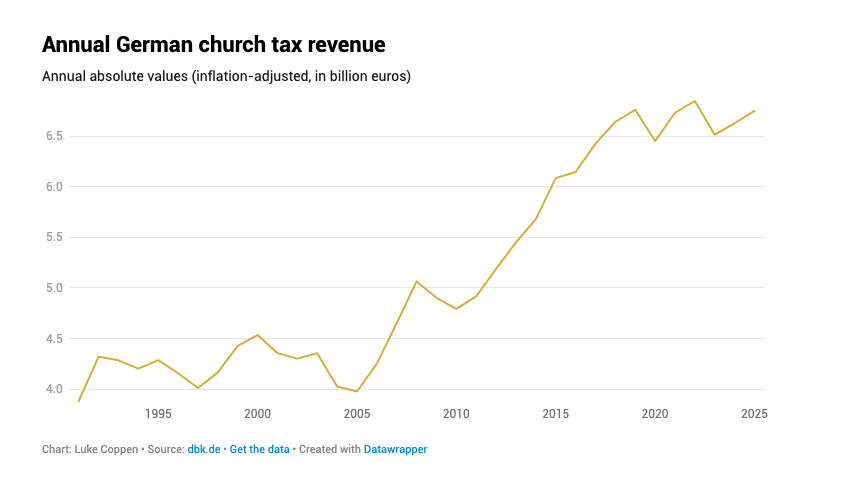
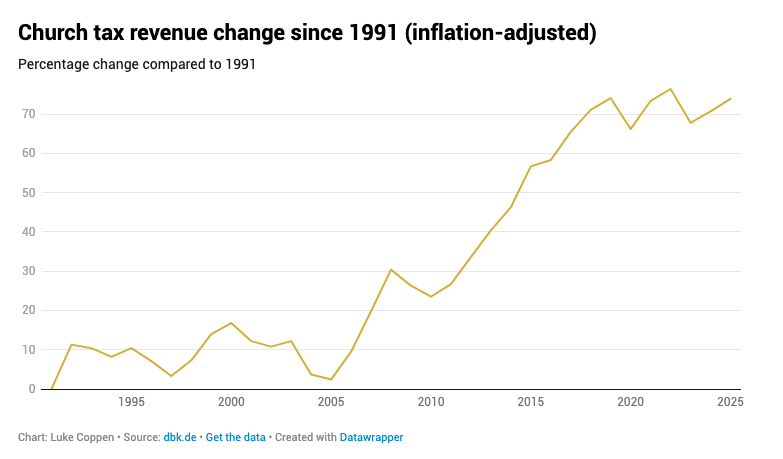
Measured over the long term, the trend is even more striking. Adjusted figures published by the bishops indicate that church tax revenue in 2025 was 1.9% higher than the previous year and stood 73.9% above the level recorded in 1991, shortly after German reunification.
These financial gains come despite the continued decline in Church membership. During 2025, 307,117 Catholics formally left the Church. Although this was fewer than the 321,659 departures recorded in 2024 and well below the 402,694 who left in 2023, the Catholic population continues to shrink at a pace that concerns Church leaders.
The apparent contradiction is largely explained by Germany’s distinctive church tax system.
Unlike many countries where churches rely primarily on voluntary donations, Germany allows religious communities recognized as public-law corporations to collect a church tax from registered members. The tax amounts to 8% or 9% of an individual’s income tax liability, depending on the federal state in which the taxpayer lives. The government collects the money—generally through payroll deductions—and retains roughly 3% of the revenue as an administrative fee before transferring the remainder to the churches.
The proceeds finance a wide range of ecclesial activities, including pastoral ministry, Catholic schools, charitable institutions, clergy and lay salaries, pensions, maintenance of church buildings and international humanitarian projects.
Under German law, Catholics who wish to stop paying the tax must formally declare that they are leaving the Church before civil authorities. Following a decree issued by the German Bishops’ Conference in 2012, those who take this step ordinarily lose access to certain aspects of ecclesial life, including the sacraments, ecclesiastical offices and the possibility of serving as baptismal or confirmation sponsors unless they are reconciled with the Church.
Economists generally attribute the recent rise in revenues to changes in the composition of the remaining Catholic population rather than to renewed religious participation.
Because the tax is linked to income tax rather than a fixed membership fee, higher earnings produce disproportionately higher church tax contributions.
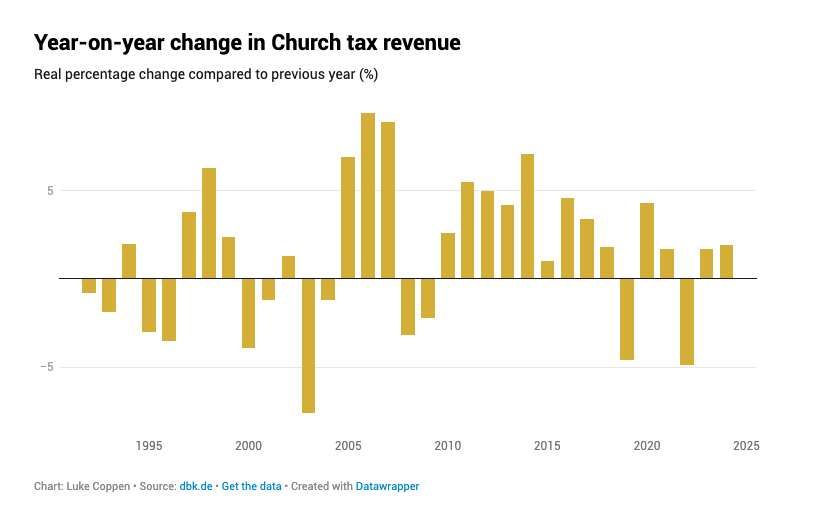
This progressive structure means that rising wages among higher-income Catholics can offset the financial impact of declining membership. Germany’s economy, after facing significant pressures linked to the COVID-19 pandemic and the war in Ukraine, experienced improving real wages as inflation eased. The Federal Statistical Office reported real wage growth of 3.1% in 2024, a development that likely contributed to higher church tax receipts.
Another factor may be demographic. Analysts suggest that many of those formally leaving the Church are younger adults or lower-income taxpayers who contributed relatively little in church tax, while many higher-income Catholics remain registered and continue making substantial contributions.
Even so, Church leaders have repeatedly cautioned that this financial stability should not be mistaken for long-term security.
An aging membership inevitably means that many of today’s highest contributors will retire or eventually pass away, while younger generations are significantly less likely to remain registered as Catholics. Over time, that demographic imbalance is expected to reduce the tax base regardless of future wage growth.
Indeed, local dioceses are already experiencing financial pressures that are not immediately visible in the national statistics.
The Catholic Church is not alone in facing this paradox. Germany’s Evangelical Church (EKD), the federation of 20 regional Protestant churches, reported a similar pattern. Despite losing approximately 586,000 members—around 3% of its total membership—in 2025, it collected roughly €6.09 billion in church tax, compared with €5.97 billion the previous year.
For many, these figures illustrate two realities unfolding simultaneously. Financially, Germany’s church tax system remains remarkably resilient, sustained by economic conditions and a progressive tax structure. Spiritually and demographically, however, both the Catholic and Protestant churches continue confronting a steady decline in active membership that cannot be reversed by favorable revenue figures alone.
The so-called «church tax miracle» may therefore prove to be less a sign of ecclesial renewal than a temporary consequence of economic and demographic factors.
Thank you for reading our content. If you would like to receive ZENIT’s daily e-mail news, you can subscribe for free through this link.

Publicaciones relacionadas:
 Campaign launched encouraging people to Give Prayer A Go
 USA: bishops release first report on religious freedom in the country
 Pope Leo XIV authorizes the beatification of one of Lebanon’s founding fathers (and 80 Spanish martyrs)
 Before the Pope’s arrival: a survey reveals the popularity of Pope Leo XIV, as well as the expectations and topics of interest among those who will welcome him in Spain
