

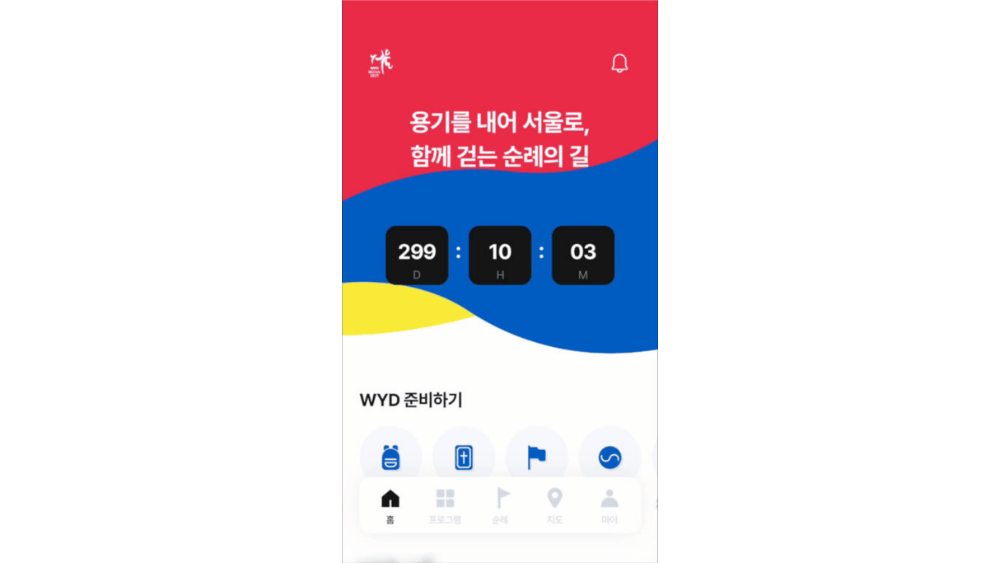
(ZENIT News / Seoul, 10.14.2026).- With less than a year to go before World Youth Day 2027, organizers in Seoul have launched an official mobile application designed to help international pilgrims prepare not only for the journey to South Korea, but also for a deeper encounter with the country’s Catholic heritage. The gathering, scheduled for August 3–8, 2027, will bring young Catholics to the South Korean capital for an international celebration of faith, making practical preparation and spiritual discovery two central goals of the new digital platform.
Developed by the local organizing committee led by Archbishop Peter Chung Soon-taick, the application is provisionally named “WYD 2027” and is available through Apple’s App Store and Google Play in Korean and English. Versions in Spanish, French, Portuguese and Italian are planned. Organizers have also announced a worldwide naming competition to select its definitive title.
The application combines travel guidance, spiritual resources, maps and information about the event. Most of its content can be accessed without registration, allowing prospective pilgrims to begin preparing well before departure. Its homepage features a countdown to World Youth Day, alongside information about the official prayer, the biblical theme, key schedules and pilgrimage destinations.
Yet the platform’s most distinctive feature may be its emphasis on the history of Korean Catholicism, particularly the witness of the country’s martyrs. A dedicated pilgrimage program invites registered users to visit three museums associated with the faith’s historical presence in Seoul: the Archdiocese of Seoul History Museum at Myeongdong Cathedral, the Seosomun Shrine History Museum and the Korean Catholic Martyrs Museum at Jeoldusan Martyrs’ Shrine.
Pilgrims who verify their visits to all three sites through the application can receive a certificate of completion. The initiative offers more than a sightseeing itinerary: it encourages young visitors to explore the sacrifices of Korean Catholics whose fidelity to their faith came at a high personal cost.
Catholicism took root in Korea in an unusual way. Unlike many countries where missionaries first established the Church, Korean Catholicism initially developed through the efforts of Korean scholars who encountered Catholic writings and sought to understand and practice the faith. The community subsequently endured severe persecution, and numerous Catholics were executed for their religious convictions. The sites included in the new application provide an opportunity to encounter this history firsthand, connecting the international gathering with the experiences of local believers across generations.
The digital guide also includes information on Seoul’s Catholic pilgrimage routes, prayers for visits to sacred places and a museum pilgrimage program. Its map, built around Google Maps, currently identifies 24 locations, primarily shrines, museums and event venues, helping visitors navigate the city and plan their movements.
Practical assistance is equally extensive. The application offers advice on preparing travel kits, spiritual readiness, accommodation and pilgrimage packages, as well as basic Korean expressions for greetings, asking directions and participating in church life and Mass. Pronunciation guides accompany the Korean phrases, making them more accessible to visitors unfamiliar with the language.
The organizers have also addressed the realities of traveling in South Korea during July and August. Guidance covers heat, humidity, ultraviolet exposure, sudden rainfall, indoor air conditioning and typhoons. Additional information explains electrical outlets and voltage, packing, public behavior, waste disposal, pedestrian crossings, smoking areas, lost property and noise regulations. Emergency alerts and information about the government’s multilingual disaster notification application are included as well.
Further sections introduce the Catholic Church in Korea, local culture, public transportation and emergency procedures. Organizers say the platform will continue to receive updates before and during the gathering, while additional services connected to the pilgrim card are being developed.
Seoul 2027 will be only the second World Youth Day held in Asia, following Manila’s hosting of the event in 1995. That distinction gives the Korean gathering particular significance for a continent where Catholic communities differ widely in size, history and social circumstances.
The new application reflects an effort to make the encounter accessible from the earliest stages of planning, while ensuring that the pilgrimage extends beyond the main celebrations. For young Catholics arriving from around the world, the experience will involve discovering a different culture, sharing their faith with peers and learning about a local Church whose history includes extraordinary perseverance under persecution.
Thank you for reading our content. If you would like to receive ZENIT’s daily e-mail news, you can subscribe for free through this link.

Publicaciones relacionadas:
 The Pope at MED24 asked the young people of the Mediterranean to help the region “recover its expression of fraternity and peace” and stop being “a graveyard”
 Another Diocese Is Added to the Lowering of Age to Receive the Sacrament of Confirmation
 This is what World Youth Day Korea 2027 will look like, according to a presentation made to the press in Seoul
 UK Bible Sales Are Up 134% Since 2019
