

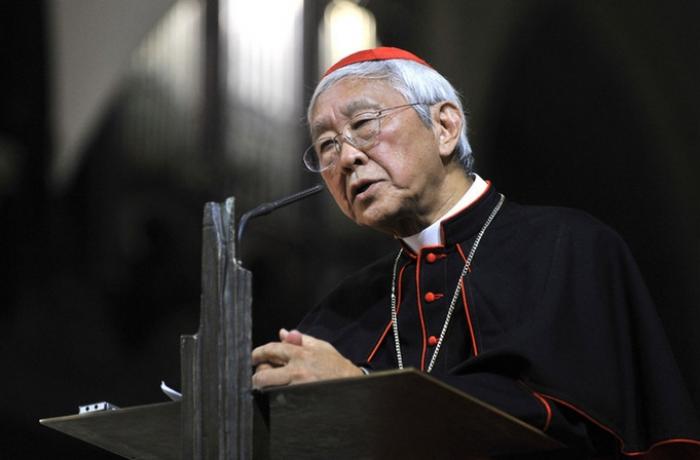
(ZENIT News / Hong Kong, 09.03.2026).- The fine imposed on Cardinal Joseph Zen is relatively small. The legal question now surrounding his case is not.
Hong Kong’s Court of Appeal has rejected the challenge brought by the 94-year-old retired bishop and four other prominent trustees of the now-defunct 612 Humanitarian Relief Fund, upholding their 2022 convictions for failing to register the organization under the territory’s Societies Ordinance.
Yet the significance of the ruling extends far beyond the HK$4,000 — roughly US$510 — that each of the five defendants was ordered to pay.
Zen, barrister and former legislator Margaret Ng, singer and activist Denise Ho, former lawmaker Cyd Ho and scholar Hui Po-keung have argued that the 612 Fund was legally a trust rather than a “society,” and therefore was not subject to the registration requirements applied by the authorities. The three appellate judges disagreed, concluding that the fund was more than money simply held in trust and had operated through the five trustees as an organized management body collecting and distributing public donations.
The defendants have now announced that they will take their case to Hong Kong’s Court of Final Appeal.
At the heart of their challenge is a question with consequences for the territory’s shrinking civic space: how broadly can the law define a “society”?
The 612 Humanitarian Relief Fund was created in June 2019 during the mass demonstrations initially sparked by a proposed extradition bill that would have allowed people in Hong Kong to be transferred to mainland China for prosecution. Although the bill was eventually withdrawn, the protests developed into a much broader pro-democracy movement.
The fund provided humanitarian, financial, legal and medical assistance to people who had been arrested, injured or otherwise affected during the unrest. More than 10,000 people were arrested in connection with the protests, while nearly 3,000 faced criminal charges.
For the Court of Appeal, the trustees’ activities brought the fund within the legal definition of a society. The judges emphasized that the group had deliberately used the fund to solicit, collect and apply public donations in support of protesters.
The defense, however, has warned that the ruling could establish a much wider principle. If virtually any group of people who come together to pursue a common purpose can be classified as a society requiring registration or an exemption, Margaret Ng argued after the decision, the consequences for Hong Kong’s civil society could be enormous.
That concern is particularly important because this is understood to be the first prosecution in Hong Kong for this particular type of violation of the Societies Ordinance. The law requires organizations covered by its provisions to register, or seek an exemption, within a month of their creation.
The appellate court rejected constitutional objections to the registration system, ruling that the legislation struck a reasonable balance between freedom of association and considerations of public safety, public order and national security. The judges found no evidence that the requirements imposed an unacceptably harsh burden on the defendants’ right to associate freely.
But critics of the case see a broader political context that cannot easily be ignored.
All five trustees were initially arrested in May 2022 on suspicion of collusion with foreign forces under Hong Kong’s sweeping national security law, a charge that could have carried far more severe penalties, including life imprisonment. Those accusations did not ultimately lead to prosecution. Instead, the case against Zen and his fellow trustees focused on the fund’s failure to register properly.
Their convictions were handed down in November 2022 following proceedings at West Kowloon. A sixth person, the fund’s secretary Sze Ching-wee, was separately convicted and fined HK$2,500; he did not appeal.
For Cardinal Zen, however, the legal battle has inevitably acquired a significance that reaches beyond the technical classification of a humanitarian fund.
The former Bishop of Hong Kong has long been one of the territory’s most outspoken Catholic voices on democracy, human rights and religious freedom. Since retiring in 2009, he has continued to speak publicly about Hong Kong’s political future and about the situation of the Church in China.
His case has therefore been followed closely by Catholics around the world, particularly because the authorities’ initial use of national security allegations raised fears that prominent religious figures could also become vulnerable when they enter the public debate.
Zen himself has sought to distinguish his personal legal difficulties from a straightforward dispute over religious freedom. But the freedom of the Church cannot be entirely separated from the wider condition of civil society. Religious communities, charities and humanitarian organizations all depend, in different ways, on the ability of people to organize, associate and act publicly without excessive state control.
The Court of Appeal’s ruling does not accuse Cardinal Zen of violence, nor does it concern the content of his Catholic faith. Formally, it is a dispute about registration requirements. Its wider importance lies elsewhere: in determining how much room remains for independent groups to operate when the legal definition of an association becomes increasingly expansive.
The 612 Fund itself closed in October 2021. Its legal legacy, however, is still unfolding.
For Cardinal Zen and his four fellow trustees, the next stage will be the Court of Final Appeal. For Hong Kong, the case may ultimately become a test of something much larger than the fate of five defendants: whether citizens can still come together for humanitarian or civic purposes without fearing that the very act of organizing may place them under the control of the state.
Thank you for reading our content. If you would like to receive ZENIT’s daily e-mail news, you can subscribe for free through this link.

Publicaciones relacionadas:
 Second in Hierarchy of the Vatican Secretariat of State Appears in Court in London
 Catholic Patriarch Emeritus of Jerusalem demonstrates that Israel’s security cannot be achieved through violence
 Leader of all U.S. bishops to migrants: “Count on our commitment to accompany you in these difficult times”
 Unexpected: Vatican court rules trial against Cardinal Becciu partially invalid and orders a retrial
