

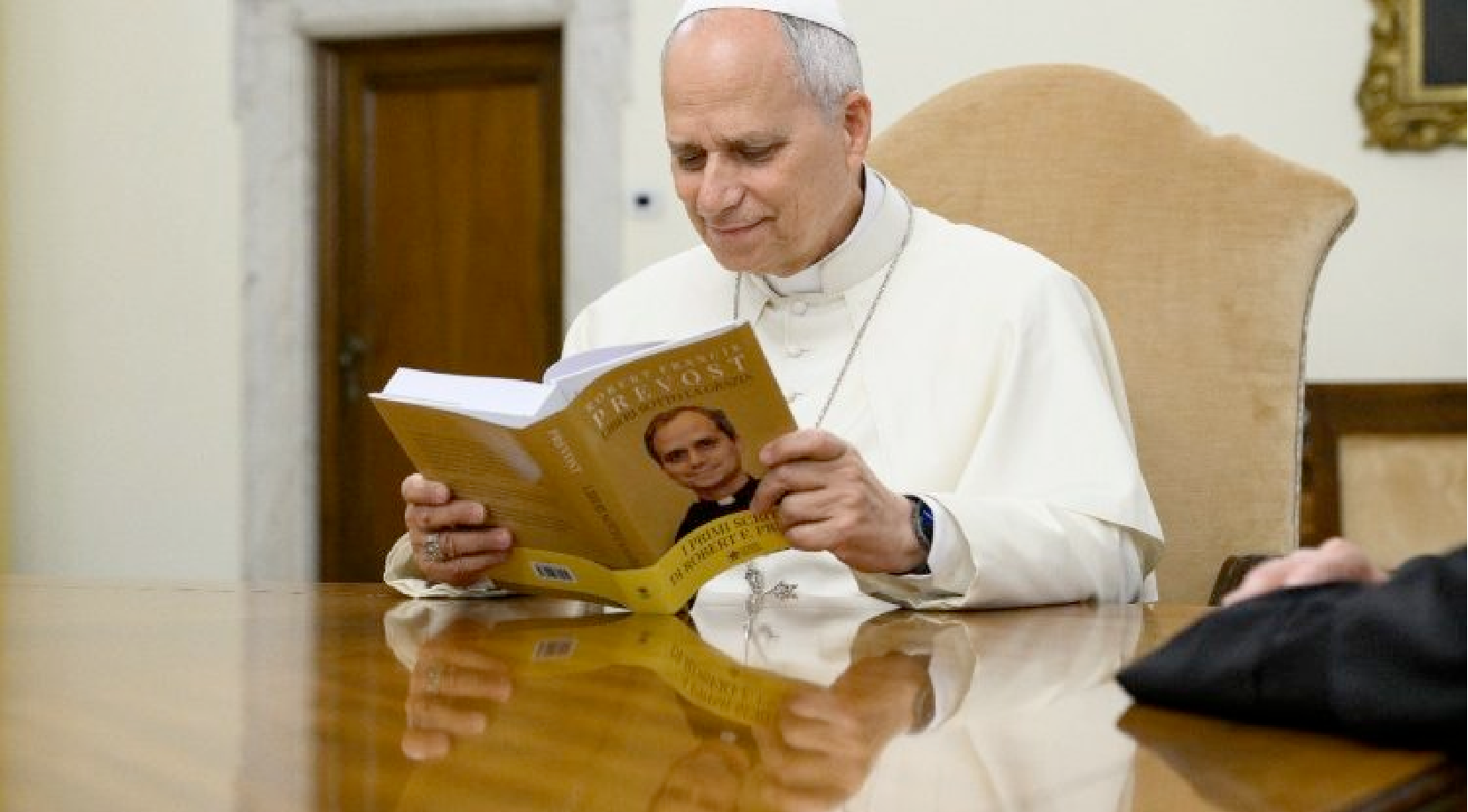
(ZENIT News / Rome, 05.14.2026).- Less than a year into the pontificate of Pope Leo XIV, the Vatican has unveiled what many already consider a key text for understanding the spiritual and intellectual foundations of the new Pope’s vision for the Church.
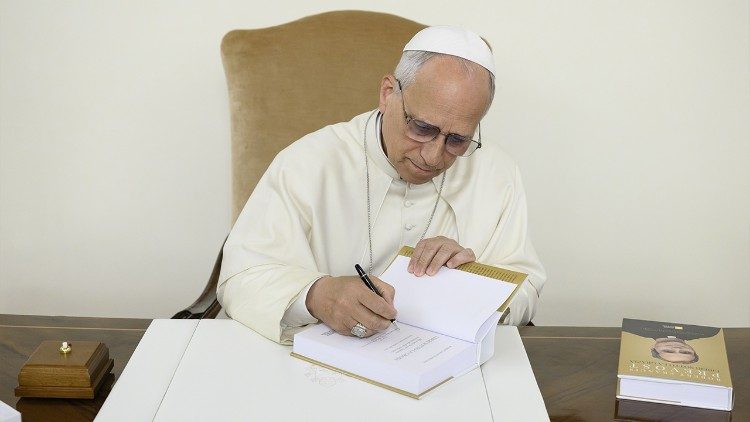
The volume, titled “Free Under Grace: At the School of Saint Augustine Before the Challenges of History, gathers speeches, homilies, letters, and reflections delivered by Robert Francis Prevost during his years as Prior General of the Order of Saint Augustine between 2001 and 2013. Published by Libreria Editrice Vaticana, the work has already attracted significant attention inside ecclesiastical and academic circles, not only because it is the first book associated with Leo XIV’s still-young pontificate, but because it offers rare insight into the theological temperament of a Pope who remains relatively unknown to many Catholics worldwide.
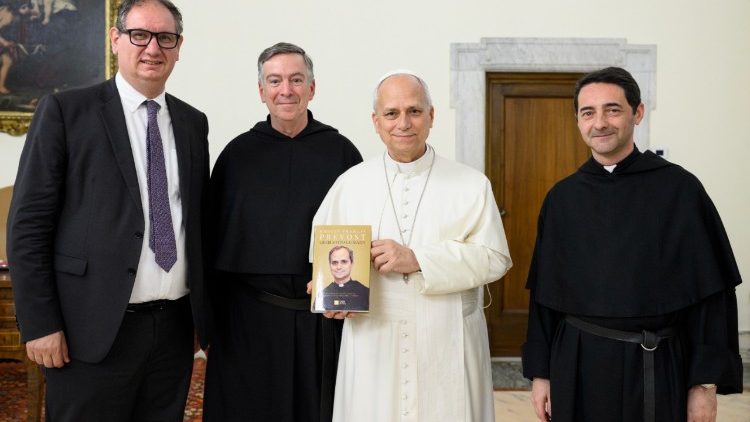
The first copy of the Italian edition was formally presented to the Pope on May 2 by Father Joseph Farrell, the current Prior General of the Augustinians, together with Father Rocco Ronzani and Vatican publishing executive Lorenzo Fazzini.
The publication was officially launched in Rome on May 6 at the Pontifical Patristic Institute Augustinianum, in an event that underscored the importance the Vatican appears to attach to the project. Among the speakers were Cardinal Pietro Parolin, communications prefect Paolo Ruffini, Vatican editorial director Andrea Tornielli, writer Maria Grazia Calandrone, and Father Farrell himself.
The book is currently being translated in 30 countries, an unusually broad international rollout that reflects both the global interest surrounding Leo XIV and the Vatican’s evident desire to introduce the Pope’s thought rapidly to Catholics across continents.
An Augustinian Pope in a Restless Age
Although comparisons between popes can often oversimplify complex personalities, the emergence of this volume highlights a defining aspect of Leo XIV’s identity: his deep formation within the Augustinian spiritual tradition.
For many ordinary Catholics, Saint Augustine of Hippo remains primarily the author of Confessions, one of the most influential spiritual autobiographies in Christian history. Yet Augustine’s broader legacy extends far beyond personal conversion narratives. His writings shaped Catholic reflections on grace, freedom, human desire, political authority, history, and the restless search for truth.
The very title of the new volume — “Free Under Grace” — evokes one of the central tensions in Augustinian theology: the relationship between human freedom and divine grace. Augustine insisted that authentic freedom does not consist in radical autonomy detached from God, but in the liberation of the human heart through truth and grace.
That theme appears especially relevant in an era marked by growing individualism, moral fragmentation, and ideological polarization both inside and outside the Church.
The publication therefore functions not merely as a historical archive of old speeches, but as a kind of theological map pointing toward the deeper instincts of the current pontificate.
A Portrait Before the Papacy
Unlike formal papal encyclicals or magisterial documents, the texts collected in the volume were written before Robert Prevost ascended to the Chair of Peter. That gives them particular importance for Vatican analysts seeking to distinguish the Pope’s authentic personal convictions from the inevitable institutional language that often surrounds high ecclesiastical office.
According to Vatican sources involved in the publication, the collection brings together materials that had never before been assembled in a single work. Readers encounter Prevost not yet as Pope, but as religious superior, missionary pastor, spiritual guide, and Augustinian thinker confronting the challenges of globalization, secularization, ecclesial reform, and cultural upheaval.
Those familiar with his trajectory note that the future Leo XIV consistently emphasized interior conversion, communion within the Church, intellectual seriousness, and missionary responsibility rooted in humility rather than ideological activism.
At a time when Catholic debates are frequently framed in purely political categories — progressive versus conservative, reform versus tradition — the Augustinian dimension of Leo XIV may suggest a different framework altogether: one centered less on ecclesiastical factions and more on the transformation of the human heart.
The Global Reach of an Unexpected Pontificate
The rapid international translation of the book into dozens of countries also reveals how quickly attention around Leo XIV has expanded far beyond Rome.
When Cardinal Robert Francis Prevost was elected Pope, many outside Vatican circles initially viewed him as a relatively discreet figure compared to more publicly visible papabili. Yet his election immediately generated interest precisely because of his unusual background: an American-born Augustinian with extensive missionary experience in Latin America and years of leadership within a global religious order.
That combination gives him familiarity with multiple ecclesial realities — North American secularization, Latin American pastoral life, missionary dynamics, and the internal governance of international Catholic institutions.
Observers increasingly note that Leo XIV’s speeches frequently avoid rhetorical extremes. Instead, they tend to combine doctrinal seriousness with pastoral restraint, an approach some peoples believe could help calm tensions that intensified within the Church over recent years.
The fact that his first published volume centers on Saint Augustine is therefore highly symbolic. Augustine lived during the collapse of the Roman world, a time of political instability, cultural uncertainty, and spiritual confusion not entirely unlike the atmosphere many Christians perceive today.
Indeed, one reason Augustine continues to resonate across centuries is his refusal to offer simplistic optimism or despair. He understood human weakness profoundly, yet never surrendered confidence in grace.
Free Under Grace appears to offer an early interpretive key to Leo XIV’s papacy. The collection suggests a Pope concerned not merely with institutional management or ecclesiastical politics, but with deeper spiritual questions: how Christians remain faithful in turbulent societies, how freedom can coexist with truth, and how the Church can speak convincingly to a fragmented modern world.
Thank you for reading our content. If you would like to receive ZENIT’s daily e-mail news, you can subscribe for free through this link.

Publicaciones relacionadas:
 Why is he called Leo XIV? The official answer given by the Pope
 “Only informed individuals peoples can make free decisions”: Leo XIV’s full speech to journalists
 Leo XIV will go to Turkey at the end of 2025. Patriarch of Constantinople confirms it after audience
 In the Heart of Rome, the Pope Becomes Its Citizen
