

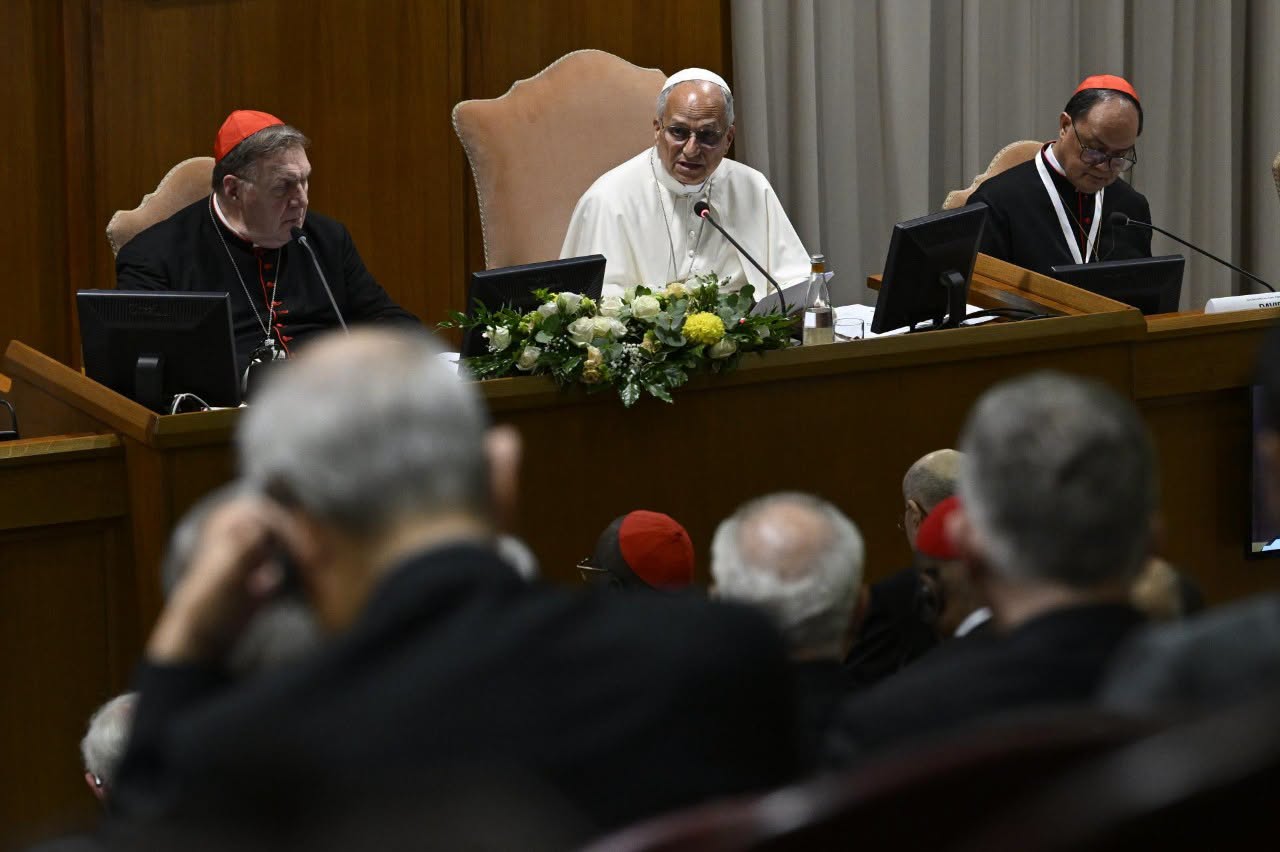
(ZENIT News / Vatican City, 06.27. 2026).- Late in the afternoon on Saturday, June 27, Pope Leo XIV delivered concluding reflections to the Cardinals gathered in the Synod Hall. He not only summarized the results of the four sessions held between Friday, June 26, and Saturday, June 27, but also explained his own understanding of synodality. Following this final meeting, the Pope hosted a dinner for the Cardinals. Below, we present ZENIT’s English translation of the Holy Father’s address.
* * *
Before turning to these concluding reflections, I wish to express our closeness, mine and that of the entire College of Cardinals, to the people of Venezuela, who have been severely struck by the violent earthquake of recent days. We assure you of our prayers for the victims, their families, and all those suffering the consequences of this tragedy. We also commend to the Lord all those engaged in relief efforts and pray that the International Community will not fail to show solidarity with that beloved Nation.
Dear Brother Cardinals, we now reach the end of these days with a sense of profound gratitude. I thank you for the freedom, fraternity, and ecclesial spirit with which you have participated in our work. I carry with me not only the content of your reflections but also the experience that made them possible. During these days, we have sought the Lord’s will together, convinced that Christ continues to act in His Church: it is He who goes before us, gathers us, speaks through our brothers, and leads us in our mission. Everything comes from Him, and everything returns to Him. Therefore, seeing Cardinals from such diverse Churches, cultures, and situations listening to one another and seeking together what best serves the Gospel, has been a source of consolation and hope for me.
We began these days allowing ourselves to be guided by the image of the Good Samaritan: a man who stops before a wounded brother, is deeply moved with compassion, and takes care of him.
I would like us to take our leave now with another Gospel image: that of the disciples of Emmaus. They, too, walked marked by sadness and disappointment, yet the Lord becomes their traveling companion; He listens to their questions, opens the Scriptures, makes their hearts burn within them, and transforms their journey. I like to think that what we have experienced during these days shares something of that same experience: we have walked together, listened to one another, and, if we have made room for the Lord, He has rekindled hope in our hearts and now sends us back to our Churches to resume the journey with a renewed perspective.
The concluding reflection on the synodal journey has helped us to re-examine what we have experienced over these days. It seems to me that the question of synodality is not, first and foremost: «Who has the power to decide?» The question is deeper: «How do we safeguard together the gift that the Lord has entrusted to His Church?» When this question becomes the center of our discernment, issues of authority, co-responsibility, and decision-making also find their proper place, illuminated by the mission and by a shared fidelity to the Gospel. For this reason, I wish to entrust to you once again the process of implementing the Synod. I ask you to support it with conviction in the Churches you serve, fostering an authentic understanding of it and encouraging everyone to take part: it is a matter of helping our Churches grow in an increasingly Gospel-oriented style.
I recommend to you, as we have heard from Cardinal Grech, that synodality is neither a series of meetings nor a working method; it is a spiritual style. It is born of encounter, grows through listening, and matures through discernment. The real question is not how many conversations we can organize, but rather what evangelical quality our encounters will possess. When we listen to one another with humility and freedom, making room for the Spirit, our conversations do not remain mere exchanges of ideas; instead, they become a space of true dialogue where we grow together in fidelity to the Lord.
Reflecting on the conversations of recent days, I carry with me, above all, the perspective through which you viewed the world during the first session. Many of you recounted the suffering caused by wars, violence, poverty, and the many injustices that mark the lives of peoples. Yet, you did not stop at merely describing them. Beyond those tragedies, you recognized an even deeper suffering: loneliness, the crisis of relationships, the loss of hope, and the difficulty of recognizing one another as brothers and sisters. It is a gaze that does not look away from the world’s wounds but seeks their roots, often recognizing, hidden within them, a renewed quest for meaning, authenticity, spirituality, and community. Today, many are searching for hope and genuine relationships.
I have been particularly struck by the way you have spoken about young people. In your questions, but also in the suffering that sometimes drives them to despair, and at times to the extreme despair of taking their own lives, you have recognized one of the deepest wounds of our time. Yet, you have also been able to recognize the action of the Spirit within this. Their search for authenticity, for genuine relationships, and for meaning reminds us that the Gospel continues to meet the deepest expectations of the human heart. Listening humbly to them and to their families is also a path through which the Lord continues to convert the Church.
Many of you have also spoken of the family. Wherever it is supported and accompanied, a school of relationships, solidarity, and hope flourishes; wherever it is wounded or isolated, society as a whole suffers the consequences. In October, we will hold a meeting with the heads of the Eastern Churches and the Presidents of the Bishops’ Conferences to evaluate the steps taken following Amoris Laetitia. Families will also participate to share their experiences. Their presence is essential, but I hope that all who attend will prepare themselves by listening closely and bringing with them the experience of the families from their own Churches.
In this way, you have sought to listen to what the wounds of the world reveal about the human heart. It is precisely there, in the heart, that peace is also decided. Before manifesting in history, war is born within us, when suspicion takes the place of trust, fear replaces hope, and the other is perceived as a threat. Yet, it is in that very heart that Christ continues to meet us, speaking to us and transforming us. From a reconciled heart, words that disarm, new relationships, and a peace capable of reaching the nations can emerge.
The second session has led us to take a further step. It seems to me that you have grasped with great clarity one of the insights of Magnifica Humanitas: war is not merely a conflict between States. It originates much earlier, in a culture of power that permeates our way of thinking, of experiencing relationships, of exercising power, and of using the economy, technology, and even religion. If this is the root of the crisis, the response requires rebuilding a culture of cooperation and dialogue, one capable of revitalizing multilateralism, so that peoples may learn once again to seek the common good of the entire human family together. On this path, the contribution of lay faithful engaged in public life is essential; they need the closeness and support of the ecclesial community to live out the «political charity» that has been highlighted. This same culture of cooperation grows through ecumenical and interreligious dialogue –dialogue that does not dilute our Christian identity but rather enables us to serve the common good and peace together.
I have found the way some of you have addressed the theme of a non-violent response to the many forms of violence to be particularly valuable. This is a profoundly Gospel-based way of living within history, born of contemplating how Jesus acted. It does not consist of renouncing conflict or adopting a passive attitude, but rather of choosing to face it without replicating its logic. It neither abandons the truth nor remains silent about evil, yet it refuses to defend the truth through violence or to turn the other person into an enemy; instead, it begins by disarming itself. In this way, it reveals the logic of Easter, in which love proves stronger than hatred and forgiveness breaks the spiral of vengeance. This is the power of the Crucified and Risen One: a power that does not destroy the enemy but makes it possible to rediscover a brother.
From this perspective, various groups have highlighted the importance of further exploring the issue of legitimate defense in light of the profound transformations that have occurred in the nature of contemporary conflicts. This reflection deserves to be developed further with the necessary theological and pastoral rigor.
I have also noted with particular interest your emphasis on the Social Doctrine of the Church. You have expressed the desire for it to become increasingly a living part of our communities’ heritage, a standard criterion for the formation of consciences and for pastoral discernment. It does not offer pre-packaged solutions; rather, it educates the Church in an evangelical way of engaging with reality, interpreting it, and guiding action responsibly.
I was also struck by another point of convergence. Many of you have observed that, today, the common good is not merely a goal to be pursued; it is a reality to be rediscovered together. We live in times when it is becoming difficult even to recognize what is truly good for everyone. Therefore, rooted in Christ, the Church is called to foster spaces for encounter, listening, and dialogue where a renewed culture of the common good can mature. This also requires patient educational work that helps us recognize the inviolable dignity of every person and the responsibility that binds us to one another. On this journey, the poor are not merely recipients of our care, but protagonists of the hope that God continues to awaken in history.
Another conviction has also strongly emerged from many of these reflections. As we examined the Church’s responsibilities in today’s world, the importance of witness, closeness, the formation of consciences, and the building of fraternal and credible communities was continually highlighted. This witness springs from the encounter with Christ, with His Word and the Sacraments, through which the Lord sustains His people and empowers them to serve the world with the strength of the Gospel. The Church is called to become ever more fully what she proclaims. It is upon this foundation that the necessary reforms of structures, institutions, and processes can also bear fruit.
Thus, these days strengthen my hope, not only because of what we have shared, but because of the way we have shared it. In a time marked by polarization, the very way the Church listens and engages in dialogue becomes part of her proclamation. If we can continue to seek the Lord’s will together, allowing ourselves to be guided by the Holy Spirit, I am certain that our communion will become increasingly fruitful for the Church’s mission and for service to the entire human family.
I believe that, little by little, we are rediscovering the most authentic meaning of the Consistory: the gathering of the College of Cardinals around the Successor of Peter so that, through mutual listening and shared discernment, the Holy Spirit may help the Pope guide the Church. It is not a Parliament, nor a Congress where opinions or interests prevail, but an experience of communion in the service of the mission. What we are learning to live out during these days does not concern the College of Cardinals alone. It is a style we are called to promote throughout the Church, so that every baptized person, according to their own vocation and responsibility, may participate in building the Civilization of Love and in serving the common good. As I have already mentioned, I wish to continue this annual gathering starting next year. I have not yet set the date; I expect to communicate it to you towards the end of this year.
This Consistory has been a precious moment, but it must not remain an isolated event. Throughout the Church, we wish to foster spaces where the People of God can listen to one another, pray, discern, and walk together. This is the heart of the journey to implement the Synod. It will also be the spirit of the upcoming meeting dedicated to Amoris Laetitia and of many other initiatives the Lord will call us to undertake. What matters is not multiplying meetings, but learning to experience encounters in which, by listening to one another, we learn together to listen to the Lord.
Before concluding, I wish to embrace the unanimous appeal that has emerged from this Consistory and make it my own. Moreover, I would like us to do so together, through these words. Let us say it to our brother Bishops, to the Churches entrusted to our ministry, and to all the peoples of the earth: God desires peace for every nation and for every people. Therefore, we must not resign ourselves to violence. Violence will not have the final word. God continues to open paths of reconciliation and peace in history. We have the responsibility to walk them with courage and to help the world recognize them.
Brothers, I thank you from the bottom of my heart for your contributions, as well as the speakers, the moderators, and all those who, with generosity and discretion, have made these days of work and fellowship possible. Thank you for helping me, once again, to recognize the work that Christ continues to carry out in the midst of His people and in the world. We entrust the fruits of this Consistory to the intercession of the Virgin Mary, Mother of the Church. May she teach us to safeguard unity in diversity and to serve the Gospel of peace with humility, courage, and hope. Thank you!
Translation into Spanish of the Italian original by ZENIT’s Editorial Director and, into English by Virginia M. Forrester

Publicaciones relacionadas:
 What is human prosperity? Pope Leo XIV answers based on St. Augustine
 Jesus’ “I thirst” on the cross explained by Pope Leo XIV
 “We cannot and do not want to forget”: Pope Leo XIV at ecumenical celebration for martyrs and witnesses of the faith
 Jubilee, Hope, and Family: Three Reflections by the Pope on the Future of the Family
