

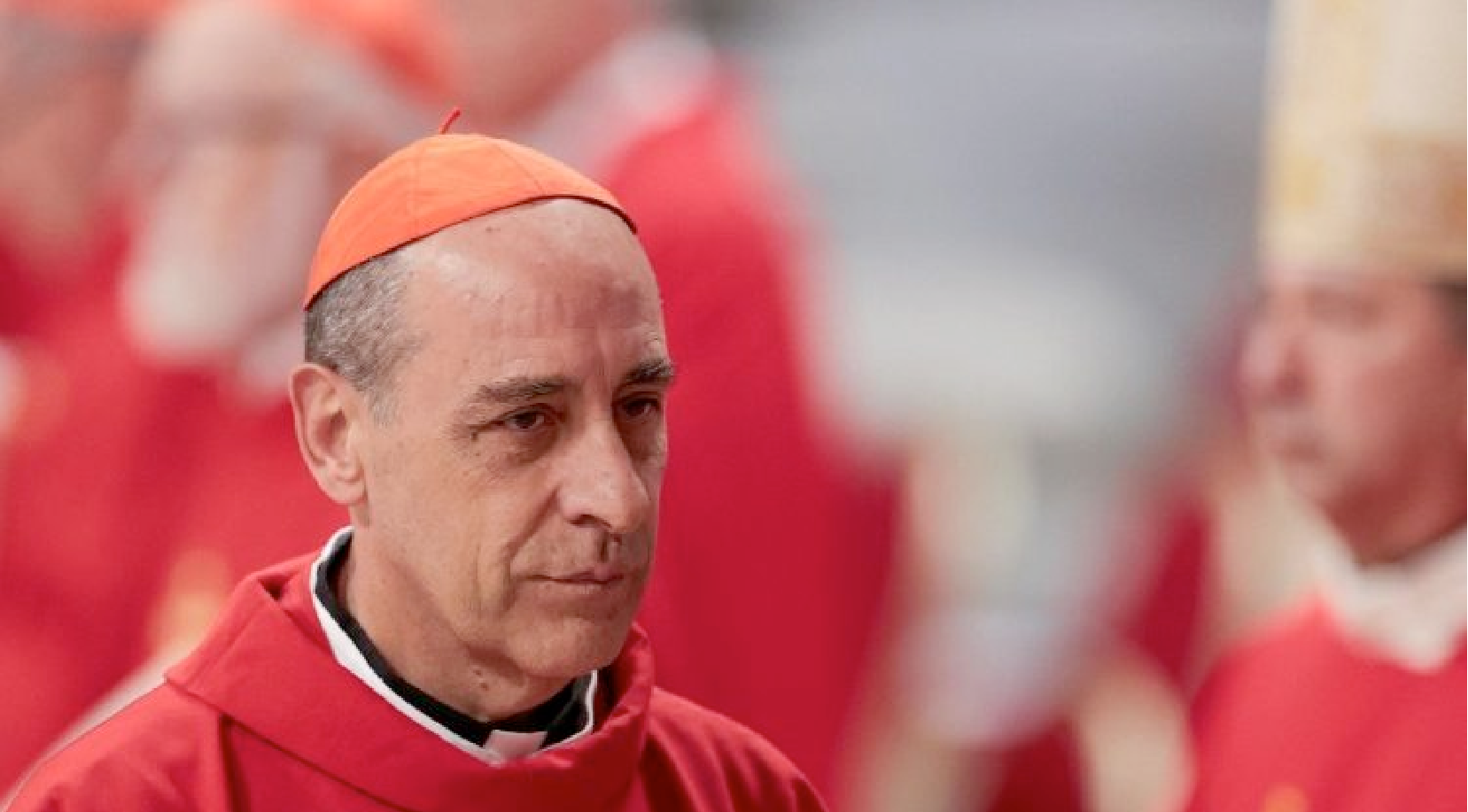
Cardinal Víctor Manuel Fernández
(ZENIT News / Vatican City, 06.26.2026).- Below is the address delivered by Cardinal Víctor Manuel Fernández, Prefect of the Dicastery for the Doctrine of the Faith, which was read at the start of the afternoon session on the first day of the Consistory for Cardinals. The address was presented during the general session dedicated to the theme “The Culture of Power and the Civilization of Love.”
***
The fifth chapter of the Encyclical Magnifica Humanitas addresses the topic of war, but the chapter’s title specifies what is new about the Encyclical’s approach to this issue: the “culture” of power. Indeed, a profound “cultural” transformation is underway that facilitates the outbreak of new wars. The culture of power is one that can influence everyone, even those living far from war zones. It is a globalized culture that fosters a certain passivity on the part of the individual in the face of the unchecked advance of certain forms of power—not least due to new communication tools that have been vastly enhanced by Artificial Intelligence (AI).
In terms of Catholic doctrine on war, the major innovation of Magnifica Humanitas is the call to recognize that “the ‘just war’ theory […] is outdated” (MH 192). Two key points, in particular, are made explicit and help us understand the urgency of this call. The first is that our doctrine of just war “has all too often been used to justify any kind of war” (ibid.).
This creates a paradox: the Church’s Social Doctrine is manipulated to provide a theoretical foundation for the most unjust wars; instead of stopping wars, it helps to justify them.
The second point made by the Encyclical concerns the fact that legitimate defense can be invoked only if understood “in the strictest sense” (ibid.), that is, not in the broad and overly open sense of so-called ‘preemptive wars.’
The conditions for legitimate defence, which remain valid according to the Catechism of the Catholic Church, are as follows:
“— the damage inflicted by the aggressor on the nation or community of nations must be lasting, grave, and certain;
— all other means of putting an end to it must have been shown to be impractical or ineffective; — there must be serious prospects of success;
— the use of arms must not produce evils and disorders graver than the evil to be eliminated. The power of modern means of destruction weighs very heavily in evaluating this condition.” (CCC 2309).
And all of this was affirmed by the Church long before AI was applied to warfare.
Though the Catechism does not state this explicitly, the first two conditions refer to a strict and proven ‘necessity.’ The third condition—that of “serious prospects of success”—indicates that a war cannot be continued indefinitely merely to prevent an injustice if this entails grave and unceasing harm to the population concerned, particularly the constant killing of people. Accordingly, the last condition implies that there must be ‘proportionality’ between the attack received and the defensive response and its effects. In this regard, it seems we have already forgotten what the Second Vatican Council affirmed. Gaudium et Spes makes clear that “massive and indiscriminate destruction” is “far beyond the bounds of legitimate defence” (GS 80). Above all, the Council solemnly declared that: “Any act of war aimed indiscriminately at the destruction of entire cities of extensive areas along with their population is a crime against God and man himself. It merits unequivocal and unhesitating condemnation” (ibid.). The destruction of entire cities cannot be considered a proportionate defensive action.
The enormous disproportion of the military interventions in Gaza and southern Lebanon, for example, is evident. In fact, since these are territories that are not densely populated, the percentage of civilian deaths relative to the total population, the enormous number of children killed (at a much higher rate than in other countries at war), and the number of homes bombed allow us to speak of total destruction. Yet, whether in the case of Russia or the United States, the justification for foreign powers getting involved in the wars in the Middle East is seemingly always some form of supposed ‘self-defence.’
What remains of the conditions that sought to limit wars? And all this without even considering the forgotten international humanitarian law. We are, as the Encyclical asserts, in the midst of a cultural process of “normalization of war” and a “troubling revival of war as an instrument of international politics” (MH 189-190), accompanied by a serious “loss of historical memory” (MH 191).
Preemptive wars unilaterally invoke possible—yet unproven—preparatory actions for external aggression and, ultimately, mere assumptions about what another country might do. This ends up justifying everything we have seen and continue to see in Gaza, Lebanon, Ukraine, and in many other places. In these cases, acts of war appear to be the application of theological criteria—not only those of Judaism, nor only those of Orthodoxy in the case of Russia, but also those of Catholic doctrine itself on just war and legitimate defence.
Consequently, what the Encyclical now adds with regard to the Catechism’s teachings on just war is that not only the application but also the very notion of legitimate self-defence must be more clearly defined so that it can be understood in its strictest sense. Thus, the very notion of just war must be revised and refined, lest the classic criteria for a just war become useless and ineffective in today’s world.
Let us now return to the initial point expressed in the title of Chapter 5 of Magnifica Humanitas, namely, the “cultural” problem of power, which challenges us today and concerns all our countries. In our time, in reality, the groundwork for starting and continuing a war without effective opposition—like other unjust political decisions—is laid out through a ‘cultural battle.’ It is a meticulous, pervasive, and global effort that leads to the relativization of everything and thus ends up granting broad freedom to violent leaders. This fundamentally implies three things that we bishops cannot accept:
1) Firstly, the constant—and at times unrestrained—discrediting of those who think differently, coupled with constant lies for which no one is held accountable. In the end, a large part of the population feels that everything is the same and resigns itself to the current situation, provided at least that a minimum income is promised. As the Encyclical explains, by using today’s powerful means of communication, “politics often turns to misinformation and ridiculing opponents, and systematically cultivating fears and resentments […] creating an environment in which new conflicts can develop almost imperceptibly” (MH 206). Violence, cynicism, and spiteful verbal attacks by political leaders in some countries have reached levels that were unimaginable not long ago.
2) Secondly, the imposition of a ‘political realism’ regarding war, where the will to power reigns. This so-called realism, as the Encyclical states, “dismisses peace and dialogue as utopian or irrational positions that ignore the risks at stake” (MH 205). Consequently, even the critical public ends up becoming accustomed to political violence and war “as necessary, inevitable or even ‘sanitized’” (MH 192). Sometimes even bishops fall into this trap so as not to be regarded as naive.
3) Thirdly, the acceptance of inconsistency as a strategy. For example, if a country is an enemy, it is condemned as undemocratic and sanctioned in various ways; but if it is an ally, the fact that it lacks freedom of expression, human rights, or democracy is ignored. And this applies not only to leaders who are heavily criticized around the world, but also to the European Union. The European Union, in fact, imposes economic sanctions on one country, and sends financial aid and weapons to another; yet fails to do the same in the face of other, even more serious invasions with even more brutal consequences for entire populations. These contradictions, present throughout the world, suggest that, in practice, concerns boil down to the political and economic interests of different regions of the globe. There is no longer a real and stable framework of truth and values. All of this, unfortunately, serves the interests of the most powerful, who proceed unchecked.
The good news in this bleak landscape is that today a new and unusual space is opening up for the Church’s Social Doctrine. Indeed, our social teaching possesses an integrity, harmony, and coherence that is not found in politics, ideological proposals, or other sectors of society. While our message defends unborn life, it also cares for migrants and strongly opposes war. While it stands with the vulnerable and the marginalized and defends the weakest populations, it is also unwavering in its rejection of abortion. At the same time, the Church is uninvolved in electoral interests, does not resort to verbal violence, and does not claim privileges. It always proclaims the saving love of Christ, but never separates it from the constant defence of human dignity in every circumstance, since such a defence lies at the heart of the Gospel. All of this inspires trust in—or at least a certain respect for— the Church’s word.
Here, however, we must finally ask ourselves whether, in our local Churches, we maintain the same consistency and integrity seen in the teaching and witness of the Popes; whether we are careful not to succumb to the culture of power; and whether we strive to nurture the alternative culture of fraternity and the common good. Only in this way will the full inculturation of the Gospel in our countries and in our times be possible.
Thank you for reading our content. If you would like to receive ZENIT’s daily e-mail news, you can subscribe for free through this link.

Publicaciones relacionadas:
 Pope’s Secretary of State visits Brazilian President and presides over opening of Brazilian Episcopate Assembly
 New Zealand Cardinal acquitted by Vatican and Police in unproven abuse case
 Pope, his Council of Cardinals and 3 women discuss canon law, role of women and economics
 Bishop announces resignation if Vatican does not rule in his favor in dispute with Opus Dei
