

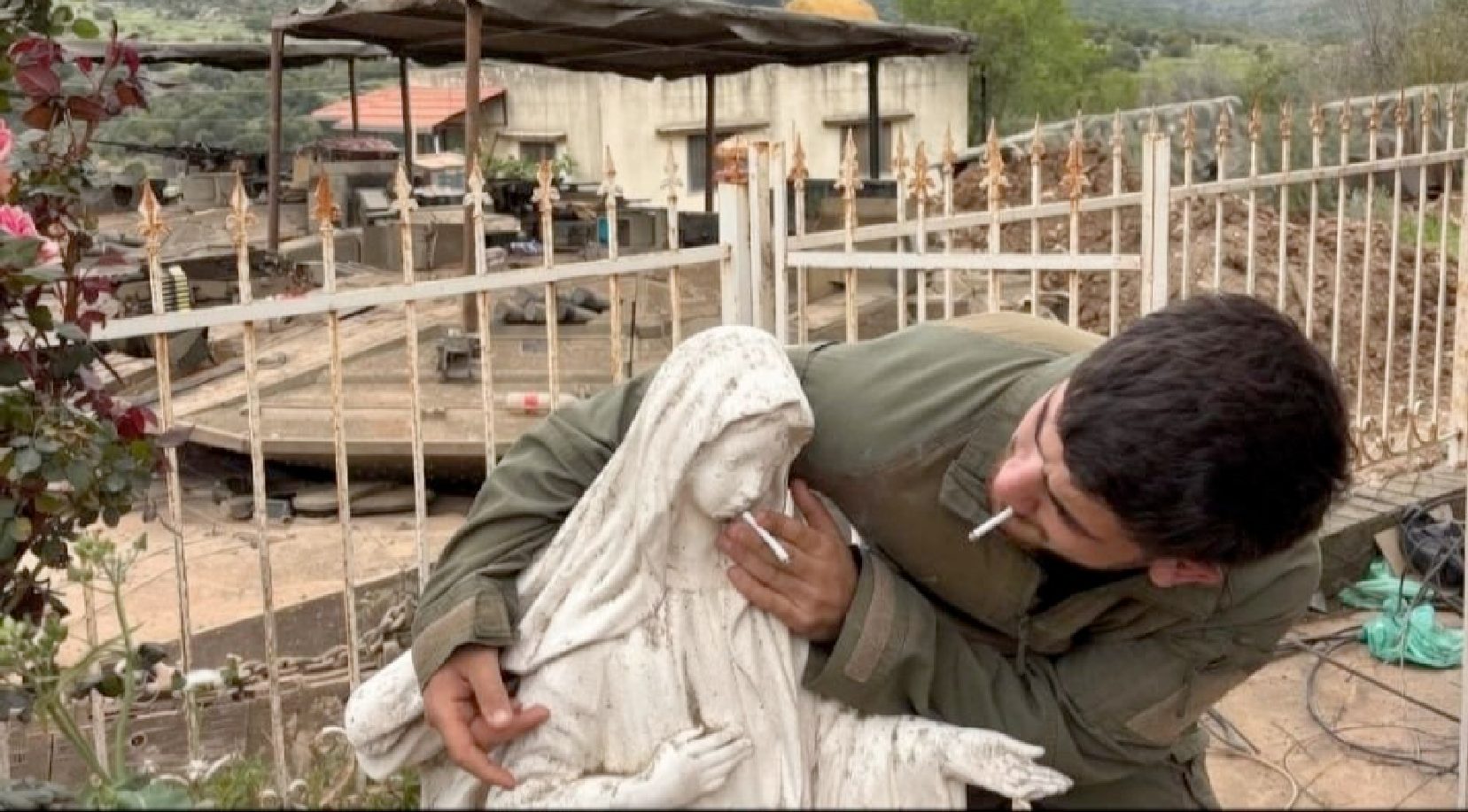
(ZENIT News / Beirut, 05.07.2026).- A photograph taken in the Christian village of Debel in southern Lebanon has reignited tensions between Israel and Christian communities across the region after an Israeli soldier was seen placing a cigarette in the mouth of a statue of the Virgin Mary.
The image, which circulated widely online on Wednesday, May 6, immediately provoked outrage among many Lebanese Christians and renewed scrutiny of a growing series of incidents involving Israeli troops and Christian religious symbols during the conflict along the Israel-Lebanon border.
Following public backlash, the Israel Defense Forces announced that the soldier involved had been identified and would face disciplinary measures. In an official response, the military described the episode as “very serious” and insisted that the soldier’s behavior was “completely contrary to the values expected” of Israeli forces.
According to the army’s preliminary investigation, the photograph had actually been taken several weeks earlier in Debel, a predominantly Christian village near the border, but only surfaced publicly this week.
The IDF views the incident with utmost severity and emphasizes that the conduct of the soldier completely deviates from the values expected of its personnel.
Following an initial review, the image in question was taken several weeks ago. The incident will be investigated, and… https://t.co/fi2gQXzdYj
— LTC Ariella Mazor (@LTC_Ariella) May 6, 2026
The incident may appear minor compared to the broader violence consuming the region, yet for many Christians in Lebanon it touches a particularly sensitive nerve. In Middle Eastern Christian communities, Marian devotion is not merely symbolic or cultural; statues of the Virgin frequently occupy central places in homes, churches, and village life, especially in areas long marked by war and displacement. Acts perceived as desecration therefore carry emotional and spiritual weight far beyond the object itself.
The controversy also comes against the backdrop of other recent allegations involving Israeli soldiers in the same village.
In April, footage emerged allegedly showing a soldier damaging a statue of Jesus in Debel. Separate videos also appeared to show military bulldozers destroying solar panels in the area. The Israeli military later stated that two soldiers connected to the vandalism against the Christian statue had been removed from combat duty and disciplined, while the case involving the solar panels remains under investigation.
Israeli authorities insist these incidents do not reflect official policy.
The army reiterated this week that it “respects freedom of religion and worship” as well as “holy sites and religious symbols of all religions and communities.” It also emphasized that it has “no intention of harming civilian infrastructure,” including religious buildings and sacred images, during military operations against Hezbollah.
Nevertheless, the repetition of such episodes has increasingly strained Israel’s relationship with Christian communities both locally and internationally.
For years, Israeli officials have sought to present the Jewish state as a guarantor of religious liberty and as a natural ally of Christians in a Middle East where many ancient Christian populations face persecution, discrimination, or demographic collapse. Yet critics argue that repeated attacks on churches, clergy, cemeteries, and religious symbols — whether carried out by extremists, civilians, or soldiers — have undermined those claims and created the perception of insufficient accountability.
The latest controversy unfolds amid continuing instability in southern Lebanon following months of fighting between Israel and Hezbollah.
Hostilities intensified after Hezbollah began launching attacks against Israel on March 2, shortly after the outbreak of the broader confrontation involving the United States, Israel, and Iran. Israel responded with heavy airstrikes and an expanded military presence deeper inside Lebanese territory.
Although a temporary ceasefire was announced on April 17, the truce has remained fragile. Fighting continues at a lower intensity, and Israeli forces have maintained military activity in selected areas near the border.
Outrage is growing over a photo of an Israeli soldier pushing a cigarette into the mouth of a statue of the Virgin Mary in southern Lebanon.
Israeli army officials say the ‘matter is under examination.’ pic.twitter.com/fYVdHE9PBd
— Al Jazeera English (@AJEnglish) May 7, 2026
Notably, unlike some neighboring localities, Debel and several other Christian villages in southern Lebanon were not formally ordered to evacuate by Israeli authorities during the escalation. Even so, residents have continued living amid uncertainty, bombardments, and military operations.
For many Christians in the region, the cumulative effect of these incidents is generating growing anxiety about their already precarious future in the Middle East.
Lebanon still contains one of the largest Christian populations in the Arab world, but decades of economic collapse, political instability, emigration, and regional conflict have steadily weakened many historic Christian communities. Southern Lebanon’s border villages, where Christians, Shiite Muslims, and other groups have long coexisted uneasily, now find themselves once again trapped between larger geopolitical forces.
The image of a soldier mocking a statue of the Virgin Mary therefore resonated far beyond a single act of misconduct. To many believers, it symbolized a deeper fear: that amid war, the dignity of vulnerable religious communities and the sacred symbols sustaining them are becoming collateral damage.
Israel’s decision to sanction the soldier may help contain immediate fallout. Yet the episode also highlights a broader challenge facing the Israeli military and political leadership: convincing Christian communities that such incidents are isolated deviations rather than signs of a deeper erosion of respect toward their presence and heritage in the Holy Land and neighboring regions.
Thank you for reading our content. If you would like to receive ZENIT’s daily e-mail news, you can subscribe for free through this link.

Publicaciones relacionadas:
 53 Humanitarian Organizations Denounce «False Narratives» to Sabotage Those Saving Lives in Palestine
 The last historic Christian village in the Holy Land, threatened with annexation by the Jewish state of Israel
 A besieged Easter: Lebanon’s Christians between bombardment, blocked aid, and a fragile hope
 Holy Land: Catholic Church denounces Jewish settlers’ encroachment on church-owned properties. Israeli government seeks to mend relations
