

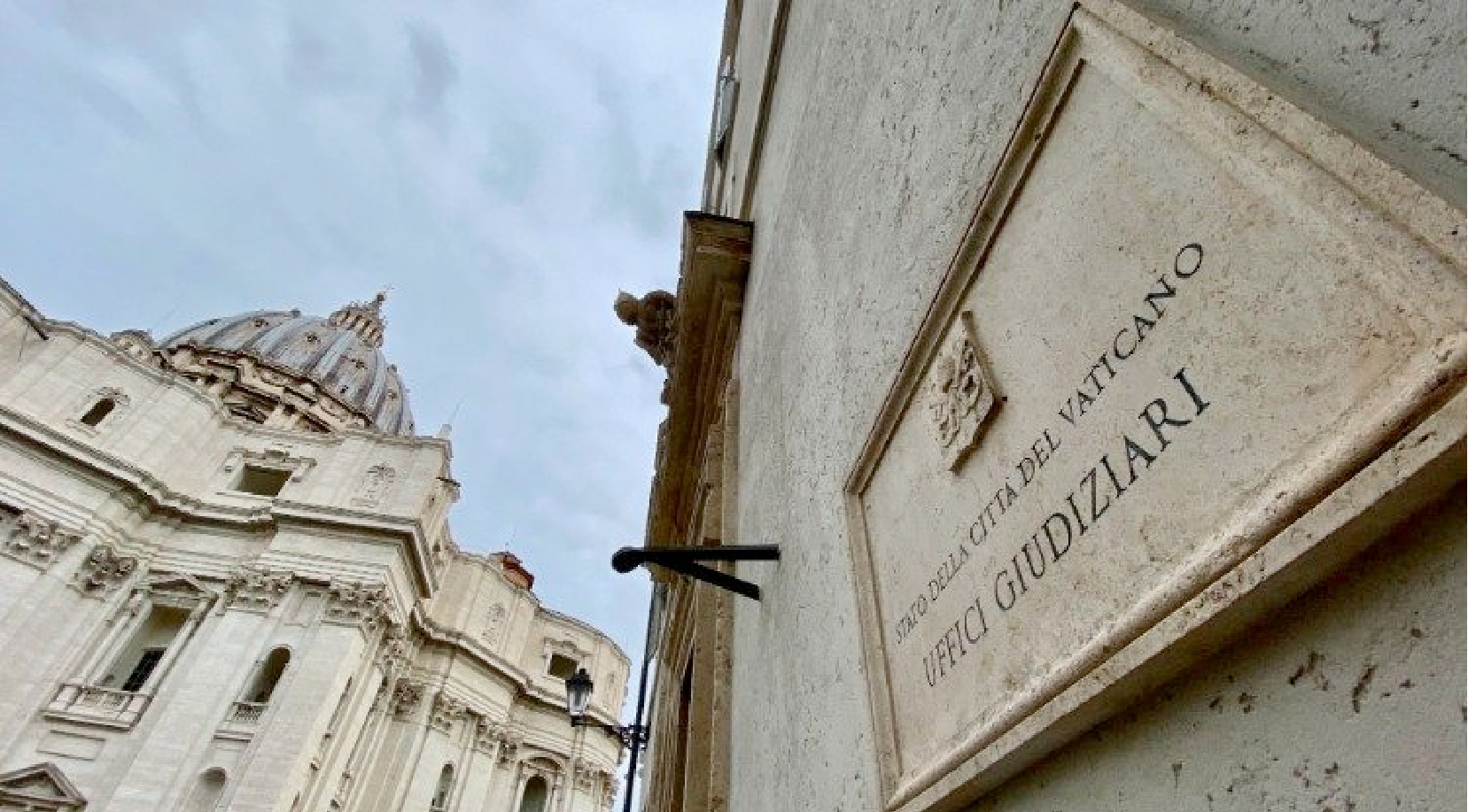
(ZENIT News / Rome, 05.07.2026).- What began nearly a decade ago as the Vatican’s most ambitious attempt to confront financial corruption may now be evolving into something far more dangerous for the Holy See: a legal and reputational collapse capable of undoing years of reform efforts while exposing the Secretariat of State to potentially massive new financial liabilities.
The sprawling criminal proceedings tied to the controversial London property deal centered on 60 Sloane Avenue were initially presented as a historic turning point in Vatican accountability. Instead, a growing series of judicial reversals, procedural complications, and international legal defeats now threaten to transform the case into one of the most damaging institutional crises the modern Holy See has faced.
At stake is not only the future of the Vatican’s flagship financial corruption trial, but also the credibility of the reform agenda that successive pontificates have tried to advance in response to decades of scandals involving opaque investments, weak oversight, and internal power struggles.
The latest shock came in March 2026, when the Vatican City appeals court ordered a review of the investigation and prosecution that launched the landmark financial crimes trial in 2022. In an extraordinary decision, the judges effectively invalidated the decrees issued under Pope Francis that had enabled prosecutors to pursue the criminal investigation into the London affair.
Although the convictions handed down in 2024 technically remain in place for now, the appeals ruling has opened the possibility that the entire proceeding could eventually be declared null and void.
If that happens, the consequences would be profound.
The Vatican spent years presenting the London case as proof that even senior officials and powerful financial intermediaries could be held accountable. Prosecutors argued that the Holy See lost around €200 million through a complex web of investments and transactions linked to the acquisition of the luxury London property before 2018.
Yet after six years of investigations, arrests, trials, leaked documents, and relentless international scrutiny, the possibility now exists that none of the ten defendants originally prosecuted may ever face enforceable criminal consequences through the Vatican judicial system.
Such a collapse would already constitute a humiliation for the Vatican tribunal. But the danger extends far beyond embarrassment.
The London affair has generated parallel legal disputes in several countries, and those proceedings have increasingly exposed weaknesses in the Vatican’s own strategy. Particularly troubling for the Secretariat of State is the impression that it may now be undermining its own legal claims abroad.
One of the clearest examples emerged in Switzerland.
In late April 2026, Swiss authorities announced they were abandoning efforts to prosecute financier Enrico Crasso, a key figure linked to the Secretariat of State’s investments. According to businessman Raffaele Mincione — the man who ultimately sold the London building to the Vatican — Crasso played a central role in arranging the Secretariat’s investment structures and allegedly engaged in behavior ranging from highly irregular to potentially illegal.
Crasso had also faced accusations of attempting to pressure or blackmail others involved in the transaction to gain control over the London property. Additional reporting had connected him to the management of millions of euros in Vatican funds tied to a supposed highway construction project in the United States that allegedly never truly existed.
Despite all of this, Swiss prosecutors dropped the case because the Secretariat of State reportedly refused to make crucial witnesses available.
Among those witnesses were Monsignor Alberto Perlasca, formerly head of the administrative office inside the Secretariat, and Archbishop Edgar Peña Parra, one of the highest-ranking officials in the department.
That refusal may prove extraordinarily consequential.
By declining to cooperate fully in a case initiated at its own request, the Secretariat not only weakened the possibility of recovering frozen assets in Switzerland, but may also have damaged its credibility in ongoing litigation elsewhere — especially in the United Kingdom.
There, Mincione has continued legal action against the Secretariat of State and several financial institutions through proceedings before the British Commercial Court. The financier has long argued that the Vatican falsely accused him of misconduct and mismanagement while attempting to shift blame for losses caused internally.
He has already secured partial legal victories. In earlier proceedings, the Secretariat of State was ordered to pay him more than £1 million in legal costs.
One especially damaging moment came when Archbishop Peña Parra testified in London that he knowingly approved a €5 million invoice despite recognizing it was “completely fictitious.” During questioning, he reportedly acknowledged concerns regarding his honesty.
Such testimony has fueled arguments by Vatican critics that the scandal may reveal not merely external fraud against the Holy See, but also severe dysfunction and questionable conduct within the Secretariat itself.
Now legal observers warn that if Vatican officials again refuse to provide witnesses in British proceedings, judges there could conclude that the Secretariat has effectively abandoned its accusations against Mincione altogether.
That scenario would create enormous risks.
Mincione could potentially argue that he was induced to accept and manage Vatican funds that had themselves been improperly handled internally, only to later become the public scapegoat for the resulting losses. If British courts found merit in such arguments, the Vatican could face additional damages potentially amounting to millions more.
Financially, the implications are alarming enough. But institutionally, the stakes may be even higher.
The Holy See’s credibility has already suffered heavily from years of revelations involving financial opacity and internal rivalries at senior levels of the Roman Curia. The London affair was supposed to demonstrate that a new era of transparency and accountability had arrived.
Instead, critics increasingly see confusion, procedural irregularities, and competing narratives about who actually bears responsibility for one of the Vatican’s most disastrous financial ventures in modern history.
This uncertainty comes at a delicate moment for Pope Leo XIV, whose pontificate has thus far projected cautious optimism regarding Vatican finances and institutional reform. While acknowledging that major challenges remain, Leo XIV has signaled satisfaction with the broader direction of reform efforts and with improving financial discipline inside the Holy See.
Yet a chain reaction of failed prosecutions, collapsed cases, and international court defeats could seriously weaken that momentum.
The reputational damage would not stem merely from losing legal battles. More damaging still would be the perception that individuals widely viewed as responsible for grave misconduct — whether inside or outside Vatican structures — ultimately escaped accountability altogether, while the Secretariat itself could end up being judged partially responsible for the very wrongdoing it claimed to denounce.
For many Catholics, financial scandals within the Church carry a uniquely painful dimension because they involve resources entrusted for spiritual, charitable, and pastoral purposes. The London property affair has therefore never been simply about real estate or investment losses. It has become a test of whether the Vatican can govern its temporal affairs with the same moral seriousness it asks of others.
That test is now entering perhaps its most precarious phase yet.
Thank you for reading our content. If you would like to receive ZENIT’s daily e-mail news, you can subscribe for free through this link.

Publicaciones relacionadas:
 Gender Ideology Comes to Christmas Cribs… Including with the Help of a Priest
 Controversial Antwerp bishop expands on his idea of ordaining married men and shares his thoughts on women
 A diplomatic storm denied: Vatican and Washington push back against claims of Pentagon pressure on the Holy See
 Trump and Vance prolong the conflict with Leon XIV as Russia and Brazil join the controversy
