

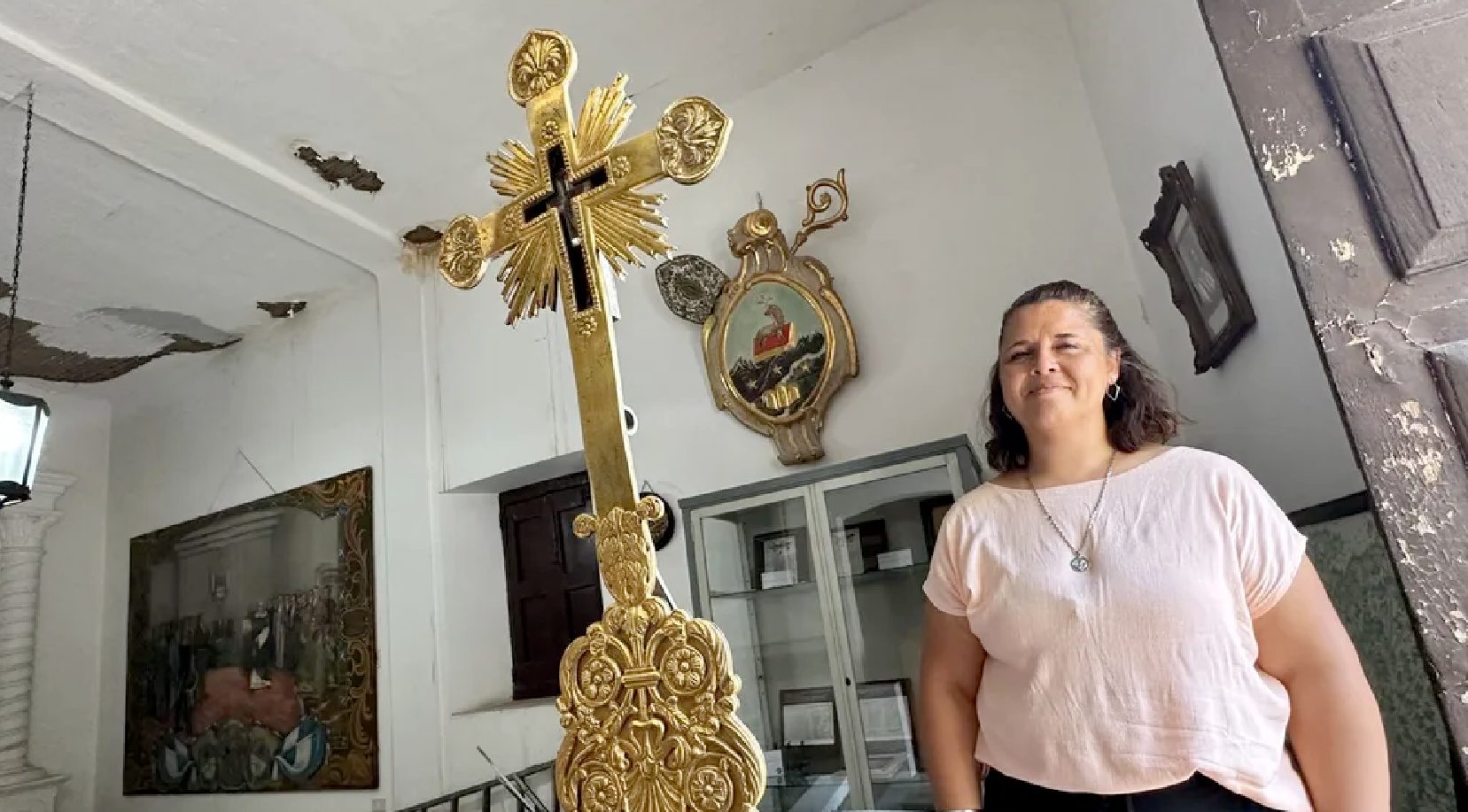
(ZENIT News / San Juan, Argentina, 03.16.2026).- A discovery hidden in plain sight for decades has brought renewed attention—and emotion—to the Catholic community of San Juan in Argentina. A small reliquary containing fragments believed to come from the cross of Jesus Christ has been rediscovered after more than 80 years and returned to the city’s cathedral, in the liturgical season of Lent.
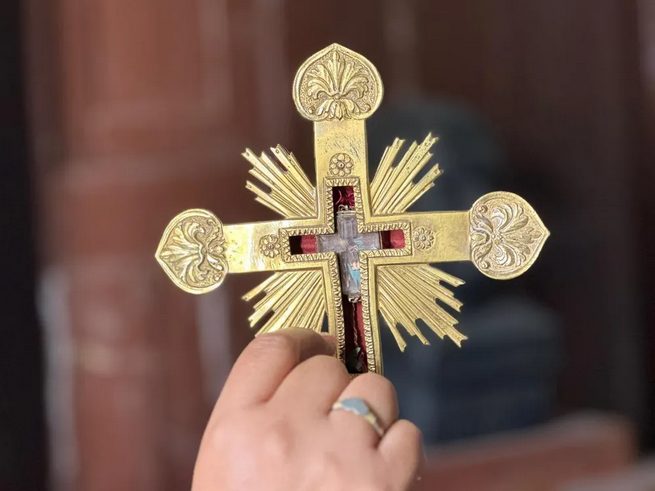
The unexpected find was made toward the end of 2025 inside the chapel of the Santa Rosa de Lima School, where staff uncovered a sealed glass reliquary concealed behind a rotating piece of furniture in the sacristy—an object that had apparently gone untouched for generations. Inside were two tiny splinters arranged in the shape of a cross.
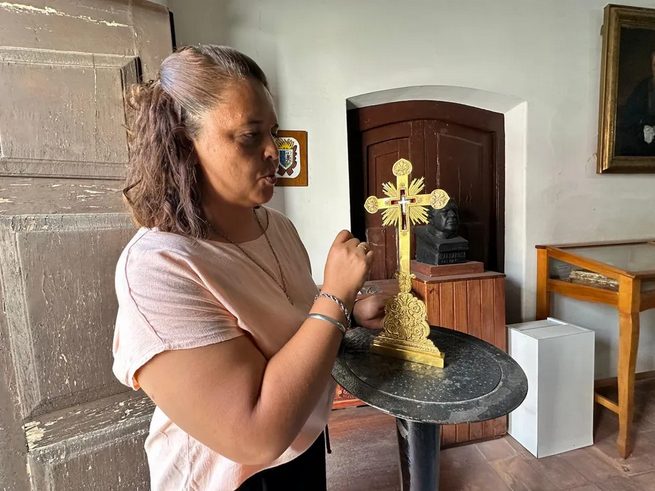
What initially appeared to be a curious artifact quickly became the subject of a detailed historical and ecclesiastical investigation. Church authorities, working with specialists in relic authentication and consulting archival inventories of the Archdiocese, were able to reconstruct the object’s origins with surprising precision.
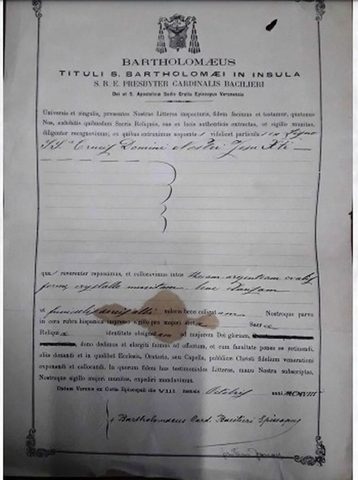
The reliquary, identified as a Lignum Crucis—Latin for “wood of the Cross”—was traced back to the Cathedral of San Juan, where it had been housed since 1908. According to documentation recovered during the investigation, the relic arrived through the efforts of Bishop Sansierra and was accompanied by official certification issued in Rome, attesting to its authenticity as a fragment of the cross of Christ preserved in the Basilica of the Holy Cross in Jerusalem.
Its disappearance, long unexplained, now appears linked to one of the most traumatic events in the city’s history: the devastating earthquake of 1944, which destroyed much of San Juan, including the cathedral. In the chaos that followed, the relic is believed to have been displaced and eventually stored—then forgotten—within the school’s chapel.
For local clergy, the rediscovery carries both historical and spiritual weight. Father Andrés Riveros, a priest of the cathedral, described the finding as a moment of grace arriving at a particularly meaningful time in the Church calendar. Lent, he noted, is a period traditionally centered on reflection on Christ’s passion, making the return of such a relic especially significant for the faithful.
The relic was formally restored to the cathedral on Friday, March 6, during a morning Mass presided over by the local archbishop, Jorge Lozano. The ceremony marked not only the physical return of the object but also its reintegration into the liturgical and devotional life of the community.
In Catholic theology, relics such as the Lignum Crucis are classified as sacramentals—sacred signs instituted by the Church to help the faithful grow in holiness. Unlike sacraments, they do not confer grace automatically but are understood to dispose believers to receive it through faith and devotion.
The Church has long maintained rigorous procedures for the authentication of relics. Documents known as “authentics” accompany legitimate relics, certifying their origin and integrity. In the case of the San Juan fragments, archival research uncovered such a certificate, which describes the extraction of particles from an authenticated source, their placement in a sealed reliquary, and their authorization for public veneration.
The tradition of venerating fragments of the so-called True Cross dates back to the early centuries of Christianity. According to longstanding tradition, the cross on which Jesus was crucified was discovered in the fourth century by Helena, mother of the Roman Emperor Constantine, during a pilgrimage to Jerusalem. Over time, the wood was divided and distributed across the Christian world, with portions preserved in major centers such as Jerusalem, Constantinople and Rome.
This historical process explains how small fragments—often reduced to minute splinters—came to be housed in churches far from the Holy Land, including in Latin America.
In San Juan, the rediscovered relic is expected to play a visible role in upcoming liturgical celebrations. It is on display during Lent for public veneration in the cathedral. On Good Friday, it is scheduled to be carried through the city streets as part of the traditional Way of the Cross procession, before being permanently installed behind the presbytery.
Local Church authorities have emphasized that the event is not merely about recovering a historical artifact, but about rekindling devotion among the faithful. The participation of the Dominican sisters and the school authorities, who safeguarded the object unknowingly for decades, has also been publicly acknowledged.
What began as a случайous discovery inside a quiet sacristy has thus evolved into a moment of collective memory for a city marked by loss and reconstruction. In the return of these small fragments, many in San Juan see not only a link to the distant origins of Christianity, but also a tangible sign of continuity—between past and present, destruction and recovery, faith and history.
Thank you for reading our content. If you would like to receive ZENIT’s daily e-mail news, you can subscribe for free through this link.

Publicaciones relacionadas:
 Syria: Christian families return to homes rebuilt after the uprising
 The 7th shrine dedicated to Mary, mother of persecuted Christians, will open in Iraq
 For the First Time in 800 Years, the Body of Saint Francis of Assisi Will Be Displayed. Dates, Location, and Details Here
 Asia’s Oldest Seminary Turns 360 Years: Where Is It?
