

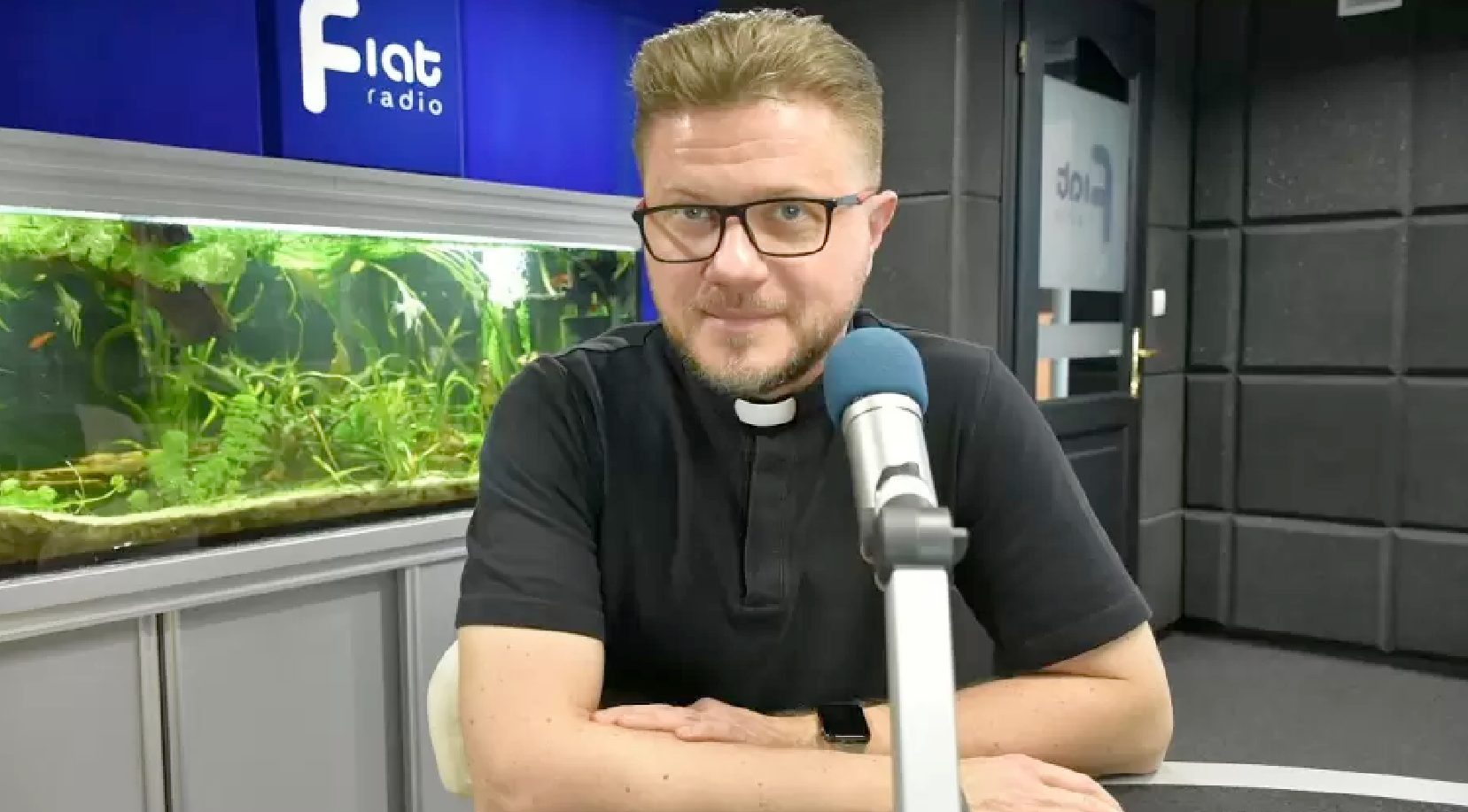
(ZENIT News – Porta Luz / Santiago, 03.19.2026).- Saint Vincent Pallotti, founder of the Catholic Apostolate Association and the Union of the Catholic Apostolate, is considered a great devotee of Divine Mercy. With his founder as a source of spiritual inspiration, the Pallottine priest Mariusz Marszalek has served for several years at the Youth Addiction Treatment Center in Częstochowa. Simultaneously, he pursued studies in psychotherapy, which have enabled him to provide comprehensive support to those suffering from various mental health vulnerabilities. This reality also affects many priests, as he reveals in this interview with Catholic Echo of Poland.
«When I hear the phrase, ‘Depression is cured with prayer,’ I ask: Is cancer also cured by intensifying devotional practices? When someone suffers from cancer, they go to an oncologist, follow a specific treatment, and at the same time, pray. Prayer can lead to a miracle, but above all, it helps to find meaning in suffering by uniting it with the suffering of Jesus,» says Father Mariusz.
* * *
On social media, you publish the series «The Man in the Cassock»: unvarnished, without pretending. What led you to decide to speak so openly about the mental health of the clergy?
Because I see how many priests suffer in silence, and silence can kill. The impetus to address the topic was the news of the suicide of Father Matteo Balzano, from the diocese of Novara, in Italy. I followed the reactions to this news in the Italian media and on the Facebook profiles of friends in Italy, and I was surprised by how much they differed from the comments that appear in other public spaces in response to news of similar tragedies. Italians, regardless of their relationship with faith and the Church, expressed empathy, compassion, concern, and sadness. The event was not used to attack the Church. The focus was on the human being.
Around the same time, the results were published of a study in France on the mental health of priests. The data pointed to a real problem. I connected it to the situation in Poland and realized that the mental health of priests in our country is either not discussed at all, or it’s brought up to fuel anti-clerical rhetoric. The idea arose to address this issue not by looking for someone to blame, but by focusing on real ways to help.
Sometimes, in the face of a crisis, a clergy member hears: «Pray more,» «React.» Why can these pieces of advice — however pious they may sound — worsen the loneliness of someone struggling with depression?
Because they sound like: «Your suffering is your own fault.» Depression is a well-described illness in the 11th edition of the World Health Organization’s International Classification of Diseases and, like any other, requires treatment. When I hear the phrase, «Depression is cured with prayer,» I ask: Is cancer also cured by intensifying acts of piety? When someone suffers from cancer, they go to an oncologist, follow a specific treatment, and, at the same time, pray. Prayer can lead to a miracle, but above all, it helps to find meaning in suffering by uniting it with the suffering of Jesus. The same is true for mental illnesses. The person who is suffering needs empathy, support, and companionship, not «golden advice.» Relating suffering to guilt is profoundly contrary to the Gospel. Following this line of thought, one would have to say that Jesus, in carrying the cross, suffered because of His own guilt. That was the narrative of the Pharisees and Scribes. It has nothing to do with the Christian faith.
Why is it still so difficult to talk about burnout, crisis, or the need for therapy within the clergy?
I don’t have a clear answer to this question. However, it seems to me that we are touching on a very delicate subject here: secularization, that is, the secularization of ecclesial thought. A mentality centered on efficiency and effectiveness has infiltrated the Church. It is a corporate logic, not evangelical. This attitude requires a conversion within the Church. At the heart of the Gospel is the human being, not a result in the form of rising statistics. This phenomenon was already pointed out years ago by the authors of the document from the Congregation for Institutes of Consecrated Life and Societies of Apostolic Life entitled «New Wine, New Wineskins.» It is a shame that it has not been read in depth. Although it refers to consecrated persons, it affects — in my opinion — the entire Church.
What would you say to a young priest who is convinced that depression can be «cured with prayer» and is afraid to seek professional help?
I’m not an expert at giving good advice, so I don’t know what I would tell him. Rather, I would accompany him in the discovery of his own humanity as the locus of God’s revelation. This is beautifully illustrated by the image of Divine Mercy painted by Kazimirowski, the first and only one in whose creation Saint Faustina participated.
It contains the theological depth of the truth about God’s Mercy. Jesus, depicted walking against a dark background, is a symbol of God, who enters into the life of man as he is. In the New Testament, it is precisely the life of man that becomes the space of theophany. By rejecting my own humanity, I do not allow God to reveal Himself. I hope that the young priest, in accepting himself, will open himself to various paths of encountering God, not only through religious practices. I know people for whom therapy and confronting illness became the beginning of conversion and the transition from piety to a mature spirituality.
Psalm 23 contains the image of the «dark valley.» For many priests, this is not a poetic metaphor, but a real experience of crisis, fear, or depression. What is this «dark valley» in the life of a priest?
We are talking about one of the 150 Psalms that make up a larger whole. If we perceive Psalm 23 precisely in this context, we discover that “nothing human is alien to God.» Sadness, anger, fear, or joy are, after all, natural states of human beings created in the image and likeness of God. Therefore, the Book of Psalms is an ancient manual of spirituality and psychology. At the same time, the language of the Psalms is poetic, not scientific. That is why I am very cautious when considering the «dark valley» as a synonym for crisis or depression. The metaphor has a pastoral meaning, but it is not a diagnosis. In the life of a priest, the «dark valley» does not always signify the absence of God, but rather a lack of strength, sleep, security, and relationships. It is the experience of moving forward without feeling motivated.
The priest usually operates in an environment of high expectations: he must be available, affable, and have unwavering faith. How does this pressure affect his mental state and his willingness to acknowledge his weaknesses?
In psychotherapy, we speak of transference: the unconscious projection onto the therapist of feelings one has toward important people from the past. The patient begins to feel toward the therapist what they once felt toward their father or mother — sometimes love and admiration, sometimes anger and fear — projecting unmet expectations onto them and seeing them as the antidote to their difficulties. A similar mechanism applies with respect to the priest. The faithful expect him to provide security, stability, to satisfy their needs and whims: to always be available, smiling, etc. And suddenly, — to use the language of psychotherapy — the «ideal father.» The difference between psychotherapy and pastoral care is fundamental here. The psychotherapist has tools to understand and work through this experience. The priest often succumbs to this pressure, especially because it has a collective character. He tries to detach himself from the role of «ideal father,» distancing himself from his own self and assuming a role he is not capable of fulfilling. This generates frustration, exhaustion, and sometimes a crisis that could lead him to consider leaving the priesthood.
Many priests hear — either directly or implicitly — that depression is synonymous with a lack of faith. Where does this belief come from, and to what extent is it unjust?
It stems from a lack of understanding. Depression is a neurological illness that requires pharmacological treatment. Psychotherapy, in this case, is only a supportive measure. Depression may raise questions about the meaning or presence of God, but it is not due to a lack of faith. It is a «democratic» illness: it affects people of different social conditions, professions, and faiths.
There are priests who are capable of delivering moving sermons, leading gatherings, attending to pastoral duties, and at the same time, feeling an inner emptiness and a lack of meaning. Why is this particular form of suffering often the most difficult to detect in priests?
Think about it: Is it possible, in the long term and without consequences for mental and physical health, to deliver moving sermons, lead retreats, carry out parish pastoral work, and at the same time be «on top of your game» in everything, always in good shape, always going full steam ahead? If we take Olympic sports as a reference, it’s not possible to practice several demanding disciplines at the highest level at the same time. The same is true for priests. Although we are all called to pastoral ministry, each of us has specific talents and aptitudes. That’s why collaboration and the sharing of responsibilities are so important in pastoral ministry. This protects us from the suffering and frustration that arise from feeling «insufficient.»
The image of the priest as a hero — always strong, available, «for everyone» — has taken deep root in the Church. What price does one pay who, for years, tries to live up to that ideal?
Human beings are social beings, composed of body, mind, and soul. Renouncing one of these dimensions throws the whole system off balance. Shortly before dying, Jesus didn’t throw Himself into a whirlwind of activity. He didn’t decide to preach day and night and «convert the multitudes.» He went to Bethany, to the home of his friends, where He spent time in a warm and peaceful atmosphere, among those who loved Him. If the Savior Himself shows me how important it is to take care of mental health and the balance between body, mind, soul, and the relational dimension of humanity, who am I to place myself above it? If I do not accept my own humanity, I condemn myself to suffering that leads to slow degradation, and this often manifests itself in the form of addictions, inner emptiness, and bitterness.
How can lay people react with wisdom and responsibility when they learn that their parish priest is suffering from depression, or when they see that «something is wrong»? What is most needed at that moment: discretion, dialogue, concrete help, or perhaps simply a simple question like, «How are you, Father?»
A friend of mine, a priest and psychotherapist, pointed out that the clear distinction between laity and clergy didn’t appear until the Middle Ages. Before then, there were faithful who performed various ministries: simply brothers and sisters in faith. Perhaps speaking openly about the crises and mental illnesses of priests is a step toward the ideal of the early Church. It is important to see in the other — regardless of their role — a brother or sister in humanity and in faith.
I find the question, «How are you, Father? Everything alright, yes?» both amusing and annoying. This question assumes the answer and closes the encounter with politeness. Similarly, the question, «How are you really feeling, Father?» can be a trap because it invades privacy and prompts the response, «Everything is fine.» If I see suffering, I don’t have to name it; a simple sign is enough: «I see you’re tired. How can I help?» Therefore, sometimes it’s easier to start a conversation, for example, with words like, «I think you’ve had a lot on your mind lately, because I see you’re tired,» or «I have the impression that you’ve been going through a difficult time lately. How can I help you?» Sometimes, priests remain silent and say, «I don’t know what to say.»
The young men at the Addiction Treatment Center react differently. When they hear that question, they speak openly about their experiences, ask for help, but also want to know how you feel. This highlights the shortcomings in the human formation of the priesthood. The importance of emotions in the lives of priests has been discussed since «Pastors Dabo Vobis,» and Leo XIV recalled it in the Apostolic Letter «A Fidelity that Generates the Future.» This lesson is still pending.

Publicaciones relacionadas:
 Massacre Against Catholics in Nigeria: What Is Known About the Attackers? How Many Dead Are There? A Local Priest of Owo Talks About It
 Do I need healing? Human wounds and healing ministry in the Church. Interview with Father Miguel Guerra, LC (Part I)
 [Interview] Pope’s Nuncio in the USA Talks about the Synod: People Will Come with Their Own Agenda; The Role of the Pope Will Be to State
 Ecclesiastical Academic Institution Promotes Culture of Dialogue
